
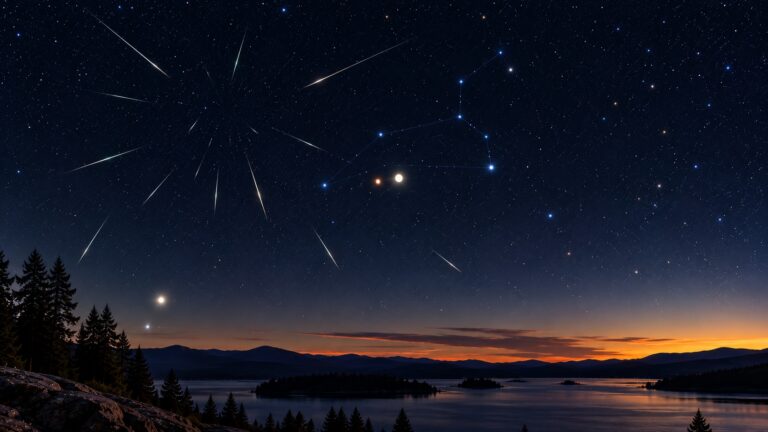
Mars, Jupiter, and the Leonids Bring Leo to Life in November 2026
November 2026 brings two skywatching events that share the same celestial stage.
Before sunrise on November 15, Mars and Jupiter will appear remarkably close together in the constellation Leo. Two days later, the Leonid meteor shower reaches its annual peak, sending fast streaks of light away from the same constellation.
These events do not require a telescope or any knowledge of complicated star charts. All you need is a clear sky, an open view, and a willingness to wake up before dawn.
The best plan is to step outside before sunrise on November 15 to see Mars and Jupiter at their closest. Then return during the predawn hours of November 17 or 18 to look for Leonid meteors. When you return, the two planets will still be close together in Leo, creating a bright signpost beneath the meteor shower’s radiant.
Mars and Jupiter Meet in Leo
Mars and Jupiter will appear approximately 1.2 degrees apart around November 15. That is a little more than twice the apparent width of the Full Moon.
This is close enough for both planets to fit comfortably within the view of ordinary binoculars. To the unaided eye, they will resemble two bright points placed unusually close together.
Jupiter will be the brighter planet. It will shine with a strong, creamy-white light that should make it easy to identify. Mars will be fainter, but its warm orange or reddish color will create an attractive contrast.
Mars will appear slightly north of Jupiter. The pair will remain close on the mornings immediately before and after November 15, so one cloudy morning will not necessarily spoil the event.
The planets will begin rising in the east around 11:00 to 11:30 p.m. local time. They will initially be close to the horizon, where trees, buildings, and haze may make them difficult to see. As the night progresses, they will climb into the southeastern sky.
The best view will come between approximately 4:00 a.m. and the beginning of morning twilight. Around 5:00 or 5:30 a.m., the planets should be high enough to see easily from most of North America.
Look toward the southeast or south. Jupiter should attract your attention first. Once you find its brilliant white light, look immediately beside it for orange Mars.
Are the Planets Really Close Together?
Mars and Jupiter will look close from Earth, but they will not be anywhere near each other in space.
Mars is a relatively small rocky planet traveling around the Sun just beyond Earth’s orbit. Jupiter is a giant world located hundreds of millions of miles farther away.
Their meeting is an effect of perspective. Earth, Mars, and Jupiter briefly move into positions that place the two planets along almost the same line of sight.
Astronomers call this kind of close apparent meeting an appulse. The planets do not need to pass directly in front of each other. They simply appear close together in our sky.
The view changes from night to night because every planet is moving along its orbit at a different speed. Mars moves eastward against the background stars more quickly than Jupiter. It will approach Jupiter, pass it, and then gradually pull away.
Watching on several mornings can reveal that motion. The change will be subtle, but it is a visible reminder that the solar system is always in motion.
What You Can See with Binoculars or a Telescope
No equipment is needed to enjoy the conjunction. The color contrast between white Jupiter and orange Mars should be visible to the unaided eye.
Binoculars will make the pairing even more impressive. Both planets should fit easily within the same field of view. Steady binoculars may also reveal one or more of Jupiter’s four largest moons as tiny points beside the planet.
A small telescope at low magnification may show all four Galilean moons, depending on their positions that morning. These moons are Io, Europa, Ganymede, and Callisto.
Mars will look much smaller. It may appear as a tiny orange disk, but it will probably show little surface detail through a beginner’s telescope. Its color will remain its most obvious feature.
Jupiter may reveal two dark cloud belts crossing its bright disk. A larger telescope and steady air can show additional detail.
Begin with low magnification if you want to see both planets together. Higher magnification will narrow the field and separate them into individual views.
Finding Leo
Mars and Jupiter will be located in Leo the Lion.
Leo is one of the more recognizable constellations of spring, but in November it belongs to the late-night and morning sky. It rises in the east during the late evening and climbs higher toward dawn.
The constellation’s brightest star is Regulus. It marks the lower end of a curved pattern called the Sickle, which resembles a backward question mark. This pattern forms the head and mane of the Lion.
Jupiter will be so bright that you will not need to identify every star in Leo before finding the planets. The pairing can actually help you begin learning the constellation.
Look for Jupiter first, identify Mars beside it, and then search around the planets for Regulus and the curved stars of the Sickle.
Leo will remain important two nights later because it is also the constellation from which the Leonid meteors appear to radiate.
Venus Joins the Morning Display
Mars and Jupiter will not be the only planets visible before sunrise.
Venus will shine lower in the east or southeast near Spica, the brightest star in Virgo. Venus will be brighter than Jupiter, although it will be much closer to the horizon.
This creates an impressive arrangement across the morning sky. Mars and Jupiter will be high in Leo, while Venus and Spica shine lower toward the glow of approaching sunrise.
Venus will appear intensely white. Spica will look noticeably fainter and may display a blue-white color.
A clear eastern horizon will be important. Venus should be easy to see, but nearby hills, trees, or buildings could hide it.
The Leonids Arrive Two Days Later
After watching Mars and Jupiter, keep your warm clothing ready. The Leonid meteor shower reaches its annual maximum around November 17.
The Leonids are active from approximately November 6 through November 30. They occur when Earth passes through a stream of debris associated with Comet 55P/Tempel-Tuttle.
Each piece of debris is usually no larger than a grain of sand or a small pebble. When it enters Earth’s atmosphere at tremendous speed, friction and compression heat the surrounding air. The resulting glow creates the streak of light we call a meteor.
The Leonids appear to spread away from a point in Leo called the radiant. This is another effect of perspective. The particles travel along roughly parallel paths, but they appear to separate as they approach us, much like parallel railroad tracks seem to meet in the distance.
Mars and Jupiter will still be close together when the Leonids peak. The planets can help viewers locate Leo, although the actual radiant will be north of the planetary pair.
Which Night Should You Watch?
The timing of the 2026 Leonids requires a little explanation.
The regular maximum is predicted for November 17 at approximately 23:45 UTC. That is 6:45 p.m. Eastern Standard Time, 5:45 p.m. Central Standard Time, 4:45 p.m. Mountain Standard Time, and 3:45 p.m. Pacific Standard Time.
At that moment, Leo will not yet be visible from eastern North America. Farther west, the Sun may still be above the horizon.
Fortunately, a meteor shower does not begin and end at one exact minute. Leonid activity builds and fades around the predicted maximum. Different astronomy calendars therefore describe the main observing period in slightly different ways.
For North American observers, the most practical plan is to watch during the predawn hours of both November 17 and November 18.
On Tuesday morning, November 17, look from approximately 2:00 a.m. until dawn. This period falls before the formal maximum, but it remains within the broader peak and may include activity from older dust trails.
On Wednesday morning, November 18, watch during the same hours. This period comes after the predicted maximum, but Leo will again be well placed in a dark sky.
If the weather is clear on only one morning, go out when you can. If both mornings are clear, watching twice will improve your chances.
The Moon Should Cooperate
The Moon reaches its first-quarter phase on November 17. Approximately half of its visible surface will be illuminated.
A half-lit Moon can hide faint meteors while it is in the sky. Fortunately, a first-quarter Moon rises during the afternoon and sets during the late evening or around midnight.
By the time Leo climbs high enough for the best Leonid viewing, the Moon should be low or below the horizon. The important hours between midnight and dawn will therefore be considerably darker than the evening.
If you begin watching before moonset, position yourself so a building or tree blocks the Moon without blocking too much of the sky. Once it sets, your eyes will adjust to the deeper darkness.
Where to Look for Leonid Meteors
Leo rises in the east during the late evening. Around midnight, the Leonid radiant will still be fairly low. It will climb higher through the early morning and become best placed before dawn.
You do not need to stare directly at Leo.
Meteors seen close to the radiant have short paths. Those appearing farther away can create longer streaks across the sky. Face generally east or southeast, lean back, and take in as much sky as possible.
A reclining chair makes meteor watching much more comfortable. Point your feet toward the east and look overhead rather than directly at the horizon.
The planets will help you stay oriented. Jupiter will be the bright white point in Leo, with orange Mars close beside it. The Leonid radiant will be north of the pair, but meteors can appear in any part of the sky.
If a meteor’s path can be traced backward toward Leo, it is probably a Leonid.
How Many Meteors Can You Expect?
Under perfect conditions, the regular Leonid maximum may produce an ideal rate of approximately 15 meteors per hour.
Most observers will see fewer.
The radiant’s height, the timing of the maximum, artificial light, haze, clouds, and obstructions all reduce the number visible from a particular location. A realistic observer may see several Leonids during an hour from a dark site.
This is not expected to be a meteor storm. The sky will not be filled with continuous streaks.
The Leonids reward patience. There may be long quiet periods followed by two or three meteors within a few minutes. Give the shower at least an hour if conditions allow.
Ordinary sporadic meteors and a few lingering Taurids may also appear. Not every meteor seen that morning will necessarily belong to the Leonids.
Some of the Fastest Meteors of the Year
Leonids enter Earth’s atmosphere at approximately 44 miles, or 71 kilometers, per second. They are among the fastest meteors produced by any major annual shower.
Their speed gives them a different appearance from the Northern Taurids, which peak only a few nights earlier. Taurids often seem to move slowly and deliberately. Leonids can flash across the sky almost before you have time to react.
Bright Leonids sometimes leave glowing trains behind them. These pale trails can remain visible for several seconds and may twist or change shape as winds in the upper atmosphere move the glowing material.
Leonids can also display color. White and blue-white are common, but some observers report green, yellow, or orange tones in brighter examples.
The shower can occasionally produce fireballs and Earth-grazing meteors. Earth-grazers skim through the upper atmosphere at a shallow angle and can create long, colorful paths near the horizon.
A Meteor Shower with a Dramatic History
The Leonids have produced some of the greatest meteor storms in recorded history.
The storm of November 1833 was so intense that thousands of meteors appeared to fall from the sky. Many witnesses believed the stars themselves were raining down.
The event became important to the development of meteor science. Before then, the origin of meteors was poorly understood. Careful observations of the 1833 storm helped astronomers recognize that the streaks appeared to radiate from Leo and that meteor showers were connected with material moving through space.
Another extraordinary storm arrived in 1966. For a short period, observers reported thousands of meteors per minute. The sky seemed to flow with streaks of light.
Strong Leonid displays also occurred around 1999, 2001, and 2002.
These storms are connected with Comet Tempel-Tuttle, which returns to the inner solar system approximately every 33 years. When Earth passes through especially dense trails left during the comet’s earlier visits, meteor rates can rise dramatically.
Comet Tempel-Tuttle will next pass closest to the Sun in 2031. No major Leonid storm is predicted for 2026. Astronomers have identified several possible encounters with older, low-density trails, but none is expected to create a significant outburst.
The 2026 shower should be treated as a normal Leonid display with the possibility of occasional bright and fast meteors.
Two Early Mornings Worth Remembering
These events offer more than two dates on an astronomy calendar. Together, they create a small story in the November sky.
On November 15, Mars and Jupiter meet in Leo. One is a small, rocky world with a rusty surface. The other is a giant planet large enough to contain more than a thousand Earths. From our viewpoint, they briefly appear almost side by side.
Two days later, Earth travels through particles left by a comet. Those particles enter the atmosphere at nearly 160,000 miles per hour and flash across the sky from the same constellation.
The planets will still be close when the meteors arrive. Jupiter and Mars will mark Leo below the radiant while Venus shines closer to the dawn.
Set an alarm, prepare warm clothes, and find a place with a clear southeastern sky. Begin with the bright certainty of two planets on November 15. Return for the quieter uncertainty of the Leonids on November 17 or 18.
You may see only a few meteors. You may see one brilliant streak that makes the early alarm completely worthwhile. Either way, Leo will be waiting, with two planets close together and pieces of an ancient comet flashing overhead.
Please be advised that, despite our best efforts, International Star Registry – Name a star provides astronomical content for entertainment purposes. We cannot guarantee the accuracy of all information given.