
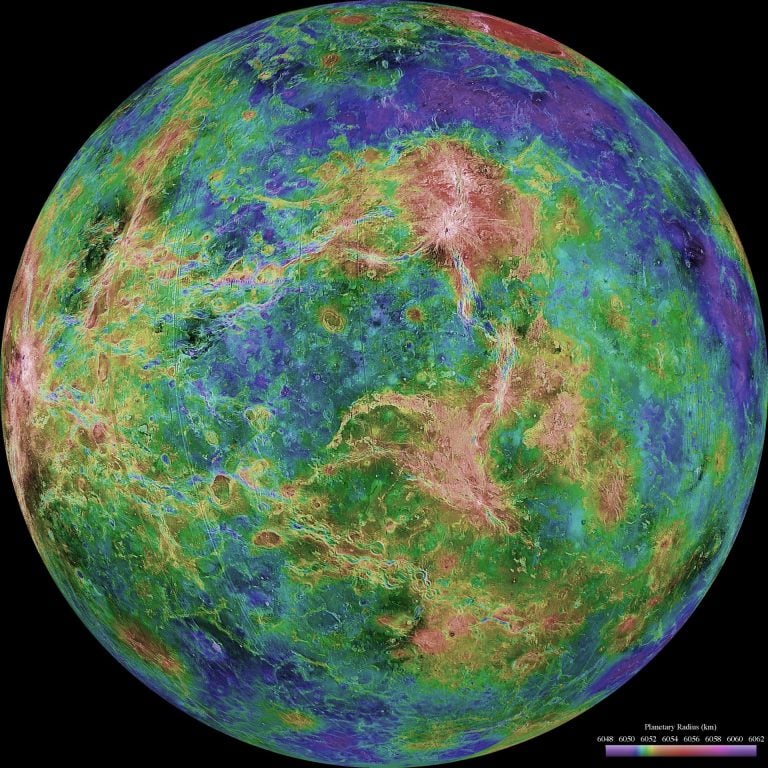
Few sights in the sky capture human attention as easily as Venus. On many evenings or early mornings, a bright white light appears low on the horizon. It shines far brighter than any star. Many people assume it is an airplane or an unusually bright star. In reality, it is the planet Venus, our closest planetary neighbor and one of the most fascinating worlds in the solar system.
Venus has inspired stories, myths, and observations for thousands of years. Ancient civilizations saw it rise and set with striking regularity. Its brilliance made it impossible to ignore. Over time, cultures connected the planet with beauty, love, fertility, and divine power. The Romans named the planet Venus after their goddess of love and beauty. That name remains in use today.
Yet behind its beautiful appearance lies a world of intense heat and thick clouds. Venus is often called Earth’s twin because it is similar in size and composition. But its surface environment is far more hostile than anything on Earth. Studying Venus helps scientists understand how planets evolve and how delicate the balance of planetary climates can be.
Venus also continues to enchant observers who watch the sky. Its brightness and graceful movements make it one of the most recognizable celestial objects visible from Earth. The planet links science, history, mythology, and human curiosity in a remarkable way.
Venus in the Solar System
Venus is the second planet from the Sun. It orbits our star at an average distance of about 67 million miles. This places Venus between Mercury and Earth. Because of this position, Venus is often called an inferior planet. This term simply means it orbits closer to the Sun than Earth does.
A year on Venus lasts about 225 Earth days. That is the amount of time it takes the planet to complete one orbit around the Sun. Venus travels along a path similar to Earth’s orbit, but slightly closer to the Sun.
In terms of size, Venus is very similar to Earth. Its diameter is about 7,520 miles, which is only slightly smaller than Earth’s diameter of roughly 7,900 miles. Because of this similarity, scientists once wondered whether Venus might host conditions similar to those on Earth.
However, further study revealed a very different reality. Venus has one of the most extreme environments in the solar system. Its atmosphere is incredibly thick and composed mostly of carbon dioxide. This dense atmosphere traps heat through a powerful greenhouse effect.
As a result, Venus has the hottest surface temperature of any planet in the solar system. Temperatures on the surface reach about 870 degrees Fahrenheit. That is hot enough to melt lead. Even Mercury, which is closer to the Sun, is cooler because it lacks such a thick atmosphere.
The pressure on the surface of Venus is also extreme. It is about 90 times greater than the atmospheric pressure at sea level on Earth. This pressure is similar to what a human would experience nearly a mile beneath the ocean on Earth.
The Mysterious Surface of Venus
Because the atmosphere of Venus is so thick and cloudy, the surface cannot be seen with ordinary telescopes. For centuries, astronomers could only observe the bright cloud tops that completely cover the planet.
These clouds reflect a large portion of the sunlight that reaches Venus. That high reflectivity is one reason why the planet appears so bright in the sky.
The true nature of Venus’s surface remained hidden until spacecraft began exploring the planet in the twentieth century. Radar instruments were used to penetrate the thick cloud layer and map the terrain below.
These radar images revealed a landscape filled with volcanic plains, mountains, and unusual geological formations. Much of the surface appears relatively young in geological terms. Scientists believe large volcanic eruptions may have resurfaced the planet hundreds of millions of years ago.
Venus contains thousands of volcanoes. Some of them are enormous shield volcanoes similar to those found in Hawaii. Others are strange circular features that scientists call coronae. These formations may result from rising plumes of hot material deep inside the planet.
The planet also contains highland regions with dramatic mountain ranges. One of the tallest peaks is Maxwell Montes, which rises more than 36,000 feet above the surrounding plains.
Despite these impressive features, the surface environment of Venus remains extremely hostile. Temperatures are hot enough to destroy most spacecraft within a short period of time. Several Soviet missions in the 1970s and 1980s successfully landed on Venus, but they survived only for a brief time before the heat and pressure overwhelmed their instruments.
Venus and Its Unusual Rotation
Venus has one of the most unusual rotations of any planet in the solar system. It spins very slowly on its axis. One full rotation takes about 243 Earth days.
This means that a single day on Venus is longer than its year. A Venusian day is about 18 Earth days longer than a Venusian year.
Venus also rotates in the opposite direction of most planets. Earth and most other planets spin from west to east. Venus spins from east to west. This is known as retrograde rotation.
If someone could stand on the surface of Venus, the Sun would appear to rise in the west and set in the east. However, the thick cloud layer would prevent any clear view of the Sun.
Scientists are still studying why Venus rotates this way. Some theories suggest that massive collisions early in the planet’s history may have altered its rotation.
Venus and Its Thick Atmosphere
The atmosphere of Venus is one of the most striking features of the planet. It is composed of about 96 percent carbon dioxide, with small amounts of nitrogen and trace gases.
Above the planet lies a dense layer of clouds made primarily of sulfuric acid droplets. These clouds form several layers that stretch from about 30 miles to more than 40 miles above the surface.
Winds in the upper atmosphere move at incredible speeds. These winds can reach more than 200 miles per hour. Interestingly, the atmosphere circles the planet much faster than the planet itself rotates. Scientists call this phenomenon atmospheric super rotation.
The thick atmosphere traps heat very effectively. Sunlight passes through the clouds and warms the surface. The heat then becomes trapped by the carbon dioxide atmosphere. Over millions of years this process created the intense greenhouse effect that defines Venus today.
Understanding Venus’s atmosphere helps scientists learn about climate systems and how greenhouse effects can influence planetary environments.
Venus in Ancient Sky Watching
Venus has been observed by humans for thousands of years. Its brightness and predictable movements made it one of the most important objects in ancient astronomy.
One of the earliest known records of Venus comes from ancient Babylon. Babylonian astronomers carefully tracked the planet’s appearances and movements. Clay tablets from more than 3,000 years ago contain detailed observations of Venus rising and setting in the sky.
Many early cultures did not realize that the bright object seen in the morning and evening was the same planet. They believed the morning star and the evening star were two different celestial bodies.
Eventually astronomers recognized that both appearances belonged to Venus. This discovery marked an important step in understanding planetary motion.
In ancient Greece, the morning appearance of Venus was called Phosphorus or Eosphorus. The evening appearance was known as Hesperus. Greek philosophers later recognized that these two objects were actually the same planet.
The Maya civilization of Central America also studied Venus extensively. Maya astronomers carefully recorded the planet’s cycles. They believed Venus played an important role in divine timing and ceremonial events.
These observations show how deeply Venus influenced early scientific and cultural traditions.
The Goddess Venus in Roman Mythology
The Roman name for the planet comes from the goddess Venus. In Roman mythology, Venus represented love, beauty, desire, and fertility. She was one of the most important goddesses in Roman culture.
Venus was often associated with romance, attraction, and harmony. Ancient artists frequently depicted her as the ideal representation of beauty.
The Roman goddess Venus closely resembled the Greek goddess Aphrodite. Both figures symbolized love and emotional connection. Many of the stories about Aphrodite were later adopted into Roman mythology under the name Venus.
One of the most famous myths tells of Venus emerging from the sea as a fully grown goddess. This image became one of the most enduring symbols in art and literature.
Because the planet Venus shines so brightly and beautifully in the sky, ancient observers found it fitting to connect the planet with the goddess of beauty.
The brilliance of Venus at dawn or dusk seemed almost magical. Its appearance during twilight created a sense of wonder that inspired mythological storytelling across many cultures.
Venus in Astrology
In astrology, Venus represents love, harmony, beauty, and relationships. Astrologers associate the planet with attraction, creativity, pleasure, and emotional connections.
Venus rules two zodiac signs. These signs are Taurus and Libra. Taurus represents sensual enjoyment, stability, and appreciation for beauty in the physical world. Libra represents balance, partnership, and social harmony.
Astrologers often interpret Venus as a symbol of how people express affection and form relationships. The planet is also associated with art, music, and aesthetic appreciation.
The position of Venus in an astrological chart is believed to influence personal tastes, romantic preferences, and creative expression.
Venus moves through the zodiac more slowly than Mercury but faster than the outer planets. It completes a full cycle through the zodiac approximately every year.
During certain periods Venus appears to move backward across the sky from Earth’s perspective. These events are known as Venus retrograde periods. Astrologers sometimes interpret these times as periods of reflection in relationships and personal values.
Although astrology is symbolic rather than scientific, Venus remains one of the most important planets in astrological interpretation.
Observing Venus from Earth
Venus is the brightest planet visible from Earth. Only the Sun and Moon appear brighter in our sky.
Because Venus orbits closer to the Sun than Earth does, it never appears far from the Sun in the sky. This means the planet is usually visible either shortly after sunset or shortly before sunrise.
When Venus appears in the evening sky, it is often called the Evening Star. When it appears before sunrise, it is known as the Morning Star.
Venus can become incredibly bright during favorable viewing periods. At its brightest it reaches a magnitude of about negative 4.7. Under dark conditions some observers report seeing Venus even during daylight hours.
Through a telescope Venus reveals phases similar to those of the Moon. These phases occur because we see varying portions of the planet’s sunlit side as it moves along its orbit.
Galileo Galilei first observed these phases in the early seventeenth century. His discovery provided important evidence that planets orbit the Sun rather than Earth.
Observers sometimes notice Venus shining through thin clouds during twilight. Its brightness often allows it to remain visible even when the sky is not fully dark.
The Graceful Dance of Venus
The movements of Venus in the sky follow a repeating pattern that ancient astronomers carefully studied. Over time Venus appears to trace a looping path among the stars.
This pattern repeats approximately every eight years. After eight Earth years, Venus returns to nearly the same position in the sky on the same date.
Some researchers have suggested that this cycle may have influenced ancient architectural alignments and ceremonial calendars.
The graceful rhythm of Venus’s appearances helped ancient civilizations track time and seasons. Even today, many sky watchers look forward to each new cycle of Venus rising and setting in the twilight sky.
A Planet That Inspires Wonder
Venus is a planet of striking contrasts. It shines beautifully in our sky and has inspired countless myths about love and beauty. Yet its surface is one of the most hostile environments in the solar system.
Studying Venus helps scientists understand planetary climates and the powerful effects of greenhouse atmospheres. It also reminds us how different neighboring planets can become over time.
For sky watchers, Venus remains one of the most rewarding sights in the heavens. Its brilliant glow at sunrise or sunset connects us with thousands of years of human observation.
Ancient astronomers, myth makers, and modern scientists have all looked toward the same bright planet. Each group has found meaning in its presence.
The next time you see a bright white light glowing in the twilight sky, you may be looking at Venus. That small point of light carries stories from ancient myths, clues about planetary science, and the shared human experience of gazing upward in wonder.
Please be advised that, despite our best efforts, International Star Registry – Name a star provides astronomical content for entertainment purposes. We cannot guarantee the accuracy of all information given.