
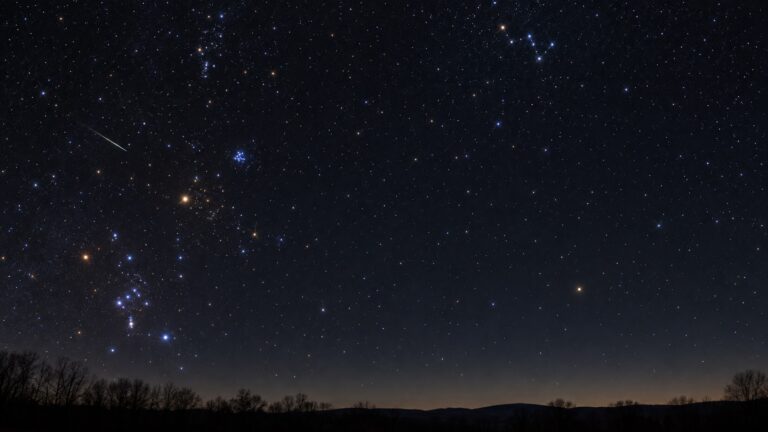
The Upcoming New Moon Means You’ll Be Starting the Weekend with a Spectacular View
The New Moon of November 2026 arrives at the perfect time for anyone who wants to explore the night sky. With the Moon hidden from sight, its light will not wash out faint stars, distant galaxies, or passing meteors. The result will be some of the darkest and most inviting nights of the month.
For most of North America, the New Moon officially occurs overnight Sunday, November 8, into the early morning of Monday, November 9. That is 2:02 a.m. Monday Eastern Standard Time, 1:02 a.m. Central Standard Time, and 12:02 a.m. Mountain Standard Time. Along the Pacific Coast, it occurs at 11:02 p.m. on November 8.
You will not actually see the New Moon that night. It will be positioned in approximately the same direction as the Sun, with its illuminated side facing away from Earth. Instead, the absence of moonlight will reveal the evening’s sky objects without the moon’s obstructive light.
This dark night offers a beautiful transition between the autumn and winter skies. The constellations of fall will be overhead during the evening, the first great constellations of winter will rise later, and several planets will take turns appearing from sunset through dawn.
Begin the Evening with Saturn
Saturn will be the easiest planet to find during the evening. Look toward the southern sky after darkness falls. The planet will resemble a steady, pale golden star.
Unlike a star, Saturn usually does not twinkle dramatically. Its light tends to remain calm and steady, which can help you distinguish it from the surrounding stars.
Saturn will be located in the constellation Cetus, close to the border of Pisces. Cetus is traditionally known as the Sea Monster or Whale. It covers a large area of the sky but contains few bright stars. This means Saturn may appear to be sitting by itself in a relatively empty part of the southern sky.
The planet should become visible between approximately 6:00 and 7:00 p.m. local time. It will be highest and easiest to observe around 9:00 to 10:00 p.m. After that, it will gradually move toward the southwestern horizon and set during the early morning hours.
Saturn reached opposition on October 4, when Earth passed between the planet and the Sun. By the November New Moon, it will still be relatively bright and well placed for viewing. A small telescope should reveal its famous rings. They will appear narrower than they have during some previous years, but seeing them with your own eyes remains one of astronomy’s most memorable experiences.
Follow the Great Square to Andromeda
While Saturn shines in the south, look higher in the sky for the Great Square of Pegasus. Its four stars form a large, tilted square that dominates the autumn evening sky.
Pegasus provides an excellent starting point for finding the constellation Andromeda. From one corner of the square, a curved chain of stars extends toward the northeast. This is Andromeda, the princess of ancient Greek mythology.
Hidden within this constellation is the Andromeda Galaxy. At approximately 2.5 million light-years away, it is the most distant object most people can see without a telescope.
Under suburban skies, the galaxy may be difficult to detect with the unaided eye. From a dark location, it appears as a faint, misty patch. Binoculars reveal it more clearly as an elongated glow with a brighter center.
The New Moon provides an excellent opportunity to search for it because there will be no moonlight to brighten the background sky. Try between 7:00 and 10:00 p.m., when Andromeda will be high overhead.
The light reaching your eyes began its journey long before humans existed. When you see the Andromeda Galaxy, you are looking more than two million years into the past.
Look North for Cassiopeia and Perseus
Cassiopeia will be easy to recognize in the northern or northeastern sky. Its five brightest stars form a distinctive W shape. As the night progresses, the W may appear to turn on its side or become an M.
Near Cassiopeia is Perseus. Between the two constellations lies the Double Cluster, one of the finest binocular sights in the autumn sky. To the unaided eye, it can resemble a small hazy patch. Through binoculars, it divides into two glittering groups filled with blue-white stars.
The clusters contain hundreds of young stars and are several thousand light-years away. They are visible during much of the year from northern locations, but cool, clear November nights are especially good for viewing them.
Cassiopeia can also help you find the northern part of the Milky Way. From a very dark location, a pale band of concentrated starlight runs through Cassiopeia and Perseus. Moonless conditions are essential for seeing its more delicate structure.
Watch Taurus Rise with the Pleiades
During the evening, Taurus the Bull will climb into the eastern sky. One of its treasures will appear first.
The Pleiades star cluster, also called the Seven Sisters, will look like a tiny silver group of stars. Most people can see six stars without optical aid, although observers with sharp eyesight under dark conditions may see more.
The Pleiades are best appreciated through ordinary binoculars. Binoculars reveal dozens of stars while preserving the shape of the entire cluster.
Below the Pleiades is another star cluster called the Hyades. Its stars form a broad V shape that represents the face of Taurus. The orange star Aldebaran appears along one side of the V and marks the Bull’s fiery eye. Aldebaran is much closer to Earth than the Hyades and is not a true member of the cluster, even though it appears to be part of the pattern.
By approximately 9:00 or 10:00 p.m., Taurus should be well above the eastern horizon. It will continue climbing and will be beautifully placed around midnight.
Taurus is also important during this New Moon because it is the apparent source of the Taurid meteor showers.
Watch for Taurid Fireballs
The November New Moon arrives during one of the best parts of the Taurid meteor season.
The Southern Taurids reach their broad peak several nights before the New Moon, while the Northern Taurids peak on November 11 into November 12. Both showers will remain active around November 8 and 9.
Taurids are not known for producing large numbers of meteors. You may see only a few during an hour of patient watching. What makes them special is their tendency to produce brilliant fireballs.
A Taurid fireball can cross the sky slowly and shine brightly enough to attract attention even when you are not looking directly at it. Some leave a glowing trail that remains visible for several seconds.
The best time to watch will be from approximately 9:00 p.m. until 2:00 a.m. Taurus will climb higher during this period, but there is no need to stare directly at the constellation. Meteors can appear anywhere in the sky.
Choose a place with a wide view, lie back, and allow at least 20 minutes for your eyes to adjust to the darkness. Avoid looking at a phone or another bright screen. A red flashlight will preserve your night vision better than a white one.
The Northern Taurid peak on November 11 and 12 will also enjoy excellent conditions. The Moon will be only a very thin waxing crescent and will set early, leaving most of the night dark.
Welcome Orion Back to the Evening Sky
By late evening, Orion will begin rising in the east. Its return is one of the clearest signs that winter is approaching.
Look for three evenly spaced stars forming Orion’s Belt. Above the belt is Betelgeuse, a reddish star marking one of Orion’s shoulders. Below the belt is Rigel, a brilliant blue-white star representing one of his feet.
Orion should begin appearing between approximately 8:00 and 9:00 p.m., depending on your latitude and local horizon. By midnight, most of the constellation will be easy to see.
As Orion rises, other winter constellations follow. Auriga appears higher in the northeast with the brilliant star Capella. Gemini rises later with the twin stars Castor and Pollux. Canis Major brings Sirius, the brightest star in the nighttime sky.
This creates a striking seasonal scene. The Summer Triangle will still be descending in the west while Orion and the winter stars rise in the east. Autumn will be visible between them in Pegasus, Andromeda, Cassiopeia, Perseus, and Taurus.
Mars and Jupiter Take Over After Midnight
The planetary display will change after midnight.
Mars and Jupiter will rise in the east between approximately 11:00 p.m. and midnight. Both planets will be in Leo and will appear fairly close together.
Jupiter will be easy to identify. It will shine as an intensely bright, creamy-white point that outshines the nearby stars. Mars will be fainter, but its warm orange or reddish color will distinguish it.
Around November 9, the two planets will already be moving toward a close meeting. They will appear only about 1.2 degrees apart on November 15 and 16. That is slightly more than twice the apparent width of the Full Moon.
The planets will climb higher as morning approaches. They should be at their best between approximately 3:00 and 5:30 a.m., when they will be in the southeastern or southern sky.
The bright star Regulus can help observers recognize Leo. Regulus marks the heart of the Lion and will add another point of light to the gathering.
Mars and Jupiter will make an especially attractive binocular target, but both will be easy to see without equipment.
Venus Returns Before Sunrise
Venus will make a more challenging appearance shortly before sunrise.
The planet passed between Earth and the Sun in late October and will be emerging into the morning sky. On November 9, it will still be low in the east-southeast, so you will need a clear horizon.
Begin looking about an hour before sunrise. Venus will appear as a brilliant white light close to the horizon. It will be in Virgo near Spica, the constellation’s brightest star.
Venus will be much brighter than Spica. It may become visible while the sky is already beginning to brighten.
This will be only the beginning of Venus’s new season as the Morning Star. It will rise earlier and become much easier to see as November progresses.
Mercury will also be moving toward the morning sky, but it will remain too close to the Sun to be a practical target around the New Moon. It will become easier to observe later in the month and reaches its greatest western elongation on November 20.
Make the Most of the Darkness
A New Moon night rewards patience. Give your eyes time to adapt, wear warmer clothing than you think you will need, and move away from streetlights whenever possible.
You do not need a telescope. The constellations, Saturn, Jupiter, Mars, Venus, the Pleiades, and any Taurid meteors can all be seen without one. Binoculars will add the Andromeda Galaxy, the Double Cluster, more stars in the Pleiades, and a chance to search for distant Uranus near Taurus.
The best approach may be to divide the night into chapters. Begin with Saturn, Pegasus, and Andromeda. Watch Taurus and the Pleiades rise. Welcome Orion back to the evening sky. Then stay up late enough to see Mars and Jupiter emerge in Leo. If you continue until dawn, brilliant Venus will complete the journey.
The November New Moon may be invisible, but that is exactly what makes it so valuable. Its darkness allows the rest of the universe to step forward.
Please be advised that, despite our best efforts, International Star Registry – Name a star provides astronomical content for entertainment purposes. We cannot guarantee the accuracy of all information given.