
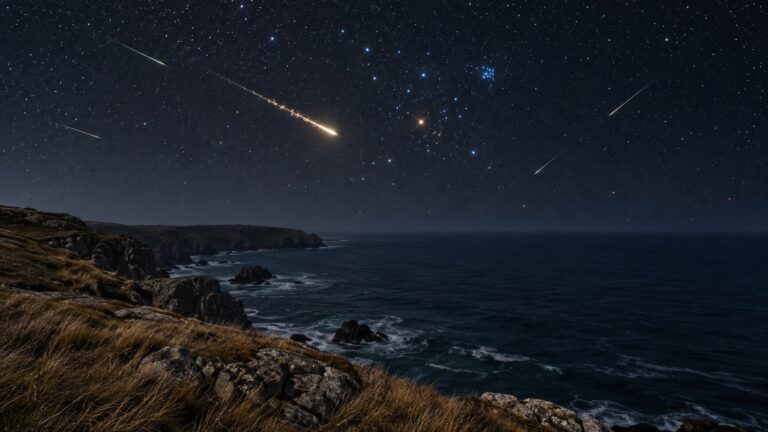
Watch for Fireballs During the 2026 Northern Taurid Meteor Shower
The Northern Taurid meteor shower reaches its peak on the night of November 11 into the early morning of November 12, 2026. It will not produce hundreds of shooting stars or fill the sky with constant activity. Instead, it offers something more subtle and unpredictable.
The Northern Taurids are known for slow, bright meteors and the occasional spectacular fireball. One brilliant meteor can transform an otherwise quiet hour beneath the stars into a night you remember for years.
Conditions should be especially favorable in 2026. The Moon will be a thin waxing crescent, only about 4 percent illuminated. It will set during the early evening, leaving the sky dark throughout the most useful viewing hours.
For observers across North America, this will be a good year to give the Northern Taurids a little time and patience.
When to Watch the Northern Taurids in 2026
The Northern Taurids are active from approximately October 20 through December 10. Their activity rises gradually and then fades slowly, so there is no sharply defined burst lasting only an hour or two.
The shower’s broad maximum occurs around November 12. For North American viewers, the best night to watch will be Wednesday, November 11, into Thursday morning, November 12.
The night of November 12 into November 13 should also be worth watching. If clouds interfere on the primary night, you will not necessarily miss the entire shower.
Begin looking around 9:00 or 10:00 p.m. local time. By then the sky will be fully dark and Taurus, the constellation from which the meteors appear to emerge, will be climbing higher in the east.
The most convenient viewing window will be from approximately 10:00 p.m. until 2:00 a.m. Taurus will be high toward the south around midnight, placing the radiant in an excellent position.
You can continue watching into the early morning, but you do not have to stay outside until dawn. Unlike some meteor showers, the Northern Taurids can produce visible meteors during the late evening.
A Nearly Moonless Night
Moonlight can hide many of the faint meteors in a shower. That will not be a significant problem for the Northern Taurids in 2026.
The New Moon occurs on November 9. By November 11, the Moon will have grown into a very slender waxing crescent. Only about 4 percent of its visible surface will be illuminated.
The crescent may create a lovely sight low in the southwestern sky shortly after sunset, but it will not remain there for long. It should set between approximately 6:00 and 7:15 p.m. across much of North America, depending on location.
By the time Taurus is well above the eastern horizon, the Moon will be gone.
This will leave a naturally dark sky for the rest of the night. Observers who can travel away from cities and suburbs will have an especially good opportunity to see faint stars, the Milky Way, and any Taurid meteors that appear.
Where to Look
Northern Taurid meteors appear to originate from the northern part of Taurus the Bull.
Taurus will be rising in the east during the evening. The easiest landmark is the Pleiades star cluster, which appears as a small, compact group of stars. It is sometimes called the Seven Sisters.
Most people can see six Pleiades stars without optical assistance. Under dark conditions, some observers can see more. Binoculars reveal dozens of stars, although binoculars should be put aside when you begin watching for meteors.
Below the Pleiades is a broader V-shaped collection of stars called the Hyades. The orange star Aldebaran appears along one side of the V and marks the fiery eye of Taurus.
The Northern Taurid radiant will be in this general part of the sky.
A radiant is the point from which a meteor shower’s streaks appear to spread. The meteors are not actually coming from Taurus. The stars in the constellation are many light-years away and have no physical connection with the shower. Taurus simply provides the background against which the meteors appear.
You do not need to stare directly at the radiant. Meteors seen close to it tend to have short paths. Those appearing farther away can create longer and more dramatic streaks.
During the late evening, find a comfortable position with a broad view toward the east and southeast. Around midnight, Taurus will be higher toward the south. The best strategy is to watch the darkest and most open area of the sky.
How Many Meteors Will You See?
The Northern Taurids have an expected zenithal hourly rate of approximately five meteors.
That number describes ideal conditions with the radiant directly overhead, no clouds, no artificial light, and an observer who can see every part of the sky. Most viewers should expect to see fewer than five Northern Taurids in an hour.
This is not a meteor storm. There may be long quiet periods with no Taurid activity at all.
The Southern Taurids will still be active at the same time, however. Their radiant is also in Taurus. Ordinary sporadic meteors can appear as well, so the total number of shooting stars may be somewhat higher than the Northern Taurid rate alone.
It is reasonable to hope for several meteors during an hour of careful watching from a dark location. It is not reasonable to expect continuous streaks.
The secret to enjoying this shower is to stop counting and allow the night to unfold. Watch Taurus rise. Find the Pleiades. Notice Orion appearing below and to the east. Let your eyes adjust fully to the darkness.
Then wait for the possibility that makes the Taurids special.
The Possibility of a Fireball
Taurid meteors are famous for producing fireballs.
A fireball is an exceptionally bright meteor. Some rival Venus in brightness, while rare examples can illuminate the landscape or cast faint shadows. They may display white, yellow, orange, green, or blue color as different materials become heated during their passage through the atmosphere.
A bright Taurid can flare suddenly or break into several glowing fragments. Some leave a luminous trail that remains visible after the meteor itself has disappeared.
Taurid meteors enter Earth’s atmosphere at approximately 65,000 miles per hour. That is remarkably fast by everyday standards, but relatively slow for a meteor shower. Leonid meteors, for comparison, travel more than twice as fast.
This lower relative speed gives Taurids their distinctive appearance. Instead of vanishing in an instant, they can seem to move deliberately across the stars. A bright one may remain visible long enough for you to turn your head, follow it, and watch it disappear.
The stream also contains some comparatively large pieces of material. These larger particles are responsible for the shower’s reputation for brilliant fireballs.
Not every observer will see one. That uncertainty is part of the experience. A single Taurid fireball can arrive without warning during an otherwise quiet night.
Is 2026 a Special Fireball Year?
Astronomers do not expect 2026 to be an enhanced Taurid swarm year.
In certain years, Earth encounters a denser concentration of larger particles within the Taurid stream. This concentration is connected with material held in a 7-to-2 orbital resonance with Jupiter. The encounters can produce an unusual increase in bright fireballs.
These special years do not occur annually. The densest concentration returns at irregular intervals, and 2026 is not currently expected to be one of the stronger encounters.
That does not mean there will be no fireballs. Northern Taurids can produce brilliant meteors during ordinary years. It only means that viewers should not expect an unusual outburst or a meteor storm.
The excellent Moon conditions may still make 2026 feel rewarding. With no bright moonlight to hide the fainter meteors, observers will have a better chance of seeing whatever the stream delivers.
A Meteor Shower with a Complicated Family
The Taurids belong to a large and ancient collection of debris known as the Taurid complex.
This complex is closely associated with Comet 2P/Encke, a small comet that travels around the Sun once every 3.3 years. It has the shortest known orbital period of any comet.
Encke’s nucleus is approximately 3 miles, or 4.8 kilometers, across. As the comet repeatedly travels through the inner solar system, heat from the Sun releases dust and rocky material. This debris spreads along related orbits.
Earth encounters portions of the complex at different times of the year. In autumn, these encounters create the Southern and Northern Taurid meteor showers.
The Northern Taurids may be particularly connected with an object known as asteroid 2004 TG10. This body may be a fragment of the same larger object or cometary system that produced Encke and the rest of the Taurid complex.
Some astronomers think the entire complex may have formed when a much larger comet began breaking apart thousands of years ago. Comet Encke, smaller asteroids, and the streams of dust encountered by Earth may all be surviving members of this ancient family.
The Unusual Story of Comet Encke
Comet Encke also has an interesting place in astronomical history.
French astronomer Pierre Méchain first observed the comet in 1786. Other astronomers saw it during later appearances, but they did not immediately realize they were looking at the same returning object.
German astronomer Johann Franz Encke studied the observations and calculated the comet’s orbit. He correctly determined that it returned to the inner solar system every few years.
The comet was named for Encke because of this achievement, even though he was not its original discoverer. It is one of the relatively rare comets named for the person who calculated its orbit rather than the person who first saw it.
Its official designation, 2P/Encke, tells another part of the story. The letter P identifies it as a periodic comet. The number 2 indicates that it was the second periodic comet recognized, following 1P/Halley.
When a Northern Taurid crosses the sky, you may be watching a tiny part of that long and complicated history burn brightly in Earth’s atmosphere.
How to Watch Comfortably
Meteor watching requires no telescope, binoculars, or special astronomical knowledge.
Choose the darkest location you can safely reach. Open rural areas are best, but a large park or backyard shielded from direct lights can still provide a worthwhile view.
Find a place with as much open sky as possible. Avoid tall trees, buildings, and streetlights. A reclining chair will be much more comfortable than standing and looking upward.
November nights can become cold quickly. Wear several layers, including gloves, a warm hat, and insulated shoes. Bring a blanket or sleeping bag if you plan to stay outside for more than a few minutes.
Allow at least 20 minutes for your eyes to adjust to the darkness. Avoid checking a bright phone screen. Even a brief look can reduce your night vision and force your eyes to adjust again.
If you need a light, use a dim red flashlight.
Give the shower at least an hour. Taurid meteors are widely spaced, so a short ten-minute visit can easily end without seeing one.
A Quiet Shower with a Bright Surprise
The Northern Taurids will not be the most active meteor shower of 2026. The Perseids and Geminids will produce far more meteors.
The Taurids offer a different kind of night.
The Moon will be little more than a delicate crescent and will leave the sky early. Taurus and the Pleiades will rise in the east. Orion will follow. The winter stars will begin returning to the evening sky.
Between those stars, a slow meteor may glide silently overhead.
Perhaps it will be a modest streak that lasts only a moment. Perhaps it will be a brilliant fireball that flashes, changes color, or breaks into glowing fragments.
There is no promise that the most dramatic moment will arrive. There is only a dark November sky, a patient observer, and the possibility of something unforgettable.
Please be advised that, despite our best efforts, International Star Registry – Name a star provides astronomical content for entertainment purposes. We cannot guarantee the accuracy of all information given.