
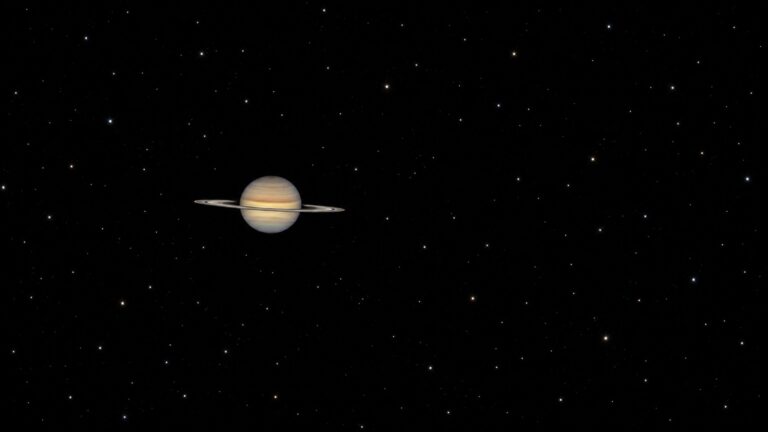
Saturn at Opposition on October 4, 2026
Saturn reaches opposition on October 4, 2026, giving skywatchers their best opportunity of the year to see the famous ringed planet. Saturn will be brighter than usual, visible throughout the night, and well placed for observation with the unaided eye or a telescope.
You do not need any special equipment to find Saturn. It will look like a steady, yellow-white point of light in the eastern sky after sunset. However, a small telescope will reveal the feature that has fascinated observers for centuries: Saturn’s magnificent rings.
What Does Opposition Mean?
A planet is at opposition when Earth passes between that planet and the Sun. From our viewpoint, the planet appears on the opposite side of the sky from the Sun.
As the Sun sets in the west, Saturn rises in the east. The planet remains visible throughout the night and sets in the west around sunrise. It reaches its highest point in the sky near the middle of the night.
Opposition also brings Saturn relatively close to Earth. Saturn reaches opposition at about 12:21 UTC on October 4. It will be approximately 784 million miles from Earth and will shine at about magnitude 0.3. That makes it brighter than most stars, although it will not be as brilliant as Venus or Jupiter.
Saturn does not become dramatically larger to the unaided eye during opposition. The difference becomes more noticeable through a telescope. The planet’s disk and rings appear larger and brighter than they do when Saturn is farther away.
The weeks before and after October 4 are also excellent for viewing. If clouds interfere on the night of opposition, you will have many more opportunities to see Saturn during October.
Where to Find Saturn
Saturn will be located in the constellation Pisces. It rises near the eastern horizon around sunset and climbs into the southeastern sky during the evening. Later at night, it travels across the southern sky before setting in the west around sunrise.
Pisces is one of the constellations of the zodiac. It represents two fish connected by a cord. Despite its large size, Pisces is not particularly easy to recognize because most of its stars are faint. This actually makes Saturn stand out. The planet will appear brighter than the stars immediately surrounding it.
Begin looking toward the east as the sky darkens. Saturn should become visible as a bright, steady light. Stars often appear to twinkle because their light is disturbed by Earth’s atmosphere. Planets usually shine more steadily because they appear as tiny disks rather than single points of light.
Saturn’s pale golden color can also help distinguish it from nearby stars. It does not have the strong orange-red color of Mars or the intense white brilliance of Jupiter.
A stargazing application can confirm Saturn’s position, but it should not be necessary once you identify the brightest planet-like object rising in that part of the sky.
Exploring the Surrounding Autumn Sky
Saturn sits in a relatively quiet part of the autumn sky. Pisces is surrounded by several constellations connected with water, including Aquarius, Cetus, and Piscis Austrinus.
This region is sometimes called the celestial sea because so many of its constellations have aquatic themes. Pisces represents two fish. Aquarius is the Water Bearer. Cetus is a sea creature or whale. Piscis Austrinus is the Southern Fish.
Look above and to the left of Saturn for the Great Square of Pegasus. Four moderately bright stars form a large, tilted square. The Great Square is one of the easiest patterns to recognize in the autumn sky and can help you become oriented.
The constellation Andromeda extends away from one corner of the Great Square. Under a dark sky, you may be able to find the Andromeda Galaxy as a faint patch of light. Binoculars make it much easier to see.
Lower in the southern sky, look for Fomalhaut. It is the brightest star in Piscis Austrinus and one of the few bright stars in that part of the sky. Fomalhaut appears white and may twinkle more noticeably than Saturn.
Neptune will also be in Pisces during October 2026. It reached opposition in late September, so it will be well placed for observation. Neptune is far too faint to see with the unaided eye. Binoculars may show it under very dark conditions, but a telescope and a detailed finder chart are normally required.
When to Look
Saturn will rise around sunset on October 4 and remain visible for the rest of the night. In Chicago and much of the central United States, sunset occurs shortly after 6:30 p.m. local daylight time. Saturn will be low in the east as evening begins.
Wait an hour or two after sunset for a better view. By then, Saturn will have climbed above the thicker and less stable air near the horizon.
Around 10:00 p.m., Saturn should be comfortably placed in the southeastern or southern sky. Near midnight, it will be close to its highest point. This is usually the best time to view the planet through a telescope because its light passes through less of Earth’s atmosphere.
Observers do not have to stay awake until midnight. Saturn will remain an excellent evening target throughout October. As the month continues, it will rise earlier and already be above the horizon when darkness falls.
The Moon should not seriously interfere during the early evening on October 4. The Moon reaches its last-quarter phase around this time and rises later at night. This leaves darker evening skies for finding Saturn and exploring its surroundings.
Seeing Saturn Without a Telescope
Saturn is easily visible without optical equipment. To the unaided eye, it looks like a bright star with a calm, steady glow.
Of course, you will not see the rings with your eyes alone. The planet is too distant for that. What you are seeing is sunlight reflected from Saturn’s cloud tops and ring system.
Try observing Saturn several times during the night. Its position will change as Earth rotates. It will rise in the east, cross the southern part of the sky, and move toward the west before dawn.
You can also follow Saturn over several weeks. Its position against the background stars changes slowly because the planet takes about 29.5 Earth years to complete one orbit around the Sun.
That slow movement is one reason ancient observers associated Saturn with time, patience, and old age. Among the planets visible to the unaided eye, Saturn moves most slowly across the zodiac.
Viewing Saturn Through Binoculars
Ordinary binoculars will make Saturn brighter, but most handheld binoculars will not clearly separate its rings from the planet. Saturn may look slightly elongated rather than perfectly round.
Large astronomy binoculars mounted on a tripod may provide a hint of the ring system. Even then, the view will be small. Binoculars are more useful for examining the surrounding star fields and helping locate Saturn.
If you want to see the rings clearly, a telescope is the better choice.
Viewing the Rings Through a Telescope
Saturn is one of the most rewarding objects for a first-time telescope user. Even a modest telescope can reveal the rings under clear conditions.
Begin with a low-power eyepiece. Center Saturn carefully and bring it into sharp focus. Once the image is steady, increase the magnification gradually.
The rings will still be relatively narrow in 2026. They appeared almost edge-on from Earth in 2025 and are now slowly opening again. Around the 2026 opposition, their tilt will be approximately 7.5 degrees. This is enough to make the ring system clearly recognizable through a small telescope.
The planet will not look as large or colorful as it does in photographs from spacecraft or major observatories. It will appear small, delicate, and pale. Seeing the rings with your own eyes is still an unforgettable experience.
A medium-sized telescope may show a dark line between the two brightest rings. This feature is called the Cassini Division. Its visibility depends on atmospheric stability, telescope size, magnification, and careful focusing.
You may also notice Saturn’s largest moon, Titan. Titan often appears as a small point of light near the planet. Several fainter moons can become visible through larger telescopes.
Tips for the Best View
Choose a location with a clear view toward the east and southeast. Trees and buildings may block Saturn when it first rises.
Give the planet time to climb higher before using strong magnification. Objects near the horizon often look blurry or appear to shimmer because their light passes through a thicker layer of atmosphere.
Place a telescope outside at least 20 to 30 minutes before observing. This allows the instrument to adjust to the outdoor temperature. A telescope that is warmer than the surrounding air can produce an unsteady image.
Avoid observing from a deck, rooftop, or paved area that has absorbed heat during the day. Rising warm air can distort the view. A grassy location usually provides steadier conditions.
Do not judge the view after only a few seconds. Atmospheric turbulence changes constantly. Watch patiently and wait for brief moments when the image becomes sharp.
Saturn is bright enough to observe from a city or suburb. Traveling to a dark location will improve the surrounding sky, but it is not required for seeing the planet or its rings.
If you are using a telescope for the first time, practice setting it up before the night of opposition. Learn how to aim, focus, and change eyepieces while there is still some daylight.
Saturn in Ancient Culture
Saturn has been observed since prehistoric times because it is visible without a telescope. Ancient skywatchers noticed that it moved slowly among the stars. Its stately pace distinguished it from the faster-moving planets.
The Romans named the planet Saturn after their god of agriculture, sowing, and time. Saturn was associated with an earlier golden age of abundance and peace. The Roman festival of Saturnalia was held in December and included feasting, gift-giving, and a temporary relaxation of ordinary social rules.
The Greek counterpart of Saturn was Cronus, one of the Titans. Over time, Cronus became connected with Chronos, the personification of time. This helped strengthen Saturn’s later association with age and the steady passage of years.
Long before telescopes, no one knew that Saturn had rings. It simply appeared as a wandering point of light.
Galileo and the Mystery of the Rings
Galileo Galilei became the first person known to observe Saturn through a telescope in 1610. His early telescope was not powerful enough to show the rings clearly. Saturn appeared to have two objects attached to its sides. Galileo described the planet as looking like three bodies joined together.
When the rings later turned nearly edge-on and became difficult to see, Galileo was puzzled. He wondered where the two companions had gone.
In 1655, Dutch astronomer Christiaan Huygens used a more powerful telescope and correctly proposed that Saturn was surrounded by a thin, flat ring that did not touch the planet. Huygens also discovered Titan, Saturn’s largest moon.
A few decades later, Giovanni Domenico Cassini discovered a dark gap within the rings. We now call it the Cassini Division.
Modern spacecraft have revealed that Saturn’s rings are made of countless pieces of ice, rock, and dust. Some particles are smaller than grains of sand, while others are as large as buildings. Together, they create one of the most beautiful structures in the solar system.
A Planet Worth Sharing
Saturn has a special ability to turn casual curiosity into genuine wonder. Many people know what the planet looks like from photographs, but seeing the rings directly through a telescope feels completely different.
If you have a telescope, invite someone else to look. Saturn is an ideal object to share with children, neighbors, and anyone who has never observed a planet through a telescope.
On October 4, step outside after sunset and face east. Find the steady golden light rising in Pisces. Watch it climb higher as the night continues.
With your eyes alone, you will be looking across hundreds of millions of miles toward one of the most distant planets known to ancient humanity. Through a small telescope, you can see the rings that confused Galileo and continue to fascinate observers today.
Saturn’s opposition is not limited to a single brief moment. The entire month of October offers excellent viewing. Choose a clear night, allow yourself time, and enjoy one of the finest sights in the autumn sky.
Please be advised that, despite our best efforts, International Star Registry – Name a star provides astronomical content for entertainment purposes. We cannot guarantee the accuracy of all information given.