
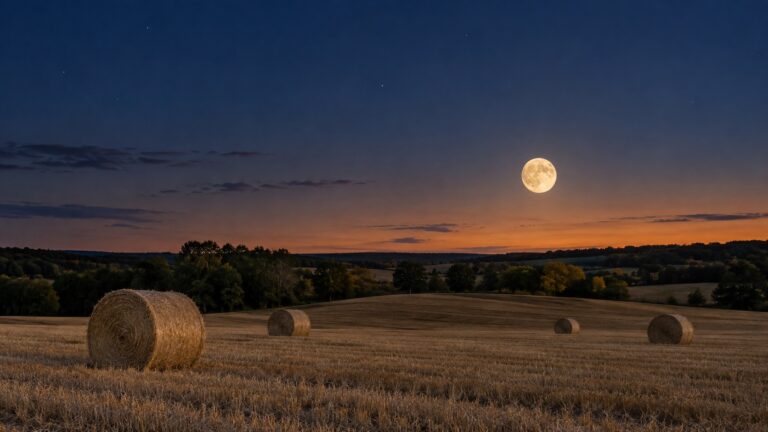
The Full Moon of September 2026: The Harvest Moon and the Beginning of Autumn
On September 26, 2026, the Moon reaches its full phase at 11:49 a.m. Central Daylight Time. At that precise moment, the Moon will be located opposite the Sun in Earth’s sky. Its near side will be fully illuminated by sunlight, creating the brilliant round Moon that has marked the changing seasons for people throughout human history. The moon will be bright on Friday night as it approaches its full phase, and still bright on Saturday night, as it will be just a few hours past its peak.
September’s full Moon is especially meaningful because it is the Harvest Moon. Unlike names such as the Strawberry Moon or Buck Moon, the Harvest Moon is not permanently assigned to one calendar month. The name belongs to the full Moon that occurs closest to the autumnal equinox. In 2026, the September 26 full Moon earns that distinction.
The Harvest Moon has a fascinating connection with agriculture. Around the autumn equinox, the Moon rises at nearly the same time for several evenings in succession at northern latitudes. Before electric lighting, this sequence of bright evenings gave farmers valuable extra light during one of the busiest periods of the year.
The 2026 Harvest Moon also provides an excellent reason to explore the early autumn sky. The Moon will be located in the constellation Pisces, while the familiar stars of summer remain visible and the great constellations of autumn begin taking their places in the evening sky.
The Astronomy Behind the September 2026 Full Moon
A full Moon occurs when the Sun and Moon appear on opposite sides of Earth. Astronomers call this configuration opposition.
The Sun illuminates half of the Moon at all times. During the full phase, nearly all of that illuminated hemisphere is facing us. This is why the Moon appears as a complete circle.
The exact full phase on September 26 occurs at 16:49 UTC. For observers in North America, this happens during daylight hours. The Moon will therefore be below the horizon in many locations at the precise moment of full phase.
That does not mean observers will miss the Harvest Moon. The Moon will appear almost perfectly full when it rises that evening. It will remain visible through the night and set around sunrise the following morning.
The full Moon rises close to sunset because of its position opposite the Sun. As the Sun disappears below the western horizon, the Moon appears near the eastern horizon.
This relationship becomes particularly interesting around the autumn equinox.
Why This Full Moon Is the Harvest Moon
The Harvest Moon is defined as the full Moon closest to the September equinox in the Northern Hemisphere. Most years it occurs in September, although occasionally the title belongs to an early October full Moon.
The name has deep agricultural roots.
Late September traditionally marked an important harvest period across much of Europe and North America. Farmers needed to gather crops before colder weather and autumn rains arrived. Every additional hour of workable light was valuable.
Normally, the Moon rises about 50 minutes later from one night to the next. Around the Harvest Moon, however, the geometry of the Moon’s orbit and the horizon changes that pattern at many northern latitudes. The delay between successive moonrises becomes noticeably shorter.
The result is several evenings when the Moon rises relatively soon after sunset.
Before tractors had powerful lights and farms had electricity, this natural evening illumination was extremely useful. Farmers could continue gathering crops after the Sun disappeared.
That practical advantage helped give the Harvest Moon its enduring name.
The Backstory of the Harvest Moon
People have followed the Moon as a calendar for thousands of years. Long before clocks and printed calendars became common, lunar phases offered an easy way to track the passage of time.
Agricultural societies paid particularly close attention to full Moons. Farming depends heavily on seasonal timing. Planting too early or harvesting too late could have serious consequences.
The September full Moon became associated with harvest activities across several cultures. European traditions connected it with grain gathering and the final major agricultural work before colder weather arrived.
As these traditions developed, the bright Moon rising shortly after sunset became an unmistakable symbol of the harvest season.
The Harvest Moon eventually became part of popular culture as well. It appears in paintings, songs, poems, and stories. Images of a large golden Moon rising above fields have become closely associated with autumn.
There is also a scientific reason that this image feels so natural. A rising full Moon often appears yellow, orange, or gold because we view it through a greater thickness of Earth’s atmosphere. The atmosphere scatters shorter blue wavelengths more efficiently, allowing warmer colors to dominate.
A Harvest Moon rising above a field can therefore genuinely look golden.
The Harvest Moon Is Not Always in September
One interesting fact about the Harvest Moon is that its date changes considerably from year to year.
The September equinox normally occurs around September 22 or 23. The full Moon closest to that date receives the Harvest Moon title.
Most years, that full Moon occurs in September. In some years, however, the closest full Moon occurs in early October.
This makes the Harvest Moon different from many other traditional lunar names. The Buck Moon is associated with July, while the Sturgeon Moon is associated with August. The Harvest Moon moves between September and October because its identity depends on the equinox.
In 2026, there is no question about which Moon receives the title. The September 26 full Moon occurs only a few days after the equinox.
Other Traditional Names for the September Full Moon
The September full Moon has also been known as the Corn Moon or Full Corn Moon.
This name reflects another important seasonal harvest. Corn reaches maturity in late summer and early autumn across much of North America. For communities that depended heavily on corn, the September Moon provided a natural seasonal marker.
Different Indigenous peoples used their own lunar calendars and names. These traditions were not universal across Native American cultures. Names reflected local environments, foods, animals, and seasonal activities.
Some September Moon traditions refer to leaves changing color, crops reaching maturity, or animals preparing for colder weather.
The common theme is transition. September stands between the warmth of summer and the cooler months ahead.
Viewing the Harvest Moon in North America
The evenings of September 25 and 26 will both provide an excellent opportunity to see the Harvest Moon across North America.
Since exact full phase occurs earlier in the day on Saturday, the Moon will already be essentially full when it rises, and approaching fullness on Friday. Look toward the eastern horizon around sunset.
The precise moonrise time depends on your location. An unobstructed eastern horizon provides the most impressive view.
At first, the Moon may appear orange or deep gold. As it climbs higher, its color gradually changes toward pale yellow and eventually white.
This is caused by Earth’s atmosphere rather than anything unusual happening on the lunar surface.
The Moon may also look enormous near the horizon. This is the famous Moon illusion. The Moon is not actually much larger at moonrise. Our brains interpret it differently when we see it beside familiar objects such as buildings, trees, and hills.
Together, the Moon illusion and warm atmospheric colors can make Harvest Moonrise one of the most beautiful lunar sights of the year.
The Harvest Moon in the Midwest
The Harvest Moon has a particularly strong connection with the agricultural landscapes of the American Midwest.
By late September, cornfields and soybean fields are approaching or entering harvest. The Moon rises over landscapes that closely resemble the scenes responsible for its traditional name.
At mid-northern latitudes, the Moon will rise near the eastern horizon around sunset and climb into the southeastern sky.
In places around Illinois and neighboring states, the September 26 Moon rises around the early evening. Local times vary, so observers should check the moonrise time for their specific city.
A rural location with an open view across farmland can provide a spectacular setting.
What to Expect in the Western United States
Observers in the western United States will also have excellent views of the Harvest Moon.
Mountain ranges and desert landscapes can create striking foregrounds as the Moon rises. Dry air in many western regions may provide especially clear views.
Because the Moon rises around sunset, observers can watch the landscape change from daylight to twilight while the Moon climbs into the sky.
Photographers can take advantage of this brief period when the brightness of the Moon and the surrounding landscape are more closely balanced.
What to Expect on the East Coast
Along the East Coast, the Harvest Moon will rise near sunset and remain visible throughout the night.
Coastal locations offer particularly beautiful viewing opportunities. Watching a nearly full Moon rise over the Atlantic can produce a dramatic golden reflection across the water.
Cities can also provide excellent views. A rising Moon behind buildings or bridges creates a strong sense of scale.
Light pollution is not a major concern when observing a full Moon. The Moon is bright enough to remain spectacular even from the center of a large city.
The Harvest Moon Will Be in Pisces
The September 2026 full Moon will appear in the constellation Pisces.
Pisces is not one of the easiest constellations to see from a city because most of its stars are relatively faint. The brightness of the full Moon will make those stars even harder to identify.
However, knowing the Moon’s location helps place the event within the larger autumn sky.
Pisces occupies an area near several important autumn constellations. Pegasus and Andromeda become prominent during September evenings. The Great Square of Pegasus is one of the easiest patterns to recognize in the autumn sky.
Saturn Joins the Harvest Moon Sky
There is another interesting sight to watch for around the September 2026 Harvest Moon. Saturn will appear near the Moon in the sky.
Saturn is bright enough to remain visible despite the glare of the full Moon. To the naked eye, it looks like a steady point of light rather than a twinkling star.
A small telescope transforms the view. Saturn’s rings are one of the most memorable sights available to amateur astronomers.
The combination of a bright Harvest Moon and Saturn provides another reason to spend some time outdoors on September 26.
Summer and Autumn Constellations Meet
September offers an unusual mixture of seasonal constellations.
The Summer Triangle, formed by Vega, Deneb, and Altair, remains prominent overhead during the evening. These three brilliant stars have dominated the sky throughout summer.
Farther east, autumn patterns are becoming increasingly important.
The Great Square of Pegasus rises higher as evening progresses. Andromeda stretches away from Pegasus. Cassiopeia becomes increasingly prominent in the northeastern sky.
This makes the Harvest Moon a natural marker of astronomical transition as well as seasonal change on Earth.
Observing the Lunar Surface
The full Moon is an excellent target for casual observation.
Dark regions called lunar maria can be seen without any equipment. These broad plains formed billions of years ago when enormous impacts created basins that were later flooded by ancient lava.
Mare Imbrium, Mare Serenitatis, and Mare Tranquillitatis are among the most recognizable features.
Binoculars reveal additional detail, including bright crater rays and subtle differences between the darker maria and brighter lunar highlands.
Full Moon is not actually the best phase for studying crater depth. Because sunlight strikes the surface almost directly, shadows are short. Quarter and crescent phases reveal much stronger relief along the lunar terminator.
Still, the full Moon provides the best opportunity to appreciate the entire visible lunar hemisphere at once.
Photographing the 2026 Harvest Moon
The Harvest Moon is an excellent photography target because its moonrise occurs close to sunset.
Try finding an open eastern horizon before the Moon rises. A distant barn, tree, lighthouse, mountain, or city skyline can create an interesting foreground.
The warm colors near moonrise usually last only a short time. As the Moon gains altitude, it becomes brighter and whiter.
A tripod can improve sharpness. Even a smartphone can capture an attractive image if it is held steady and the exposure is adjusted for the Moon’s brightness.
The most memorable photographs often include the landscape rather than showing the Moon alone. The Harvest Moon has always been connected to the Earth below it, especially fields, farms, and the changing colors of autumn.
A Full Moon That Marks a Changing Season
The September Harvest Moon arrives at a remarkable moment of balance.
The autumn equinox has just occurred. Day and night are close to equal in length. From this point forward, nights become longer across the Northern Hemisphere.
Summer stars remain overhead, but autumn constellations are arriving. Fields are being harvested. Leaves are beginning to change in northern regions. Evening temperatures are becoming cooler.
Above all of this seasonal change rises a Moon that people have watched for generations.
Modern farmers no longer depend on moonlight to finish the harvest. Powerful machinery and artificial lighting have changed agriculture completely. Yet the Harvest Moon still rises according to the same celestial rhythm.
Conclusion
The Full Moon of September 26, 2026 reaches exact full phase at 16:49 UTC, or 11:49 a.m. CDT. The Moon will be positioned opposite the Sun, with its Earth-facing hemisphere fully illuminated.
Because this is the full Moon closest to the autumnal equinox, it is the Harvest Moon. Its name reaches back to an era when the Moon’s unusually convenient sequence of evening rises provided valuable light during the autumn harvest.
The September Moon has also been called the Corn Moon, reflecting the importance of crops reaching maturity at this time of year.
For skywatchers, there is much more to enjoy. The Harvest Moon will appear in Pisces. Saturn will be nearby. The Summer Triangle will still dominate part of the sky, while Pegasus and other autumn constellations announce the changing season.
Perhaps the best way to experience the 2026 Harvest Moon is also the simplest. Find a place with a clear eastern horizon shortly before sunset on September 26. Watch the sky darken and wait for the Moon to appear.
It may begin as a deep golden disk close to the horizon. Then it will slowly brighten as it climbs into the autumn sky.
For generations of farmers, that light once meant a few more precious hours to gather the year’s crops. Today, the same Harvest Moon gives us a reason to spend an autumn evening outside and watch one of nature’s oldest seasonal traditions unfold again.
Please be advised that, despite our best efforts, International Star Registry – Name a star provides astronomical content for entertainment purposes. We cannot guarantee the accuracy of all information given.