
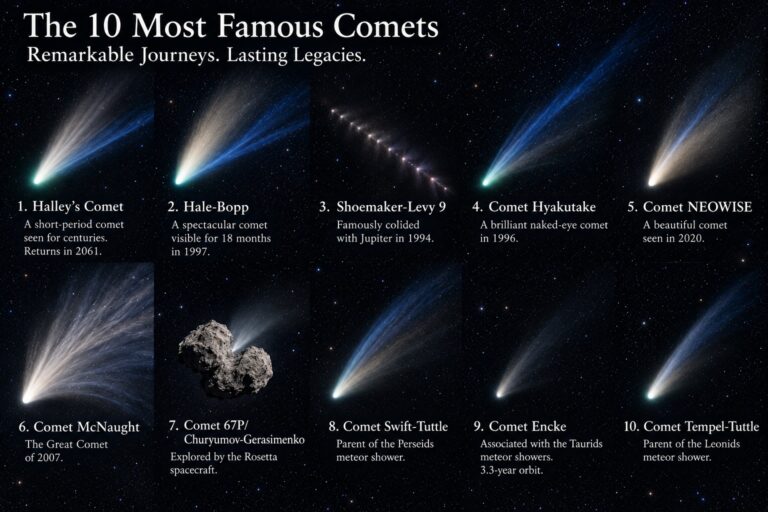
The 10 Most Famous Comets and Why We Remember Them
Comets are among the most unpredictable and memorable objects in the night sky. Some become famous because they grow bright enough to see without a telescope. Others earn their place in history by passing unusually close to Earth, creating meteor showers, surviving encounters with the Sun, or colliding with a planet. Many do not make the list, like Comet C/1861 G1 Thatcher, 21P/Giacobini-Zinner and 2003 EH1, but instead we see the meteor showers that light up the sky when the Earth passes through the field of cosmic debris they leave in their wake.
A few become part of human culture. They appear in ancient chronicles, medieval artwork, family photographs, and personal memories shared across generations.
Any ranking of famous comets is partly subjective. Brightness is not the only measure of importance. This list includes comets that changed astronomy, created unforgettable sky displays, produced famous meteor showers, or allowed spacecraft to make historic discoveries.
1. Halley’s Comet
No comet is more famous than Halley’s Comet.
Its history reaches far beyond the life of Edmond Halley, the astronomer for whom it is named. Chinese astronomers recorded several of its ancient appearances. Babylonian observers appear to have documented it in 164 BCE. It was seen in 1066 and later included in the Bayeux Tapestry, where it became part of the story of the Norman conquest of England.
For centuries, each appearance was treated as a separate comet. That changed when Edmond Halley studied comets observed in 1531, 1607, and 1682. Using Isaac Newton’s work on gravity and planetary motion, Halley concluded that the three sightings belonged to the same returning object.
He predicted that it would return around 1758. The comet did return, although Halley had died before he could witness the fulfillment of his prediction. This was the first successful forecast of a periodic comet’s return and a major triumph for Newtonian science.
Halley’s Comet travels around the Sun approximately once every 76 years, although gravitational encounters can shorten or lengthen individual orbits. It last passed through the inner solar system in 1986 and will return in 2061.
Halley also gives us two annual meteor showers. The Eta Aquariids arrive in May, and the Orionids appear in October. Each meteor is produced by a small piece of debris left behind during one of the comet’s earlier journeys.
Why it is famous: Halley’s Comet connected ancient observations with modern orbital science. It was the first comet whose return was successfully predicted, and it remains the one comet most people know by name.
Next return: 2061
Meteor showers: Eta Aquariids and Orionids
2. Hale-Bopp
Comet Hale-Bopp became the great comet of the late twentieth century.
Alan Hale and Thomas Bopp independently discovered it in July 1995 while it was still far beyond the orbit of Jupiter. Its early brightness suggested that something exceptional was approaching.
By 1997, Hale-Bopp had become a spectacular naked-eye object. It developed a bright head and two distinct tails, including a curved dust tail and a straighter blue ion tail. Unlike many comets that remain impressive for only a few days, Hale-Bopp was visible without optical aid for approximately 18 months. Millions of people saw it from cities, suburbs, and rural communities.
The comet’s long visibility helped make it a shared cultural event. For many people alive in the 1990s, Hale-Bopp remains the comet they remember seeing with their own eyes.
Hale-Bopp came from the distant Oort Cloud and follows an enormous orbit. Astronomers expect its next passage through the inner solar system around the year 4380, although predictions that far into the future remain approximate.
No major annual meteor shower has been firmly connected with Hale-Bopp.
Why it is famous: It was bright, beautiful, easy to find, and visible for an unusually long time.
Next return: Approximately 4380
Meteor shower: No major annual shower
3. Shoemaker-Levy 9
Comet Shoemaker-Levy 9 did not become famous for lighting up Earth’s sky. It became famous for striking Jupiter.
Carolyn and Eugene Shoemaker and David Levy discovered the comet in 1993. Photographs showed an unusual chain of fragments, sometimes described as a string of pearls. Jupiter’s gravity had torn the comet apart during an earlier close encounter.
Calculations revealed that the fragments were headed back toward Jupiter. Astronomers predicted that they would collide with the planet in July 1994.
The world watched as the fragments struck one after another. The impacts created enormous plumes and dark scars in Jupiter’s atmosphere. Some marks were larger than Earth and remained visible for months.
This was the first time astronomers discovered a solar system object and predicted its collision with a planet far enough in advance to organize a major observing campaign. The event demonstrated that large impacts are not confined to the distant past. It also strengthened interest in discovering and tracking objects that could approach Earth.
Shoemaker-Levy 9 will never return. The comet was destroyed by Jupiter.
Why it is famous: Humanity watched a predicted comet collision alter the atmosphere of another planet.
Next return: None
Meteor shower: None
4. Comet Hyakutake
Comet Hyakutake arrived suddenly and passed remarkably close to Earth in 1996.
Japanese amateur astronomer Yuji Hyakutake discovered it only two months before its closest approach. On March 25, 1996, the comet passed about 9.3 million miles from Earth. That is close by comet standards.
Its proximity made Hyakutake appear large and dramatic. Under dark skies, its tail stretched across an extraordinary portion of the heavens. Some observers described it as seeming to cover half the sky.
A surprising discovery came from the Ulysses spacecraft. Although Ulysses was hundreds of millions of miles from the comet, it passed through Hyakutake’s ion tail. The encounter revealed that the tail extended much farther through space than expected. Hyakutake also became the first comet clearly detected producing X-rays.
Hyakutake’s future return is not expected for many tens of thousands of years. Its exact orbit was changed by gravitational interactions during its passage through the inner solar system.
No major annual meteor shower is associated with it.
Why it is famous: Its close approach created an enormous naked-eye display and revealed that comet tails can extend across astonishing distances.
Next return: Not expected for many tens of thousands of years
Meteor shower: No major annual shower
5. Comet NEOWISE
Comet C/2020 F3 NEOWISE became a welcome celestial visitor during the summer of 2020.
NASA’s NEOWISE spacecraft discovered it on March 27, 2020. The comet survived its close passage around the Sun and emerged as a bright object with a golden dust tail.
For observers across the Northern Hemisphere, NEOWISE became the brightest widely visible comet since Hale-Bopp. It could be seen from many suburban locations and photographed above cities, lakes, mountains, farms, and national parks.
Its arrival was especially memorable because much of the world was experiencing isolation and uncertainty during the COVID-19 pandemic. People stepped outside, looked toward the horizon, and shared photographs of the same visitor. The comet became a rare communal experience during a period when many other communal experiences were unavailable.
NEOWISE follows a very long orbit. It is not expected to return to the inner solar system for approximately 6,800 years.
Why it is famous: It was the first easily visible great comet of the social-media era and brought people together during the extraordinary summer of 2020.
Next return: Approximately 8,800 CE
Meteor shower: No major annual shower
6. Comet McNaught
Comet C/2006 P1 McNaught was one of the brightest comets of modern times.
Astronomer Robert McNaught discovered it in August 2006. As it approached the Sun in January 2007, it brightened far beyond early expectations.
For a brief period, Comet McNaught became bright enough to see during daylight when observers carefully blocked the Sun. After passing the Sun, it produced a magnificent fan-shaped tail visible mainly from the Southern Hemisphere.
Photographs from Australia, New Zealand, South Africa, and South America showed a sweeping tail divided into dramatic bands. It became known as the Great Comet of 2007.
The Solar and Heliospheric Observatory recorded it as the brightest comet the spacecraft had observed.
McNaught follows such a vast orbit that no return is expected on any ordinary human timescale. Estimates are difficult because long-period comet orbits can be changed by the planets, passing stars, and the galaxy’s gravity.
Why it is famous: It was extraordinarily bright and developed one of the most beautiful and complex comet tails ever photographed.
Next return: Not expected for many thousands of years, and possibly much longer
Meteor shower: No major annual shower
7. Comet 67P/Churyumov-Gerasimenko
Comet 67P/Churyumov-Gerasimenko is difficult to pronounce and usually too faint to see without a telescope. It still belongs on a list of history’s most famous comets.
It became the destination of the European Space Agency’s Rosetta mission.
Rosetta reached the comet in August 2014 after traveling through the solar system for more than a decade. It became the first spacecraft to rendezvous with a comet and accompany it around the Sun. The Philae lander then made the first landing on a comet’s surface.
The mission revealed a dark, rugged world with two distinct lobes. Its strange shape was compared to a rubber duck. Rosetta photographed cliffs, pits, boulders, dust, ice, and jets of material escaping into space.
For more than two years, the spacecraft watched sunlight transform the comet. As 67P approached the Sun, frozen material became active and carried dust away from its surface.
Rosetta allowed people to see a comet as a world rather than a fuzzy light in the sky.
Comet 67P completes an orbit approximately every 6.4 years. It returns regularly, although it is not normally a bright naked-eye object.
Why it is famous: It was the first comet orbited by a spacecraft and the first to receive a robotic lander.
Return schedule: Approximately every 6.4 years
Meteor shower: No major annual shower
8. Swift-Tuttle
Many people have never seen Comet Swift-Tuttle, but millions enjoy its remains every August.
Lewis Swift and Horace Tuttle independently discovered the comet in 1862. Later calculations connected it with earlier observations and established that it follows an orbit lasting about 133 years.
Swift-Tuttle is an unusually large comet. Its nucleus is approximately 16 miles across, making it more than twice the estimated diameter of the object associated with the extinction of the dinosaurs. Its orbit crosses Earth’s orbit, but careful calculations show that its known future passages do not present an imminent collision threat.
The comet last passed close to the Sun in 1992 and is expected to return in 2125.
Swift-Tuttle is best known as the parent of the Perseid meteor shower. Every August, Earth travels through dust spread along the comet’s orbit. The resulting Perseids are among the most popular meteors of the year because they are active during warm Northern Hemisphere nights and frequently produce bright streaks.
The comet may be absent, but its dust returns annually.
Why it is famous: It is the large parent comet of the beloved Perseid meteor shower.
Next return: 2125
Meteor shower: Perseids
9. Comet Encke
Comet Encke has the shortest known orbital period of any major comet. It travels around the Sun once every 3.3 years.
Pierre Méchain first observed it in 1786. Other astronomers saw it during later appearances, but Johann Franz Encke calculated its orbit and showed that the sightings represented the same returning comet.
Encke was only the second comet recognized as periodic, which is why its official designation is 2P/Encke. The comet was named for the person who calculated its repeating orbit rather than the person who first discovered it.
Although Encke returns frequently, it is not usually a spectacular naked-eye comet. It has passed near the Sun many times and has lost a great deal of its easily vaporized material.
Its debris, however, produces the extensive Taurid meteor complex. The Southern and Northern Taurids appear each autumn and are famous for slow, bright fireballs. Because these fireballs are frequently seen around late October and early November, they are sometimes called Halloween fireballs.
Some astronomers believe Encke may be one surviving fragment of a much larger comet that broke apart thousands of years ago. If so, the Taurids are the remains of a dramatic event that occurred long before recorded astronomy.
Why it is famous: It has the shortest orbital period of any well-known comet and is closely associated with the fireball-rich Taurid meteor complex.
Return schedule: Approximately every 3.3 years
Meteor showers: Southern Taurids and the broader Taurid complex
10. Tempel-Tuttle
Comet 55P/Tempel-Tuttle is a relatively small comet with a very large reputation.
Ernst Tempel discovered it in 1865, and Horace Tuttle independently observed it in 1866. Its nucleus measures only about 2.24 miles across, and it completes an orbit every 33 years.
Tempel-Tuttle last reached its closest point to the Sun in 1998. It is expected to return in 2031.
Its fame comes from the Leonid meteor shower. Earth passes through the comet’s debris every November. During most years, the Leonids are a modest display. When Earth encounters a dense trail of material released during an earlier passage, the shower can become a meteor storm.
The Leonid storm of 1833 filled the sky with thousands of meteors and deeply affected communities across North America. The storm encouraged astronomers to investigate meteor showers as events occurring in space rather than weather in Earth’s atmosphere.
Another remarkable Leonid storm occurred in 1966. For a short time, observers reported meteors falling at rates of thousands per minute. Enhanced displays also occurred around the comet’s 1998 return.
A dramatic storm is not guaranteed when Tempel-Tuttle returns in 2031. Earth must cross the right dust trail at the right time. Still, astronomers expect interest in the Leonids to increase as the comet approaches the inner solar system again.
Why it is famous: Its debris produces the Leonids, including some of the greatest meteor storms ever recorded.
Next return: 2031
Meteor shower: Leonids
Which Comet Is the Greatest?
Halley’s Comet remains the most famous because it connects so many parts of the human story. It appears in ancient records, medieval art, the history of gravity, the prediction of celestial motion, and the beginning of spacecraft exploration.
Hale-Bopp may have been the most widely enjoyed comet of recent generations. Hyakutake made an unforgettable close approach. McNaught produced one of the finest tails ever photographed. Shoemaker-Levy 9 showed the destructive power of a comet on a planetary scale. NEOWISE gave millions of modern observers a comet of their own.
Swift-Tuttle, Encke, and Tempel-Tuttle are famous for another reason. They continue to place pieces of themselves in our sky through the Perseids, Taurids, and Leonids.
A comet does not need to return during our lifetime to remain present. Its dust can circle the Sun for centuries. Its appearance can survive in artwork and written records. Its discovery can change the way we understand the solar system.
The most famous comets are remembered not only because they were bright. They are remembered because each one revealed something new about the sky, our history, or our place within the solar system.
Please be advised that, despite our best efforts, International Star Registry – Name a star provides astronomical and historical content for entertainment purposes. We cannot guarantee the accuracy of all information given.