
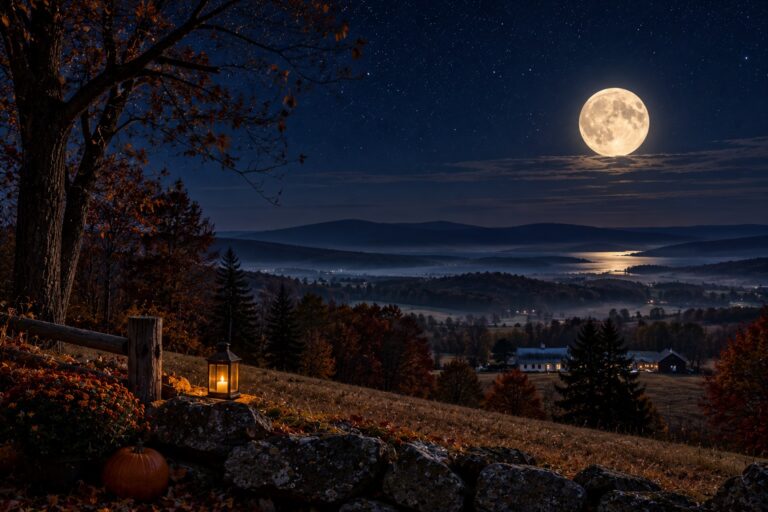
The Full Moon of November 24, 2026 Begins a Bright Holiday Season: The Beaver Supermoon and the Approach of Winter
On November 24, 2026, the Moon reaches its full phase at 14:53 UTC. At that precise moment, the Moon will be positioned opposite the Sun in Earth’s sky. Its near side will be fully illuminated by sunlight, creating the brilliant round Moon that has guided travelers, farmers, hunters, and skywatchers for thousands of years.
November’s full Moon is traditionally known as the Beaver Moon. Its name is closely connected with the preparations that animals make as winter approaches. By late November, beavers have been busy strengthening their lodges and storing food for the cold months ahead. Historical accounts also connect this time of year with the North American fur trade, when beavers were trapped for their thick winter pelts.
The November 2026 Beaver Moon has an additional astronomical distinction. It is a supermoon. The full phase occurs only hours before the Moon reaches perigee, the portion of its orbit when it is closest to Earth. This means the Beaver Moon will appear somewhat larger and brighter than an average full Moon.
There is even more to enjoy in the November sky. The Moon will be near the famous Pleiades star cluster on November 24. Meanwhile, some of the most beautiful constellations of winter are returning to the evening sky.
The Beaver Moon also arrives only two days before Thanksgiving in the United States. That makes this a fitting Moon for a season associated with gathering, gratitude, family traditions, and memories shared across generations.
The Astronomy Behind the November 2026 Full Moon
A full Moon occurs when the Sun and Moon appear on opposite sides of Earth. Astronomers call this configuration opposition.
The Sun always illuminates half of the Moon. During the full phase, nearly all of that illuminated hemisphere faces Earth. This creates the familiar circular Moon we see in the night sky.
The November 2026 full Moon reaches exact opposition at 14:53 UTC on November 24. That corresponds to 9:53 a.m. EST, 8:53 a.m. CST, 7:53 a.m. MST, and 6:53 a.m. PST.
Since the exact full phase occurs during the morning in North America, the Moon will look beautifully full on both the evening of November 23 and November 24.
As with every full Moon, it rises close to sunset and remains visible through most of the night. It sets around sunrise the following morning.
November nights are becoming much longer across the Northern Hemisphere. This gives skywatchers plenty of time to enjoy the Beaver Moon and the changing seasonal sky around it.
Why It Is Called the Beaver Moon
The name Beaver Moon has been used for generations.
One traditional explanation relates to the behavior of beavers themselves. By late autumn, beavers are preparing for winter. Their lodges need to provide protection when ponds and waterways begin freezing.
Beavers also gather branches and other vegetation that can serve as food during the winter months. Much of this activity takes place before ice makes travel more difficult.
The name has an interesting historical record. Captain Jonathan Carver documented the term during his travels in North America during the 1760s.
Another explanation connects the name with the fur trade. Late autumn was historically a period when beavers were trapped because their winter coats had become thick.
Both explanations connect the Moon with the same basic theme: preparing for winter.
That theme appears again and again in traditional November Moon names.
Other Traditional Names for the November Full Moon
Different Indigenous cultures developed their own names for lunar months. These names were based on local environments and seasonal events, so there was never one universal Native American system for naming full Moons.
The Deer Rutting Moon, associated with Dakota and Lakota traditions, describes the annual deer mating season.
The Digging or Scratching Moon, associated with Tlingit tradition, reflects animals searching for food and bears preparing winter dens.
The Whitefish Moon, associated with Algonquin tradition, refers to the spawning season of whitefish.
Weather also inspired several names.
The Frost Moon, associated with Cree and Assiniboine traditions, recognizes the increasingly frequent frosts of late autumn. The Freezing Moon, associated with Anishinaabe tradition, marks the arrival of colder weather and freezing waterways.
All of these names tell slightly different versions of the same seasonal story.
Winter is approaching, and the natural world is getting ready.
The November 2026 Beaver Moon Is a Supermoon
The 2026 Beaver Moon is especially interesting because it is also a supermoon.
The Moon does not orbit Earth in a perfect circle. Its orbit is slightly elliptical. This means its distance from Earth changes throughout each month.
The closest region of the Moon’s orbit is called perigee. The farthest point is called apogee.
When a full Moon occurs near perigee, it is commonly called a supermoon.
NASA includes the November 24, 2026 full Moon on its list of upcoming supermoons. The Moon reaches perigee only several hours after becoming full.
The difference in apparent size is not enormous. Someone casually looking at the Moon may not immediately recognize that it is larger than usual.
The difference in brightness can be more noticeable, especially when the Moon is compared with a more distant full Moon.
The best way to appreciate a supermoon is often during moonrise. When a large, bright Moon appears beside trees, buildings, or distant hills, the familiar Moon illusion can make it look especially impressive.
Supermoons and Earth’s Tides
The Moon’s closer distance also has a measurable effect on Earth.
The gravitational pull of the Moon is one of the primary causes of ocean tides. During full and new Moons, the gravitational effects of the Sun and Moon combine to produce stronger spring tides.
When the Moon is also near perigee, tides can become somewhat higher than usual.
These are sometimes called perigean spring tides.
The effect does not mean dramatic flooding will automatically occur. Local weather, coastline shape, wind, and atmospheric pressure also influence water levels.
Still, the connection provides another reminder that the Moon is not simply a beautiful object in the sky. Its gravitational influence has measurable effects here on Earth.
The Beaver Moon Meets the Pleiades
One of the most interesting features of the November 2026 sky occurs on the same day as the full Moon.
On November 24, the Moon passes near the Pleiades star cluster.
The Pleiades are among the most famous stars in the night sky. They are located in the constellation Taurus and are sometimes called the Seven Sisters.
To the naked eye, the cluster looks like a tiny group of closely packed stars. People with excellent eyesight under dark skies may distinguish six or more individual stars.
The cluster actually contains hundreds of stars.
The Pleiades have inspired stories across many cultures. Ancient Greeks associated them with the seven daughters of Atlas and Pleione. Similar groups of sisters or young women appear in stories from other parts of the world.
The Beaver Moon will make the faintest members difficult to see because of its glare. Binoculars can help.
Even if the bright Moon overwhelms the cluster itself, knowing that the Pleiades are nearby adds another layer to the evening’s astronomy.
Winter Constellations Are Returning
By late November, the transformation of the night sky is unmistakable.
The great winter constellations are returning.
Taurus rises during the evening. Its bright orange star Aldebaran marks the eye of the Bull.
Nearby is Auriga, containing brilliant Capella.
Then comes one of the most recognizable constellations in the entire sky.
Orion the Hunter rises in the east and becomes increasingly prominent as the evening progresses. Orion’s three belt stars make it easy to recognize even for beginning stargazers.
Betelgeuse marks one of Orion’s shoulders, while brilliant Rigel marks one of his feet.
Later in the night, Gemini and Canis Major become increasingly prominent. Sirius, the brightest star in the nighttime sky, eventually joins the scene.
The Beaver Moon therefore arrives during one of astronomy’s great seasonal transitions. Autumn constellations still occupy much of the sky while the brilliant stars of winter begin returning.
Viewing the Beaver Moon Across North America
The Beaver Moon will be easy to observe from anywhere in North America with clear weather.
Since exact fullness occurs during the morning of November 24, both the evening before and the evening after provide excellent viewing opportunities.
Look toward the eastern horizon around sunset.
The rising Moon may appear yellow, orange, or golden. This coloration occurs because moonlight near the horizon travels through a greater thickness of Earth’s atmosphere.
As the Moon rises higher, it usually becomes brighter and whiter.
Because this is a supermoon, moonrise should be particularly attractive. The combination of its relatively close distance and the Moon illusion may make it appear especially large beside familiar objects on the horizon.
What to Expect in the Western United States
Western observers may enjoy especially crisp views from dry desert regions and higher elevations.
Mountains provide dramatic foregrounds for a rising supermoon. The contrast between a bright Moon and snow beginning to accumulate on higher peaks can create beautiful late autumn scenes.
The Moon will remain visible for most of the night.
What to Expect in the Midwest
The November Beaver Moon has a distinctly different atmosphere in the Midwest.
Many trees will have lost most of their leaves. Harvested fields stretch across rural landscapes. Frost becomes increasingly common, and the possibility of early snow is very real.
A bright supermoon rising above bare trees or harvested farmland can illuminate the landscape surprisingly well.
Clear November nights can also produce wonderfully sharp views because cooler air often contains less moisture than humid summer air.
What to Expect on the East Coast
East Coast observers can watch the Beaver Moon rise over forests, cities, mountains, or the Atlantic Ocean.
Coastal locations provide excellent opportunities to photograph moonlight reflecting across the water.
Farther north, bare trees and late autumn landscapes create a very different setting from the Flower Moon and Strawberry Moon earlier in the year.
The changing landscape makes the progression of the lunar calendar easy to appreciate.
Looking at the Beaver Moon’s Surface
The full Moon is bright enough to reveal its largest surface features without any optical equipment.
Dark regions called lunar maria are ancient volcanic plains.
Mare Imbrium, Mare Serenitatis, and Mare Tranquillitatis are among the easiest to recognize.
Bright ray systems also become prominent around full Moon. The crater Tycho is surrounded by enormous streaks of material thrown across the lunar surface during an ancient impact.
Binoculars make these patterns especially easy to see.
A telescope reveals considerably more detail, although full Moon is not the ideal phase for studying crater depth. Sunlight strikes the surface almost directly during this phase, producing relatively short shadows.
Still, seeing the entire lunar face illuminated at once is impressive, especially during a supermoon.
Photographing the November Supermoon
The best photographs often begin at moonrise.
Find a location with an open eastern horizon before sunset. Trees, barns, church steeples, mountains, and city skylines can all provide useful foregrounds.
A tripod helps keep photographs sharp.
The Moon is much brighter than most people expect. Reducing exposure prevents it from becoming an overexposed white circle.
The warm colors visible near moonrise usually fade quickly. Within a short time, the Moon becomes pale yellow and eventually white as it climbs higher.
A Moon for Thanksgiving and the Beginning of the Holiday Season
The November 2026 Beaver Moon arrives only two days before Thanksgiving in the United States.
By Thanksgiving evening on November 26, the Moon will have begun to wane, but it will still be large and bright.
The timing feels appropriate for a Moon associated with preparation for winter.
November is also when many families begin gathering for the holiday season. Familiar recipes return to the table. Relatives travel home. Decorations emerge from boxes. Traditions repeated for years begin again.
The Moon sometimes becomes part of those memories without anyone planning it.
We may remember a bright Moon above the house where Thanksgiving was celebrated, a cold walk after dinner, or moonlight following the car during a long drive home.
There is no astronomical connection between the Beaver Moon and Thanksgiving. In 2026, their closeness on the calendar is simply a pleasant coincidence.
Still, during a busy holiday week, the bright Moon offers a simple reason to step outside for a few minutes and look up.
Families have been sharing that same view for generations.
The Last Full Moon Before Winter
The Beaver Moon is also the final full Moon before the December solstice.
That gives it a special place in the seasonal calendar.
The Harvest Moon accompanied the beginning of autumn. The Hunter’s Moon followed as people historically gathered food and prepared for colder weather.
Now the Beaver Moon arrives as the transition approaches completion.
Animals are preparing shelters. Waterways begin freezing in northern regions. Trees are bare. Nights are long.
Soon the Cold Moon of December will rise near the winter solstice.
The progression of these Moons tells the story of the season almost as clearly as a calendar.
Conclusion
The Full Moon of November 24, 2026 reaches exact full phase at 14:53 UTC. It is traditionally known as the Beaver Moon, reflecting a season when beavers and other animals prepare for the winter ahead.
Other traditional names tell their own November stories. The Deer Rutting Moon reflects the deer mating season. The Whitefish Moon marks spawning fish. The Frost Moon and Freezing Moon recognize the return of serious cold.
This year’s Beaver Moon has an additional attraction. It is a supermoon, occurring close to the Moon’s nearest point to Earth. It will therefore appear somewhat larger and brighter than an average full Moon.
The Moon will also pass near the Pleiades on November 24, while Taurus, Orion, Auriga, Gemini, and the other brilliant constellations of winter begin returning to the evening sky.
Then Thanksgiving arrives only two days later.
That makes the November 2026 Beaver Moon a fitting companion to the beginning of the holiday season. It shines over a landscape preparing for winter and over families preparing to gather.
Whether you see it above a city skyline, a quiet field, a mountain ridge, or the home where your family has gathered for years, take a moment to look up.
The Beaver Moon has marked the approach of winter for generations. In 2026, it can also become a small part of the memories that make this season special.
Please be advised that, despite our best efforts, International Star Registry – Name a star provides astronomical content for entertainment purposes. We cannot guarantee the accuracy of all information given.