
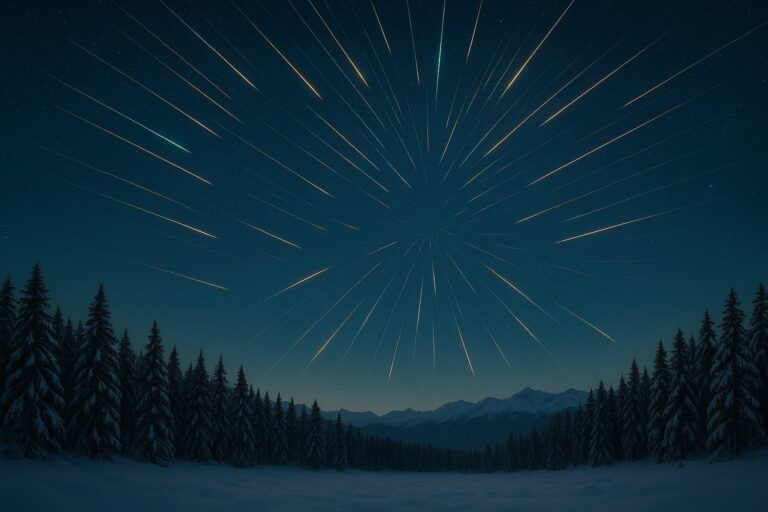
As the world settles into the heart of the holiday season—when homes glow with festive lights, families gather close, and the spirit of wonder fills the air—the universe prepares its own breathtaking celebration. On the nights of December 13 and 14, 2025, the Geminids Meteor Shower will peak, painting the winter sky with streaks of shimmering light. Known as the “King of the Meteor Showers,” the Geminids are widely regarded as the most spectacular display of shooting stars of the year, with as many as 120 multicolored meteors per hour blazing overhead at their peak.
This December, while city streets sparkle with holiday decorations and fireplaces crackle with warmth, the heavens will offer something truly magical—an invitation to step outside, look up, and witness a celestial light show unlike any other.
A December Sky Filled with Magic
Each year, as autumn fades and the chill of winter deepens, skywatchers anticipate the return of the Geminids. The shower typically runs from December 7 through December 17, but its peak on the night of December 13 and the early morning of December 14 is when it truly comes alive. This year’s event promises another unforgettable spectacle despite the presence of a second-quarter moon, which will slightly brighten the night sky and obscure some of the fainter meteors. Fortunately, the Geminids are so bright and plentiful that the show will remain mesmerizing even under lunar light.
The best time to watch will be after midnight, when the radiant point (the spot in the sky from which the meteors seem to emerge) climbs higher. The meteors appear to radiate from the constellation Gemini, the Twins, which rises in the east and soars high by the early morning hours. However, you don’t need to look directly at Gemini to see them. The meteors will streak across all parts of the sky, flashing in colors of white, yellow, blue, green, and even red, offering a vivid and almost festive celestial display.
The King of the Meteor Showers
Among all the meteor showers that grace our skies, including the Perseids of August, the Orionids of October, or the Leonids of November, the Geminids stand above them all. Their intensity, frequency, and color variety make them the most reliable and rewarding meteor shower of the year. Astronomers and casual observers alike refer to the Geminids as the “King” for good reason: while most meteor showers produce around 10 to 60 meteors per hour, the Geminids can exceed 100 visible meteors per hour under ideal conditions.
Each meteor is a fragment of cosmic dust, just tiny grains no larger than a grain of sand, burning up as they plunge through Earth’s atmosphere at speeds of up to 22 miles per second (35 kilometers per second). As they vaporize, they create brilliant streaks of light that last just moments but evoke awe that lingers far longer. Occasionally, a particularly bright meteor will burst across the sky, leaving a glowing trail that hangs for several seconds, dazzling those lucky enough to be watching.
A Different Kind of Parent: Asteroid 3200 Phaethon
What makes the Geminids truly unique is their origin. Unlike most meteor showers, which are born from comets, the Geminids are produced by debris from an asteroid, a rocky body known as 3200 Phaethon.
Discovered in 1982, 3200 Phaethon is a curious celestial hybrid. It behaves like both a comet and an asteroid. As it approaches the Sun during its orbit, it heats up and releases dust and debris into space. These particles spread along Phaethon’s orbital path, and once a year, Earth passes through this trail of debris, giving rise to the Geminid meteor shower.
Because Phaethon is rocky rather than icy like a traditional comet, the Geminids’ meteors tend to be denser and brighter, producing vivid colors and slower, longer-lasting trails. In many ways, 3200 Phaethon challenges our understanding of what defines a comet or an asteroid—standing at the crossroads of both, much like the Geminids themselves stand at the crossroads of science and wonder.
When and How to Watch the 2025 Geminids
This year, the Geminids will peak on the night of December 13, continuing into the early morning of December 14. The best viewing conditions will occur after midnight, once Gemini has risen high into the eastern sky.
Here’s how to make the most of this celestial event:
Find a Dark Location
The darker the sky, the better your experience. Seek out a rural area or a park away from city lights. If you live in a metropolitan area, even a short drive can make a huge difference in visibility.Give Your Eyes Time to Adjust
It can take up to 30 minutes for your eyes to fully adapt to the darkness. Avoid looking at your phone or using flashlights during this time. If you need light, use a red filter or a dim red LED.Dress for the Weather
December nights can be chilly, especially in the Northern Hemisphere. Dress warmly in layers, bring blankets, and perhaps a thermos of hot cocoa or coffee to make the experience more comfortable.Recline and Look Up
You don’t need a telescope or binoculars. Simply lie back on a blanket or lawn chair and gaze at the open sky. Meteors can appear anywhere, so the wider your view, the better.Watch for a Few Hours
The Geminids tend to build slowly, with activity increasing as the night progresses. The most impressive displays often occur after 2 a.m., when Gemini is highest in the sky.
Even if the moon slightly interferes early in the evening, the brightness of the Geminids ensures that many will still cut through the moonlight, looking bright, colorful, and unforgettable.
The Science Behind the Streaks
Each glowing meteor we see during the Geminids is a tiny fragment of Phaethon’s debris burning up high above us. As these particles enter Earth’s atmosphere at incredible speeds, they collide with atmospheric molecules, generating frictional heat that vaporizes the particles almost instantly. This process produces the brilliant flashes of light we call “shooting stars.”
The colors we see can range from bright white to deep green or even purple, depending on the composition of the meteoroids and the gases they interact with in the atmosphere. For example:
Green streaks often come from nickel or magnesium.
Yellow and orange hues arise from sodium.
Blue and violet tones may be due to ionized calcium or other trace elements.
Together, they form a palette as diverse and dazzling as the holiday lights adorning the earth below.
A Shower for the Holiday Spirit
The timing of the Geminids couldn’t be more perfect. Falling in mid-December, they coincide with a time when people around the world are reflecting on the past year, spending time with loved ones, and celebrating moments of joy and gratitude. Watching a meteor shower during this season adds an extra layer of meaning. Its a reminder that even amid the busyness of life, there’s beauty and wonder beyond our daily routines.
Imagine bundling up with family or friends, sipping something warm, and gazing skyward as streaks of light trace across the heavens. For many, witnessing the Geminids becomes a holiday tradition, like a cosmic celebration to pair with the lights on Earth.
The History and Discovery of the Geminids
The Geminid meteor shower is a relatively recent discovery in astronomical terms. It was first observed in 1862, making it one of the youngest of the major annual showers. Early records noted only a few meteors per hour, but over time, the shower’s intensity has increased significantly. Today, the Geminids are not only the most consistent but also the most productive meteor shower of the year.
This increase in activity is likely due to Earth moving deeper into Phaethon’s debris stream as the asteroid’s orbit gradually evolves. Each year, our planet plows through more of the leftover dust, resulting in a richer display.
Why the Geminids Stand Apart
Several unique qualities make the Geminids stand out among all meteor showers:
Asteroidal Origin
Unlike most showers caused by comets, the Geminids originate from an asteroid-like body. This makes their composition different, resulting in more durable and brighter meteors.Slow, Graceful Meteors
Geminid meteors travel slower than those from most showers, meaning their trails often last longer and appear more dramatic.Vivid Colors
The multicolored display of the Geminids is unmatched. Viewers often describe seeing emerald-green, ruby-red, or sapphire-blue streaks. Each shooting star is a natural work of art.Global Visibility
The Geminids can be seen from almost anywhere on Earth, though the Northern Hemisphere enjoys the best views.Reliability
Some showers fluctuate in intensity from year to year, but the Geminids are remarkably consistent. Every December, they return to deliver a show worthy of their royal title.
The Role of the Constellation Gemini
Although meteors from the Geminid shower can appear anywhere in the night sky, they seem to radiate from a single point within the constellation Gemini, located near the bright stars Castor and Pollux. These twin stars symbolize companionship and duality. It’s a fitting location for a shower that brings people together to share in the awe of the cosmos.
When Gemini rises in the east after nightfall, the show begins in earnest. As it climbs higher through the night, so too does the frequency of visible meteors, culminating in the hours after midnight when Earth’s rotation carries the observer into the stream’s densest part.
Tips for Photographing the Geminids
If you’re hoping to capture the Geminids with your camera, patience and preparation are key. Here are some tips for photographing this celestial event:
Use a Wide-Angle Lens:
A 14mm or 24mm lens can capture more of the sky and increase your chances of catching multiple meteors.Set a Long Exposure:
Try exposures of 15–30 seconds to allow enough time for meteors to appear in the frame.Use a Tripod:
Stability is crucial for sharp, clear shots.High ISO Settings:
Depending on your camera, an ISO between 1600–3200 usually works well in dark locations.Continuous Shooting Mode:
Take multiple photos back-to-back to increase your odds of capturing a meteor.Include Foreground Elements:
A silhouette of trees, mountains, or a tent can add scale and beauty to your image.
Even if you don’t capture the perfect shot, the experience of lying beneath a shower of celestial fire is unforgettable.
Comet Dust and Cosmic Perspective
The Geminids remind us that we are part of a vast and dynamic universe. Every shooting star is a momentary connection between our world and ancient cosmic debris because we are witnessing remnants of an asteroid that’s been orbiting the Sun for millennia. These meteors are older than humanity itself, older even than life on Earth as we know it.
As they burn away in our atmosphere, they symbolize both impermanence and continuity: fleeting moments of beauty born from timeless cosmic processes. Watching the Geminids is like watching the universe breathe, and each flash can be like a heartbeat of creation.
The Geminids in Culture and Myth
Throughout history, meteor showers have inspired wonder, fear, and reverence. Ancient civilizations often interpreted “falling stars” as messages from the gods or symbols of change and renewal. In the context of the holiday season, the Geminids feel like a cosmic that even on the darkest nights, there is always a light in the darkness like a reminder of hope, wishes, and the mysteries of the heavens.
Some modern skywatchers make a tradition of making wishes during meteor showers. Whether or not those wishes come true, wishing on a star and pausing to reflect under the vastness of the sky, connects us to generations past who looked up and felt the same awe.
From the Earth to the Stars: A Timeless Gift
For decades, people have celebrated their connection to the cosmos through organizations like International Star Registry®. Since 1979, StarRegistry.com has allowed individuals to name a star for someone they love—a symbolic and lasting way to honor a relationship, memory, or milestone.
During the Geminids meteor shower, the sky itself seems to join in this sentiment. Each streak of light becomes a symbol of love, remembrance, and possibility. The Geminids Meteor shower reminds us that the universe holds stories as vast and enduring as the stars themselves.
A named star makes an extraordinary holiday gift idea, one that captures the magic of the season and the beauty of the celestial sphere. As experts at StarRegistry.com explain, dedicating a star to someone is a way of saying that their light will shine forever, just as the Geminids light up the December sky.
The Gift of the Heavens
Imagine watching the Geminids with someone special and telling them that one of the stars above now bears their name. It’s a poetic and deeply personal gesture; one that aligns perfectly with the shower’s timing and spirit. The Geminids meteor shower is, in every sense, a reminder of connection: between Earth and sky, between science and wonder, between the people we love and the universe that surrounds us.
A Night to Remember
So, when December 13 arrives, take a moment to step away from the holiday bustle. Bundle up, venture outside, and let the night sky unfold its masterpiece. The Geminids will be there, looking brilliant, colorful, and alive with movement. Whether you see a handful of meteors or dozens streaking across the heavens, each one will be a fragment of eternity, lighting up your December night.
This year’s Geminids won’t just be a meteor shower, they’ll be a celestial celebration, nature’s way of reminding us that even in the darkest nights, there is light and wonder to be found.
Quick Facts: Geminids Meteor Shower 2025
Peak Dates: Night of December 13 and morning of December 14
Active Period: December 7–17
Meteor Rate: Up to 120 meteors per hour (under ideal conditions)
Parent Body: Asteroid 3200 Phaethon
Speed: 35 km/s (22 miles per second)
Constellation: Gemini (The Twins)
Viewing Tip: Best after midnight, from a dark location
In Conclusion
In the season of giving and gratitude, the Geminids meteor shower of 2025 offers the ultimate universal gift. Shining overhead you’ll be treated to a celestial light show that needs no wrapping, no batteries, and no shipping label. It’s a reminder that amid the sparkle of the holidays, there’s an even grander spectacle waiting above us, timeless and free for all to enjoy.
So, as you celebrate the holidays this year, remember to look up. The King of the Meteor Showers is returning to reign once more, scattering jewels of light across the December sky just in time for the most magical nights of the year.
Please be advised that, despite our best efforts, International Star Registry – Name a star provides astronomical content for entertainment purposes. We cannot guarantee the accuracy of all information given.