
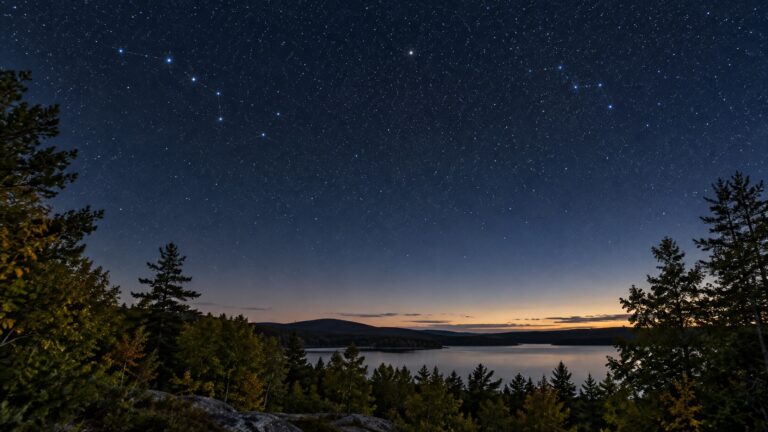
Star Gazing Season has begun
Autumn begins with a moment of balance. On the autumnal equinox, the Sun crosses the celestial equator and moves southward. Day and night are nearly equal in length across much of the world. In the Northern Hemisphere, this event marks the astronomical beginning of fall.
In 2026, the autumnal equinox occurs on September 23 at 12:05 a.m. UTC. In the continental United States, it happens on the evening of September 22. The exact local time depends on your time zone. In Chicago, for example, the equinox occurs at approximately 7:05 p.m. CDT on September 22.
The equinox is more than a date on the calendar. It marks a noticeable change in the rhythm of the year. Sunsets come earlier. Nights grow longer. Summer constellations begin their slow departure, while the stars of autumn take their place. For anyone who enjoys looking at the night sky, the weeks surrounding the equinox offer comfortable temperatures, familiar stars, bright planets, and some of the best opportunities of the year to spend time outdoors after dark.
What Happens During the Autumnal Equinox?
Earth travels around the Sun while tilted on its axis by about 23.4 degrees. This tilt causes our seasons. During one part of Earth’s orbit, the Northern Hemisphere leans toward the Sun and receives longer days and more direct sunlight. During another part, it leans away from the Sun and receives shorter days and less direct sunlight.
At the September equinox, Earth reaches a point in its orbit where neither hemisphere is tilted toward the Sun more than the other. The Sun appears directly above Earth’s equator. Both hemispheres receive nearly the same amount of daylight.
In the Northern Hemisphere, the September equinox begins autumn. In the Southern Hemisphere, the same event begins spring.
The word “equinox” comes from Latin words that mean “equal night.” The name is a helpful description, but day and night are not exactly equal everywhere. Earth’s atmosphere bends sunlight slightly, allowing us to see the Sun shortly before it has technically risen and shortly after it has technically set. Sunrise and sunset are also measured using the upper edge of the Sun rather than its center. These effects make the day a little longer than 12 hours in many locations.
The date when daylight and darkness are closest to exactly equal is sometimes called the equilux. It usually occurs a few days away from the equinox, and the date varies according to latitude.
Why the Days Become Shorter
After the autumnal equinox, the Northern Hemisphere begins tilting farther away from the Sun. The Sun follows a lower path across the sky each day. It rises farther south of east and sets farther south of west. Its light reaches the ground at a lower angle, so it provides less concentrated warmth.
The decrease in daylight is especially noticeable during the weeks immediately following the equinox. Evening seems to arrive earlier each day. Shadows grow longer, temperatures begin to fall, and the natural world prepares for winter.
This pattern continues until the winter solstice on December 21, 2026. The winter solstice brings the shortest period of daylight and the longest night of the year in the Northern Hemisphere. After that date, daylight slowly begins to increase again.
The equinox therefore represents a turning point. It is the beginning of a journey toward winter, but it is also the opening of the year’s longest stargazing season.
Look for the Sun Rising Due East
The equinox provides a simple way to become more familiar with your surroundings. Around this date, the Sun rises very close to due east and sets very close to due west.
If you have a clear view of the horizon, notice where the Sun appears in the morning or disappears in the evening. A building, tree, hill, or other landmark can serve as a reference point. Over the following weeks, you will see the sunrise and sunset positions move gradually southward.
Never look directly at the Sun without proper solar-viewing protection. Ordinary sunglasses are not safe for direct solar observation. You do not need to watch the Sun itself to notice its changing position. Simply observing the glow near the horizon or noting where it disappears behind a familiar landmark is enough.
The Stars of Late Summer Remain
The equinox does not cause the night sky to change suddenly. Instead, it marks a gradual transition between two groups of seasonal constellations.
During September evenings, the Summer Triangle remains easy to find. It is formed by three bright stars named Vega, Deneb, and Altair. Vega belongs to Lyra the Lyre. Deneb marks the tail of Cygnus the Swan. Altair is the brightest star in Aquila the Eagle.
From a dark location, the Milky Way passes through this part of the sky like a pale river of light. Cygnus appears to fly along it with its wings spread wide. This region contains rich star fields that can be explored with binoculars.
The Summer Triangle starts high in the evening sky around the equinox. As autumn advances, it moves steadily westward. It remains visible for months, but it appears lower and sets earlier each evening.
This gradual movement is caused by Earth’s orbit around the Sun. As Earth travels along its path, the nighttime side of the planet faces a slightly different part of space. The stars rise about four minutes earlier each night. Over several weeks, that small daily difference becomes easy to notice.
The Autumn Constellations Arrive
While the Summer Triangle moves west, the Great Square of Pegasus rises in the east. Four stars form a large tilted square that becomes one of the most recognizable patterns in the autumn sky.
Pegasus represents the winged horse of Greek mythology. Its Great Square can act as a guide to several neighboring constellations. Extending away from one corner is a curving line of stars belonging to Andromeda. Nearby are Cassiopeia, Perseus, Pisces, Aquarius, and Cetus.
Cassiopeia is especially helpful for beginners. Its five main stars form a distinctive W or M shape, depending on its position in the sky. It appears in the northeastern sky during autumn evenings and climbs higher as the season progresses.
Perseus rises below Cassiopeia. Between the two constellations lies the Double Cluster, a beautiful pair of star clusters that can be seen as a faint patch with the unaided eye under dark conditions. Binoculars reveal dozens of bright stars packed into two neighboring groups.
Find the Andromeda Galaxy
Autumn is the best season to look for the Andromeda Galaxy. It is the most distant object that most people can see without optical equipment.
Under a dark sky, the galaxy appears as a small, soft patch of light in the constellation Andromeda. That light has traveled for about 2.5 million years before reaching your eyes. When you see the Andromeda Galaxy, you are seeing it as it appeared long before modern humans existed.
The galaxy can be difficult to locate from a bright city. Binoculars make it much easier. Begin with the Great Square of Pegasus and follow the stars extending into Andromeda. A star chart or astronomy application can help you identify the correct area.
Do not expect the galaxy to look like a colorful photograph. To the unaided eye, it appears as a dim smudge. Through binoculars, its bright central region becomes clearer. The experience is impressive because you understand what that faint light represents.
Planets Around the 2026 Equinox
Several planets will add interest to the sky around the 2026 autumnal equinox.
Venus will be a brilliant evening object, but it will sit low in the western sky after sunset. Its evening appearance will be drawing to a close, so observers will need a clear western horizon. Venus will disappear into the Sun’s glare during October before returning to the predawn sky in November.
Mercury may also appear low in evening twilight. It is more difficult to see because it remains close to the horizon and never strays far from the Sun. Look for it only after the Sun has completely set.
Saturn will be one of the finest objects of the season. It reaches opposition on October 4, less than two weeks after the equinox. Opposition occurs when Earth passes between a planet and the Sun. Around this time, Saturn rises near sunset, remains visible through most of the night, and appears brighter than usual.
To the unaided eye, Saturn resembles a steady yellow-white star. A small telescope reveals its rings. The rings are opening gradually after appearing nearly edge-on from Earth in 2025, although they will still look relatively slender in 2026.
Neptune reaches opposition around September 25. It will be well placed for observation, but it is too faint to see without binoculars or a telescope. Even through a telescope, Neptune looks like a tiny blue-gray point or disk. A detailed chart is usually needed to distinguish it from surrounding stars.
Jupiter and Mars will be morning planets. Early risers can look for them before sunrise. Jupiter will be the brighter of the two and should be easy to recognize. Mars has a warmer orange or reddish color. Their positions will change noticeably during autumn, leading to a close meeting in November.
Uranus will be rising during the evening and becoming better placed as autumn continues. It reaches opposition in late November. It can sometimes be detected with binoculars under a very dark sky, although a telescope and a reliable finder chart make identification easier.
The Harvest Moon
The full moon closest to the autumnal equinox is traditionally called the Harvest Moon. In 2026, it falls on September 26, only a few days after the equinox.
The Harvest Moon is not a different type of moon. Its name comes from the season and from the way successive moonrises occur during this part of the year. Around the full moon nearest the equinox, the Moon rises only a little later on several consecutive evenings at many northern latitudes. Before electric lighting, the bright evening moonlight gave farmers more time to gather crops after sunset.
When the full moon rises, it may appear unusually large and golden near the horizon. The apparent size is largely caused by the moon illusion, which makes the Moon look larger when it is seen beside trees, buildings, or distant hills. Its warm color comes from the long path its light travels through Earth’s atmosphere.
The Moon usually becomes whiter as it climbs higher into the sky.
A Brief Cultural History of the Equinox
People have watched the changing position of the Sun for thousands of years. Seasonal turning points helped communities decide when to plant, harvest, travel, prepare food, or gather for ceremonies.
The autumnal equinox became closely connected with harvest traditions across many cultures. It represented gratitude for crops, preparation for colder weather, and recognition that the bright half of the year was giving way to the dark half.
In Japan, the September equinox is observed as Autumnal Equinox Day. It is a national holiday associated with seasonal change, family visits, and remembrance of ancestors.
Modern Pagan traditions often celebrate the autumn equinox as Mabon. These observances commonly focus on balance, thanksgiving, harvest, and preparation for winter. The name and many current customs are relatively modern, although they draw inspiration from older seasonal traditions.
Other autumn festivals occur near the equinox without being fixed to the astronomical event itself. Many use lunar or traditional calendars, so their dates change from year to year. The common theme is the close relationship between the sky, the harvest, and the passage of time.
Tips for Enjoying the Lengthening Nights
You do not need a telescope to enjoy the autumn sky. Begin with your eyes and a comfortable place to sit. Choose a location with an open view and as little artificial light as possible.
Allow at least 20 minutes for your eyes to adjust to darkness. Avoid looking at bright phone screens. If you need a light, use a dim red flashlight or place a red filter over an ordinary light.
Dress more warmly than you think you need to. Clear autumn nights can become chilly quickly, especially when you are sitting still. Bring layers, a blanket, and a warm drink.
Binoculars are often more useful for beginners than a telescope. They are easy to carry and provide a wide field of view. Binoculars can reveal the Andromeda Galaxy, the Double Cluster, rich Milky Way star fields, and many more stars than the unaided eye can detect.
Learn one or two sky patterns at a time. Start with the Summer Triangle, Cassiopeia, or the Great Square of Pegasus. Once you recognize a familiar shape, use it to find nearby stars and constellations.
Plan observations around the Moon. Bright moonlight can wash out faint stars and galaxies, but the Moon is itself a fascinating target. The best time to examine lunar craters is often near the first or last quarter, when shadows along the boundary between light and darkness make the surface appear more three-dimensional.
For meteor watching, telescopes and binoculars are unnecessary. Find a dark area, lie back, and watch as much of the sky as possible. Meteors can appear far from the constellation associated with their shower.
Most importantly, give yourself time. The night sky does not need to be rushed. Let your eyes adjust, notice the temperature, and watch how the stars move. A quiet hour outdoors can reveal much more than a hurried glance.
A Season of Balance and Change
The autumnal equinox lasts only a moment, but it announces an entire season of change. The Sun crosses the celestial equator. Daylight continues to decrease. The air grows cooler, leaves begin to turn, and the night sky opens earlier each evening.
Above us, the Summer Triangle gives way to Pegasus and Andromeda. Saturn reaches its best viewing period. Jupiter and Mars brighten the morning sky. The Harvest Moon rises near sunset, continuing a sight that people have watched for countless generations.
The equinox reminds us that balance in nature is temporary. Light and darkness reach near equality, then the nights continue to grow. That change is not something we need to resist. Longer nights bring more time to find constellations, follow the planets, watch the Moon, and become familiar with the universe beyond our daytime world.
Step outside after sunset. Look west for the last stars of summer, then turn east toward the constellations of autumn. The new season will be waiting in the sky.
Please be advised that, despite our best efforts, International Star Registry – Name a star provides astronomical content for entertainment purposes. We cannot guarantee the accuracy of all information given.