
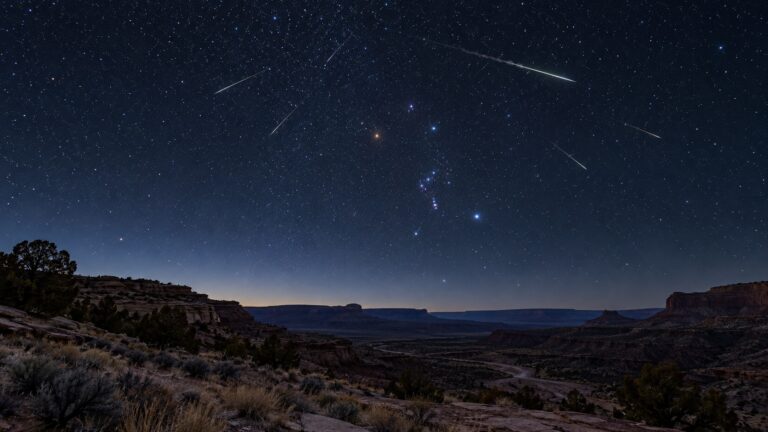
How to Watch the Orionid Meteor Shower in 2026
Every October, Earth passes through a stream of ancient debris left behind by Halley’s Comet. When those particles enter our atmosphere, they create the fast, bright meteors of the Orionid meteor shower.
The Orionids will be active from approximately October 2 through November 7 in 2026. The shower is expected to reach its broad peak between October 21 and October 23. Most observers should concentrate on the nights of October 21 and 22, especially during the hours after midnight.
The 2026 Moon will make viewing more difficult. A bright waxing gibbous Moon will illuminate the sky during the peak. It will hide many of the shower’s fainter meteors, but the Orionids are known for producing fast streaks and occasional glowing trails. The brightest meteors should remain visible.
Patience, careful timing, and a viewing location away from city lights will be important. The Orionids may not deliver their full potential in 2026, but they will still offer an opportunity to watch pieces of one of history’s most famous comets enter Earth’s atmosphere.
When Is the 2026 Orionid Meteor Shower?
The Orionids have a long period of activity. Meteors associated with the shower may appear from early October through the first week of November.
The strongest activity is expected around October 21 through October 23. Some calendars identify the night of October 21 into the morning of October 22 as the main peak. More precise models place a possible maximum during the early morning of October 23.
This difference does not mean that one forecast is necessarily wrong. The Orionids often have a broad peak rather than a short and sharply defined maximum. Activity can remain elevated for several nights.
For observers in the United States, the best plan is to watch during the early mornings of October 21, 22, and 23. If only one night is available, choose the clearest weather rather than worrying about a difference of a few hours in the predicted peak.
The shower is best after midnight and before dawn. Orion rises during the late evening and climbs higher as the night progresses. The higher the radiant rises, the more Orionid meteors become visible.
How the Moon Will Affect the 2026 Orionids
The Moon will be the greatest challenge for Orionid observers in 2026.
A bright waxing gibbous Moon will be present during the peak nights. It will be roughly three-quarters illuminated around October 21 and will grow brighter as it approaches the full moon on October 26.
Moonlight brightens the entire sky. This reduces the contrast between faint meteors and the background. Under ideal moonless conditions, the Orionids can produce about 15 to 20 meteors per hour. In 2026, most observers should expect to see fewer.
That does not mean the shower will be invisible. Bright Orionids can still cut through moonlight. The shower is also known for meteors that leave glowing trails for a few seconds after the original streak disappears.
You can reduce the Moon’s effect by placing a building, tree, hill, or other solid object between yourself and the Moon. Do not stand somewhere that blocks most of the sky. The goal is simply to keep direct moonlight out of your eyes.
Avoid looking toward the Moon. Face a darker part of the sky and allow your eyes time to adjust. Even with the Moon present, moving away from streetlights and illuminated buildings will improve your chances.
Where to Find Orion
The Orionids are named for the constellation Orion because their meteors appear to spread outward from a point in that part of the sky.
Orion is one of the easiest constellations to recognize. Look for three stars in a short, straight row. These stars form Orion’s Belt. Above the belt are two bright stars representing Orion’s shoulders. Betelgeuse is the orange-red star marking one shoulder, while Bellatrix marks the other.
Below the belt are Rigel and Saiph, which represent Orion’s feet or knees. Rigel is a brilliant blue-white star and one of the brightest stars in the night sky.
The Orionid radiant lies north of Betelgeuse, near the upper part of the constellation and close to Orion’s raised club. This is the direction from which the meteors appear to originate.
You do not need to locate the exact radiant to watch the shower. Orion simply provides a helpful reference point.
From the central United States, Orion begins rising in the east during the late evening in the second half of October. Around midnight, the constellation is clearly visible in the eastern or southeastern sky. It climbs higher before dawn.
Do Not Stare Directly at the Radiant
Although Orion contains the radiant, it is not always the best place to watch.
Meteors appearing close to the radiant have short trails because they are traveling almost directly toward the observer. This is an effect of perspective.
For longer and more impressive streaks, look about 45 to 90 degrees away from Orion. A broad view of the eastern sky and the area overhead is a good choice after midnight.
Meteors may appear anywhere in the sky. If you trace an Orionid’s path backward, it will seem to lead toward Orion. Meteors moving in other directions may be sporadic meteors or members of another active shower.
Relax your eyes and watch a large area rather than focusing on one star. Human peripheral vision is good at detecting sudden movement.
What Causes the Orionid Meteor Shower?
The Orionids occur when Earth crosses a stream of particles left by Halley’s Comet.
A comet is a mixture of ice, dust, rock, and frozen gases. As a comet approaches the Sun, heat causes some of its ice to turn directly into gas. This process releases dust and rocky particles from the comet’s surface.
Those particles continue traveling through space along or near the comet’s orbit. Over many passages around the Sun, they form a long and uneven stream of debris.
Earth passes through one section of Halley’s debris stream every October. The particles strike our atmosphere at tremendous speed. Their collisions with air molecules produce heat and glowing gases, creating the brief streaks of light we call meteors.
Most Orionid particles are tiny. Many are no larger than grains of sand. They normally disappear high in the atmosphere and do not reach the ground.
A meteor is the streak of light seen in the atmosphere. A meteoroid is the particle while it is still traveling through space. If a piece survives the atmosphere and reaches the ground, it is called a meteorite.
The Fast Meteors of October
Orionid meteors enter Earth’s atmosphere at about 41 miles per second. That is approximately 66 kilometers per second or 148,000 miles per hour.
They are among the fastest meteors produced by a major annual shower.
Their speed affects how they look. Orionids often flash quickly across the sky. Some leave luminous trails called trains that remain visible after the meteor itself has vanished.
These trains form when the meteor excites and ionizes gases in the upper atmosphere. A bright trail may glow for several seconds. Occasionally, winds high in the atmosphere twist the train into changing shapes before it fades.
Some Orionids may also fragment during their passage. A meteor can appear to flare, split, or produce several flashes along its path.
The Orionids look very different from the slower Draconids seen earlier in October. Draconid meteors enter the atmosphere at about 12 miles per second. Orionids travel more than three times faster.
One Comet Creates Two Meteor Showers
Halley’s Comet produces two annual meteor showers.
Earth crosses one part of the comet’s debris stream in May, creating the Eta Aquariids. It encounters another part in October, creating the Orionids.
The two showers appear to come from different constellations because Earth meets the debris from different directions during its orbit around the Sun.
The Eta Aquariids radiate from Aquarius and are especially impressive from the Southern Hemisphere. The Orionids radiate from Orion and are visible from both hemispheres.
This means that even when Halley’s Comet is far from Earth, its ancient debris continues to produce meteor displays twice each year.
The Long History of Halley’s Comet
Halley’s Comet is one of the most famous objects in astronomy. People observed it for centuries before they understood that its appearances belonged to the same returning comet.
Historical records of the comet extend back more than two thousand years. Ancient Chinese astronomers recorded its appearances with remarkable care. Other civilizations also treated bright comets as important and sometimes frightening signs.
One of Halley’s most famous appearances occurred in 1066. The comet was visible during the struggle for the English throne and was interpreted as an omen. It was later depicted in the Bayeux Tapestry, which tells the story of the Norman conquest of England.
In 1705, English astronomer Edmond Halley studied records of comets observed in 1531, 1607, and 1682. He concluded that these were not three different objects. They were repeated appearances of the same comet.
Halley predicted that the comet would return around 1758. He did not live long enough to see the result, but the comet returned as expected. Its successful prediction demonstrated that comets could follow calculable paths through the solar system.
The comet was later named in Halley’s honor.
Where Is Halley’s Comet Now?
Halley’s Comet last passed through the inner solar system in 1986. It is now traveling through the distant outer solar system.
The comet takes an average of about 76 years to orbit the Sun, although its exact orbital period changes because of the gravitational influence of the planets. It will return to the inner solar system in 2061.
Anyone who remembers the comet’s 1986 appearance may have another opportunity to see it in 2061. Younger observers may witness what will be one of the most anticipated astronomical events of the century.
We do not need to wait until then to encounter Halley. Every Orionid meteor is a tiny surviving piece of material released during one of the comet’s earlier journeys around the Sun.
Some of the particles producing today’s Orionids may have been traveling through the solar system for hundreds or even thousands of years.
Orion in Myth and Culture
Orion was one of the most prominent figures in Greek mythology. He was usually described as a powerful hunter.
Several versions of his story survive. In one, Orion boasted that he could defeat every animal on Earth. Gaia, the goddess of the Earth, sent a scorpion to stop him. Orion and the scorpion were later placed on opposite sides of the sky.
This celestial separation can still be observed. Orion dominates the winter sky, while Scorpius is prominent during summer. As Scorpius rises, Orion is setting. When Orion returns to the evening sky, Scorpius has largely disappeared.
Other cultures saw different figures in Orion’s stars. The three stars of Orion’s Belt have been recognized in stories, navigation traditions, calendars, and seasonal ceremonies around the world.
The Orionid meteor shower adds another layer to this cultural history. For several nights each October, swift meteors appear to fly from the region of the ancient hunter.
How Many Orionids Can You Expect to See?
Under ideal conditions, the Orionids can produce about 15 to 20 meteors per hour near the peak. Occasionally, activity rises above this level.
These numbers are not a promise of what one person will see. Published meteor rates usually assume a very dark sky, a clear horizon, a radiant high overhead, and continuous observation.
The bright Moon in 2026 will reduce the visible rate. City lights will reduce it further. An observer in a suburban area may see only a few Orionids during an hour.
A dark rural location will provide better results. Bright meteors and persistent trains may remain visible even when the Moon washes out the fainter members of the shower.
It is better to approach the 2026 Orionids with realistic expectations. The shower is worth watching, but it is unlikely to look like a continuous rain of meteors.
Choosing the Best Viewing Location
Find a location with a wide and unobstructed view of the sky. Open fields, rural parks, campgrounds, lakefront areas, and large clearings can work well.
Move as far as practical from city lights. Use a light-pollution map if you are unfamiliar with dark viewing areas near your home.
Check whether the location is open at night. Follow all posted rules and avoid entering private property without permission.
Choose a safe place away from traffic. Passing headlights can destroy night vision for several minutes.
The presence of the Moon makes careful site selection especially important in 2026. A darker location will not remove moonlight, but it will prevent artificial lighting from adding to the problem.
Tips for Watching the 2026 Orionids
Plan to begin observing after midnight. Orion will be higher then, and meteor activity should improve toward dawn.
Dress more warmly than the forecast might suggest. Clear October nights can become cold, especially when you are sitting still.
Bring a reclining lawn chair, sleeping bag, or thick blanket. Looking upward for a long period becomes uncomfortable if you have to stand.
Allow your eyes at least 20 to 30 minutes to adjust to darkness. Avoid checking a bright phone screen. Use a dim red flashlight if you need light.
Position yourself so the Moon is behind a tree, building, or other obstruction. Keep the rest of the sky as open as possible.
Watch continuously for at least an hour. Meteors do not arrive at regular intervals. Several may appear close together, followed by a long quiet period.
Do not use binoculars or a telescope while watching for meteors. These instruments show only a small section of sky. The unaided eye provides the widest field of view.
If clouds or poor weather interfere on the expected peak night, try again on another night. The Orionids remain active for weeks and do not depend on one brief maximum.
Photographing the Orionids
A camera with manual controls can capture Orionid meteors.
Mount the camera on a sturdy tripod and use a wide-angle lens. Point toward a dark portion of the sky about 45 to 90 degrees away from the radiant.
Focus manually on a bright star. Once the stars appear sharp, leave the focus unchanged.
Use exposures lasting several seconds and take photographs continuously with an interval timer. A meteor must cross the camera’s field of view while the shutter is open, so success often depends on taking many images.
The bright Moon may create glare or make the sky appear gray. Keep the Moon outside the frame and use a lens hood if possible.
Do not be discouraged if most frames contain only stars. Meteor photography requires patience and luck.
Other Sights in the October Sky
The late October sky offers plenty to see while you wait for Orionids.
Orion will be rising in the east with Betelgeuse, Bellatrix, Rigel, and the three stars of Orion’s Belt. Taurus will appear nearby with the orange star Aldebaran, the Hyades, and the Pleiades.
Gemini will rise later with the bright stars Castor and Pollux. Auriga and its brilliant star Capella will climb in the northeast.
Saturn will remain visible during the evening after reaching opposition earlier in October. Jupiter and Mars will rise later and become prominent before dawn.
The bright waxing gibbous Moon will interfere with faint stars and galaxies, but it can be an interesting object to examine through binoculars. Craters near the boundary between lunar day and night often show strong shadows.
Ancient Comet Dust in the Autumn Sky
The Orionids will not have ideal moonless conditions in 2026. The waxing gibbous Moon will hide many faint meteors during the shower’s broad peak between October 21 and October 23.
Still, the brightest Orionids may cut through the moonlight with swift streaks and glowing trails. A dark location, a wide view, and careful positioning away from the Moon can make a significant difference.
The real appeal of the Orionids reaches beyond the number of meteors counted in an hour. Each streak began as material released by Halley’s Comet, an object watched by generations of people across thousands of years.
Look toward the autumn sky after midnight. Find Orion rising in the east, place the bright Moon behind you, and wait.
A sudden streak may last only a second, but the particle creating it may have traveled through the solar system for centuries before ending its journey above Earth.
Please be advised that, despite our best efforts, International Star Registry – Name a star provides astronomical content for entertainment purposes. We cannot guarantee the accuracy of all information given.