
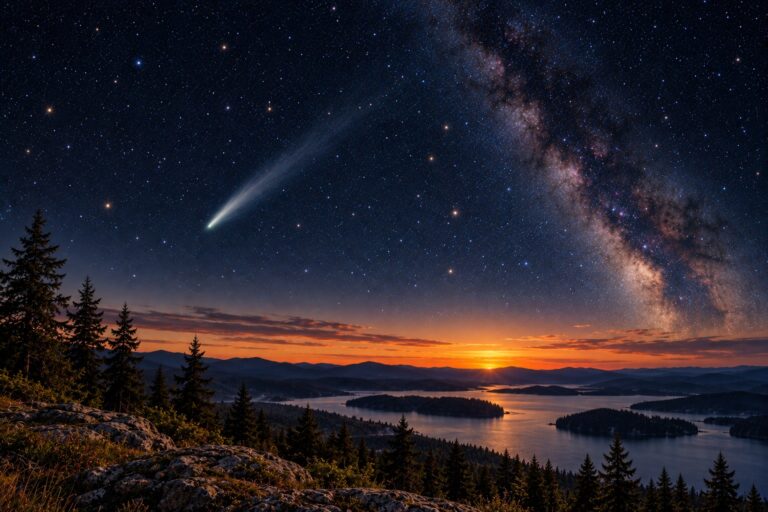
Two Comets and Three November Meteor Showers
November brings three meteor showers to the skies over North America. The Southern Taurids, Northern Taurids, and Leonids arrive within less than two weeks of one another, but they do not all look alike.
The two Taurid showers are slow, patient displays known for producing brilliant fireballs. The Leonids move much faster and have a history of erupting into astonishing meteor storms. Behind these three showers are two remarkable comet families and enormous trails of debris that have been circling the Sun for centuries.
The Southern Taurids are most closely associated with Comet Encke. The Northern Taurids belong to the same broad stream of material, although another body named 2004 TG10 may be an important immediate source. The Leonids come from Comet Tempel-Tuttle.
Together, these showers tell a much larger story about what happens when comets age, shed material, and occasionally break apart.
How a Comet Creates a Meteor Shower
A comet is a mixture of frozen gases, dust, rock, and ancient material left over from the formation of the solar system. When a comet approaches the Sun, its surface warms. Frozen substances turn into gas and release dust and small fragments into space.
These particles gradually spread along the comet’s orbit. Over time, they can form a broad stream of debris around the Sun.
When Earth passes through one of these streams, the particles enter our atmosphere at tremendous speeds. They heat the surrounding air and create glowing streaks that we call meteors. Most of the particles are quite small, but larger pieces can produce exceptionally bright meteors known as fireballs.
A meteor shower can appear every year even when its parent comet is far away. Earth is not necessarily meeting the comet itself. It is passing through material the comet left behind during earlier journeys around the Sun.
Comet Encke and the Taurid Family
The Southern and Northern Taurids are connected to one of the most interesting debris systems in the inner solar system.
Comet 2P/Encke is the best-known surviving member of this family. It has an orbital period of only about 3.3 years, the shortest of any well-known periodic comet. This means Encke returns to the region near the Sun far more frequently than famous comets such as Halley or Tempel-Tuttle.
French astronomer Pierre Méchain first observed the comet in 1786. It was seen again during later returns, but astronomers initially believed they were looking at different comets. German astronomer Johann Franz Encke calculated the orbit and showed that the sightings belonged to the same returning object.
The comet was named for Encke rather than its original discoverer. Its official designation, 2P/Encke, identifies it as the second comet recognized as periodic. Halley’s Comet was the first.
Encke’s nucleus is only about 3 miles wide, but the trail associated with it is immense. NASA’s Spitzer Space Telescope has photographed a broad band of debris following the comet’s orbit. Earth encounters portions of this material every year, producing the Taurid meteor showers.
Some astronomers think Encke may be one remnant of a much larger comet that began breaking apart thousands of years ago. If that is correct, the modern Taurid complex is not simply the trail of one small comet. It is an extended family containing dust, meteoroids, asteroids, and surviving comet fragments.
That complicated history helps explain why the Taurids are divided into several branches.
Why Are There Two Taurid Showers?
The Southern Taurids and Northern Taurids appear to come from slightly different areas of the sky near Taurus. These areas are called radiants.
The radiant is a matter of perspective. Taurid meteors can appear anywhere in the sky, but their paths seem to point backward toward Taurus. The two branches have radiants on different sides of the ecliptic, the apparent path followed by the Sun and planets across the sky.
The Southern Taurids are commonly identified with debris from Comet Encke. The Northern Taurids are part of the same broad Taurid complex, although research has also connected them with the asteroid-like object 2004 TG10. That object may itself be a fragment of the larger body that produced Encke and the rest of the Taurid family.
For casual observers, the important point is that the two showers overlap. During late October and November, Earth travels through several related streams of ancient debris. One meteor may trace back to the southern radiant while the next belongs to the northern branch.
The Southern Taurids in 2026
The Southern Taurids are active from September 20 through November 20, 2026. The shower has a long, broad period of activity rather than a brief and sharply defined maximum.
The American Meteor Society identifies two important parts of the 2026 display. The annual component reaches a maximum around October 14. A fireball-rich component peaks during the night of November 4 into the morning of November 5.
The November peak is especially appealing because the Moon will be a waning crescent and about 25 percent illuminated. Moonlight should cause only limited interference.
The Southern Taurids do not usually fill the sky with meteors. An observer may see only a few Taurids per hour, even from a dark location. What makes the shower special is the possibility of seeing a bright, slow-moving fireball.
Taurid particles enter the atmosphere more slowly than the material from many other major showers. Their visible paths can seem longer and more deliberate. A bright Taurid may cross a large section of the sky and leave a glowing trail behind it.
Some Taurid fireballs are so bright that they attract attention even from cities. They are sometimes called Halloween fireballs because the extended Taurid season overlaps the final nights of October.
The Northern Taurids in 2026
The Northern Taurids are active from October 20 through December 10, 2026. They are expected to peak during the night of November 11 into the morning of November 12.
Viewing conditions should be excellent. The Moon will be a very thin waxing crescent and only about 4 percent illuminated. It will provide little or no interference during the darker hours of the night.
Like their southern relatives, the Northern Taurids produce a modest number of meteors. This is not the type of shower that promises a meteor every minute. It rewards patience instead.
The radiant in Taurus rises during the evening and climbs higher as the night progresses. Viewing generally improves as Taurus rises higher, with late evening through the hours around midnight offering a useful window. Meteors can appear in any direction, so there is no need to stare directly at the constellation.
A bright Taurid is often worth the wait. The shower is known for larger particles capable of producing vivid flashes, long paths, and occasional bursts of color.
Comet Tempel-Tuttle and the Leonids
The Leonids come from a different comet and have a very different personality.
Comet 55P/Tempel-Tuttle travels around the Sun once every 33 years. Its nucleus is only about 2.24 miles across. Ernst Tempel discovered the comet in 1865, and Horace Tuttle independently found it in 1866. Their names were joined to identify the object.
Tempel-Tuttle last reached its closest point to the Sun in 1998. It is expected to return in 2031.
Each passage through the inner solar system allows the comet to release fresh material. The particles spread into trails, but they are not distributed evenly. Some sections are relatively thin. Others contain much denser concentrations.
Earth crosses the general Leonid stream every November. In an ordinary year, this produces a modest meteor shower. When Earth encounters one of the densest trails, however, the Leonids can become a meteor storm.
The Night the Stars Appeared to Fall
The Leonids produced one of the most famous meteor displays in recorded history on November 12 and 13, 1833.
Thousands of meteors seemed to pour across the sky. Witnesses described the stars as falling like snow or rain. The display was visible across much of North America and caused wonder, fear, prayer, and intense public discussion.
The 1833 storm also helped change the scientific understanding of meteors. Astronomers noticed that the streaks seemed to radiate from the same part of the sky in Leo. This suggested that the meteors were related and arriving along parallel paths rather than appearing randomly in Earth’s atmosphere.
Another extraordinary storm occurred in 1966. During the most intense part of that display, observers reported thousands of meteors per minute for a brief period. NASA describes a meteor storm as a display reaching at least 1,000 meteors per hour.
The Leonids also produced enhanced displays around the return of Tempel-Tuttle in the late 1990s and early 2000s. The last officially recognized Leonid meteor storm occurred in 2002.
The Leonids in 2026
The Leonids will be active from November 6 through November 30, 2026. The shower is expected to peak during the night of November 16 into the morning of November 17.
The radiant lies in Leo, which rises late in the evening and climbs higher during the hours before dawn. For viewers in North America, the best observing period will generally begin around midnight and continue until morning twilight.
The Moon will be a waxing crescent and about 39 percent illuminated on the peak night. It may hide some of the fainter meteors while it is above the horizon. Observing later at night, after the Moon is lower or has set for your location, should provide a darker sky.
The 2026 Leonids are not expected to become a meteor storm. NASA currently lists a low expected rate under dark skies. Still, the Leonids are among the fastest meteors seen from Earth. They strike the atmosphere at roughly 44 miles per second and can produce bright, colorful streaks, persistent trains, and long Earth-grazing meteors near the horizon.
You do not need to look directly at Leo. Meteors close to the radiant appear shorter because of perspective. Looking toward a broad, dark area of sky away from the radiant can reveal longer and more impressive trails.
How to Enjoy All Three Showers
No telescope or binoculars are needed to watch a meteor shower. In fact, optical equipment restricts your field of view and makes it easier to miss meteors elsewhere in the sky.
Choose the darkest safe location available with a wide view overhead. Allow at least 20 to 30 minutes for your eyes to adjust to the darkness. Avoid checking a bright phone screen, since even a quick look can reduce your night vision.
A reclining chair makes it easier to watch comfortably. November nights can become cold quickly, so bring warm layers, blankets, gloves, and a hot drink. Give each shower at least an hour if possible. Meteor activity is uneven, and several quiet minutes can be followed by a sudden bright streak.
For the Southern Taurids, watch on November 4 and 5 for slow fireballs beneath a waning crescent Moon. Return on November 11 and 12 for the Northern Taurids under an almost moonless sky. Then look again after midnight on November 16 and before dawn on November 17 for the swift Leonids.
Ancient Comets Still Writing Across Our Sky
Comet Encke and Comet Tempel-Tuttle may be small worlds, but their influence stretches across millions of miles and many generations of human history.
Encke and its extended family create the slow-burning spectacle of the Taurids. Tempel-Tuttle produces the swift Leonids and has occasionally turned an ordinary November night into a storm of falling light.
Every meteor is a tiny piece of that history. The glowing streak lasts only a moment, but the particle that created it may have traveled around the Sun for centuries before meeting Earth’s atmosphere.
This November, three meteor showers offer three opportunities to watch that ancient cometary story unfold above us.
Please be advised that, despite our best efforts, International Star Registry – Name a star provides astronomical and historical content for entertainment purposes. We cannot guarantee the accuracy of all information given.