
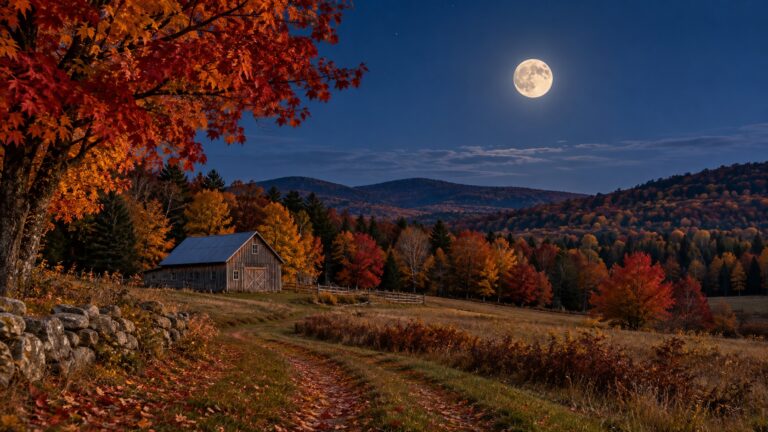
The Full Moon of October 26, 2026: The Hunter’s Moon and a Bright Autumn Sky
On October 26, 2026, the Moon reaches its full phase at approximately 05:11 UTC. At that precise moment, the Moon will be located opposite the Sun in Earth’s sky. Its near side will be fully illuminated by sunlight, creating the brilliant round Moon that has fascinated people throughout history.
For observers in the United States, one of the best opportunities to enjoy the October full Moon will be the evening of Sunday, October 25. The Moon will rise around sunset and remain visible throughout the night. In the Eastern Time Zone, exact full phase occurs shortly after midnight on October 26. Farther west, exact fullness occurs during the evening of October 25.
October’s full Moon is traditionally known as the Hunter’s Moon. The name is closely connected with the Harvest Moon that came before it. After crops had been gathered from the fields, autumn traditionally became a time to hunt and prepare food for the approaching winter.
The October Moon has also been given names that describe the changing natural world. Falling leaves, migrating birds, cooling temperatures, and the preparation of food for winter all appear in traditional names for this Moon.
The Hunter’s Moon arrives at one of the most atmospheric times of the year. Summer warmth is fading. Leaves are changing color. Nights are becoming longer. By the time Halloween arrives five nights later, the Moon will no longer be full, but it will still be bright enough to add some natural moonlight to the festivities.
The Astronomy Behind the October 2026 Full Moon
A full Moon occurs when the Sun and Moon appear on opposite sides of Earth. Astronomers call this configuration opposition.
The Sun always illuminates half of the Moon. During the full phase, almost all of that illuminated hemisphere faces Earth. This produces the familiar bright lunar disk.
The October 2026 full Moon reaches exact opposition at approximately 05:11 UTC on October 26. That corresponds to shortly after midnight in the eastern United States and the evening of October 25 farther west.
The Moon will look essentially full for observers throughout the night. You do not need to see it at the precise moment of opposition to enjoy the event.
As with other full Moons, the Hunter’s Moon rises around sunset. It travels across the sky during the night and sets around sunrise.
This relationship between sunset and moonrise is particularly important to the history of the Hunter’s Moon.
Why It Is Called the Hunter’s Moon
The Hunter’s Moon is traditionally the first full Moon after the Harvest Moon.
The Harvest Moon is the full Moon closest to the autumnal equinox. In 2026, the Harvest Moon occurs on September 26. The next full Moon, on October 26, therefore becomes the Hunter’s Moon.
The name reflects an important stage in the traditional seasonal calendar.
By October, crops had been harvested from many fields. Leaves were falling from trees. Vegetation was beginning to die back. These changes made animals easier to spot across the landscape.
Wild game had also spent the summer and early autumn feeding. Deer and other animals were preparing for winter.
For communities that depended on hunting, this was an important time to gather food and preserve meat for the colder months ahead.
The bright Moon offered another advantage. Moonlight arriving soon after sunset extended the amount of useful light available in the evening.
Long before electric lights, that extra illumination mattered.
The Hunter’s Moon and the Harvest Moon
The Harvest Moon and Hunter’s Moon form a natural pair.
The Harvest Moon helped illuminate the period when farmers were gathering crops. The Hunter’s Moon followed as people turned their attention toward hunting and preparing for winter.
There is also an astronomical reason these Moons became associated with evening light.
Normally, moonrise occurs noticeably later each successive night. Around the time of the autumn equinox, the angle of the Moon’s path relative to the eastern horizon changes this pattern for observers at northern latitudes.
The difference between one evening’s moonrise and the next can become smaller than usual.
This creates several evenings when a bright Moon appears relatively soon after sunset.
The effect is strongest around the Harvest Moon, but the Hunter’s Moon can display similar behavior.
It is a wonderful example of astronomy influencing culture. An unusual feature of the Moon’s orbit became useful to people on Earth, and that usefulness became part of the Moon’s traditional identity.
Other Traditional Names for the October Full Moon
The Hunter’s Moon is only one name associated with October.
Different Indigenous cultures developed lunar names based on the environments in which they lived. These names were not universal. Each community observed seasonal changes that were important to its own region and way of life.
The Falling Leaves Moon is associated with Anishinaabe tradition. It beautifully describes one of October’s most obvious transformations. Forests that were green throughout summer turn brilliant shades of yellow, orange, and red before the leaves fall.
The Freezing Moon is associated with Ojibwe tradition. It reflects the return of colder nights and the first freezes of the season.
The Ice Moon is associated with Haida tradition and similarly recognizes falling temperatures.
The Migrating Moon is a Cree name that reflects the movement of birds toward their wintering grounds.
The Dakota Drying Rice Moon refers to another important seasonal activity. Wild rice gathered during the harvest period needed to be processed and prepared for storage.
These names provide a fascinating record of seasonal observation. Instead of describing the Moon itself, they describe what was happening on Earth beneath it.
A Moon for the Heart of Autumn
The Hunter’s Moon arrives when autumn is well established across much of North America.
Daylight has decreased noticeably since summer. Nights are longer and cooler. Trees across northern regions may be approaching peak fall color or beginning to lose their leaves.
Wildlife behavior is changing as well. Migratory birds move south. Some mammals gather food. Others begin preparing for the colder months.
The October full Moon shines over this changing landscape.
A Moon rising behind orange and red trees can be one of the most beautiful sights of the entire lunar year.
Viewing the Hunter’s Moon Across North America
The Hunter’s Moon will be easy to observe throughout North America, weather permitting.
No telescope is required. Simply find a location with an unobstructed view toward the eastern horizon around sunset on October 25.
The Moon may initially appear yellow, orange, or even reddish. This does not mean the Hunter’s Moon has a special color.
When the Moon is close to the horizon, its light travels through more of Earth’s atmosphere. Shorter blue wavelengths are scattered more efficiently. Warmer yellow and orange colors become more prominent.
As the Moon climbs higher, it usually becomes paler and eventually appears white.
What to Expect in the Western United States
The western United States should provide beautiful opportunities to watch the Hunter’s Moon rise.
Mountain ranges, desert landscapes, and open valleys can create dramatic foregrounds. Dry air in many western regions can also produce sharp views.
Because exact full phase occurs during the evening of October 25 in the western United States, observers there will be able to see the Moon extremely close to its precise full phase.
Watching it rise while twilight is still visible can be particularly impressive.
What to Expect in the Midwest
The Midwest provides a setting that connects naturally with the history of the Hunter’s Moon.
By late October, many agricultural fields have already been harvested. Trees are changing rapidly, and fallen leaves cover forests and neighborhoods.
The Moon rising above an open field creates a scene that would have been familiar to generations of people who used moonlight during autumn.
Cooler temperatures also make the air feel noticeably different from summer observing nights. A clear October evening can produce wonderfully crisp views.
What to Expect on the East Coast
East Coast observers should look east around sunset on October 25.
Forests provide particularly colorful settings in regions where fall foliage remains. Coastal observers may also watch the Moon rise over the Atlantic.
Cities offer their own dramatic possibilities. A large orange Moon appearing behind buildings or bridges can create a memorable view.
Light pollution is not a concern for observing a full Moon. The Hunter’s Moon is bright enough to see easily from even heavily populated areas.
The Moon Illusion Makes Moonrise Special
The Hunter’s Moon may look enormous as it rises.
This is caused by the Moon illusion.
The Moon does not suddenly grow larger near the horizon. Instead, our brains interpret its size differently when we see it next to familiar objects such as houses, trees, hills, or distant buildings.
Once the Moon climbs higher and those reference points disappear, it seems smaller.
October provides some of the best opportunities to appreciate this effect because colorful trees and autumn landscapes create striking foregrounds.
The Autumn Constellations Around the Hunter’s Moon
October nights reveal a changing collection of constellations.
The Summer Triangle remains visible during the evening. Vega, Deneb, and Altair continue to shine brightly even though summer has ended.
Farther east, the constellations of autumn become increasingly prominent.
The Great Square of Pegasus is one of the easiest autumn patterns to recognize. Four bright stars create a large square that rises higher as evening progresses.
Nearby lies Andromeda. Under dark skies without bright moonlight, this region contains the famous Andromeda Galaxy. The full Hunter’s Moon will make the galaxy much harder to see, but the constellation’s brighter stars remain visible.
Cassiopeia also becomes prominent in the northeastern sky. Its familiar W shape makes it one of the easiest constellations for beginning stargazers to recognize.
Later in the night, the first great constellations of winter begin appearing.
Looking at the Moon’s Surface
The full Hunter’s Moon is a wonderful target for binoculars.
Dark regions called lunar maria can be seen easily. These broad plains formed billions of years ago when enormous impacts created basins that were later filled by ancient lava.
Mare Imbrium, Mare Serenitatis, and Mare Tranquillitatis are among the most recognizable.
Bright crater rays are also prominent around full Moon.
The crater Tycho has one of the most dramatic ray systems. Bright streaks of material extend enormous distances across the lunar surface.
Full Moon is not the ideal phase for studying crater depth because shadows are very short. Crescent and quarter phases provide stronger shadows along the lunar terminator.
Still, the full phase provides an unmatched view of the entire Earth-facing lunar hemisphere.
Photographing the Hunter’s Moon
October offers excellent opportunities for lunar photography.
The best time to begin is shortly before moonrise. Find an open eastern horizon and choose a foreground before the Moon appears.
Trees covered in autumn leaves make natural subjects. Barns, church steeples, lighthouses, mountains, and city skylines can also provide a sense of scale.
The Moon will appear warmer in color near the horizon. These colors gradually fade as it climbs.
A tripod can help produce sharper photographs. Smartphone users can improve results by keeping the phone steady and reducing exposure so the Moon does not become an overexposed white circle.
A Bright Sky for Halloween Fun
Halloween arrives on October 31, only five nights after the Hunter’s Moon.
The Moon will no longer be full. By Halloween night, it will be a waning gibbous Moon with roughly two-thirds of its visible surface still illuminated.
That means Halloween 2026 will not have the classic full Moon hanging above the neighborhood. It should still have plenty of moonlight once the Moon is up.
For trick-or-treaters, glowing pumpkins, spooky decorations, and anyone taking an evening walk, a bright waning Moon feels wonderfully appropriate.
It may not be quite the full Moon from an old monster movie, but it should be close enough to give Halloween night a little extra atmosphere.
Werewolves, fortunately, will have had their big night five days earlier.
The Hunter’s Moon and the Changing Seasons
October’s Moon tells a larger story about the movement of the seasons.
Only a month earlier, the Harvest Moon rose over fields during the beginning of autumn. Now the Hunter’s Moon appears as leaves fall and temperatures decline.
The sky changes along with the landscape.
Summer constellations slowly move west. Autumn constellations take their place. Before long, Orion and the brilliant stars of winter will return to the evening sky.
The Moon provides a familiar reference point through all of these changes.
People have watched this same cycle for thousands of years. They used it to measure time, plan harvests, follow migrations, hunt, travel, and prepare for winter.
Modern calendars have replaced many of those practical functions, but the celestial rhythm remains unchanged.
Conclusion
The Full Moon of October 26, 2026 reaches exact full phase at approximately 05:11 UTC. For much of the United States, the evening of October 25 provides an excellent opportunity to watch it rise.
Known as the Hunter’s Moon, it is traditionally the first full Moon after the Harvest Moon. Its name reflects a time when harvested fields made game easier to find and bright autumn moonlight helped extend useful evening hours.
Other traditional names tell different parts of October’s story. The Falling Leaves Moon celebrates the transformation of the forests. The Freezing Moon and Ice Moon recognize colder nights. The Migrating Moon marks the southward journey of birds. The Drying Rice Moon reflects the work of preparing food for winter.
Together, these names reveal something important about the way people once watched the sky. The Moon was not separated from life on Earth. It was part of the seasonal calendar.
The October 2026 Hunter’s Moon also arrives at a wonderful time for modern skywatchers. Autumn constellations are taking over the evening sky. Colorful landscapes provide beautiful settings for moonrise. Cooler nights make the changing season impossible to miss.
Then, only five nights later, Halloween arrives beneath a still-bright waning gibbous Moon.
So find a clear eastern horizon around sunset on October 25 and watch for the Hunter’s Moon to rise. It may emerge as a huge golden disk behind the autumn landscape before becoming bright and white as it climbs higher.
For generations, that light helped people prepare for the winter ahead. In 2026, it gives us something simpler but still worthwhile: a beautiful reason to spend an October evening looking up.
Please be advised that, despite our best efforts, International Star Registry – Name a star provides astronomical content for entertainment purposes. We cannot guarantee the accuracy of all information given.