
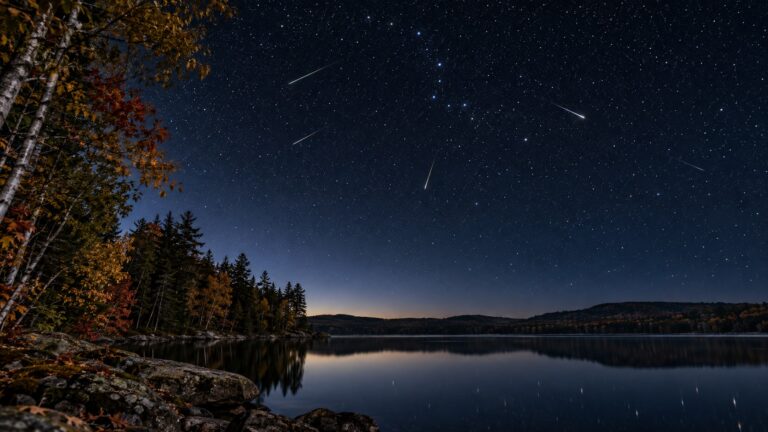
The Draconids Will Streak Across a Dark Sky in October 2026
The Draconid meteor shower returns to the Northern Hemisphere every October. 2026 promises to be a good year for viewing, thanks to dark skys resulting from the upcoming new moon. This is usually a quiet meteor shower, but it has a fascinating history of producing sudden and spectacular outbursts.
The shower is expected to be active from October 6 through October 10, with its strongest activity around the evening of October 8 and into October 9. Some astronomical calendars list October 9 as the official peak date. Since meteor shower predictions can vary by several hours, it is worth watching on both evenings if the weather is clear.
The Moon will provide excellent viewing conditions in 2026. A very thin waning crescent Moon will not rise until shortly before dawn. It will be absent during the evening, when the Draconids are best seen. This gives observers a dark, moonless sky during the most useful viewing hours.
The Draconids rarely compete with the year’s largest meteor showers. Most years, they produce only a handful of meteors per hour. However, this shower is unusually unpredictable. It has occasionally transformed from a modest display into a storm of meteors filling the sky.
That possibility, combined with the favorable Moon in 2026, makes the Draconids worth watching.
When Is the 2026 Draconid Meteor Shower?
The Draconids are active for only a few days each year. In 2026, their normal activity period runs from October 6 through October 10.
The best viewing is expected on the evenings of October 8 and October 9. You can begin looking as soon as the sky becomes fully dark. Unlike many meteor showers, there is no need to wait until after midnight.
A good viewing period will begin around 7:30 or 8:00 p.m. local time across much of the United States. Continue watching for at least an hour. Meteor activity can arrive in brief clusters, followed by quiet periods.
The exact peak may occur when it is daylight or when another part of the world is better positioned. That is common with meteor showers. Earth is moving through a trail of dust in space, and the densest portion of the trail may be narrow. Observing on two consecutive evenings improves your chances of seeing activity near the peak.
Why the Draconids Are an Evening Meteor Shower
Most meteor showers are best after midnight or before dawn. The Draconids are different.
The shower’s radiant is located in the constellation Draco. The radiant is the point in the sky from which the meteors appear to spread. During early October, Draco is already high in the northern sky when darkness falls across the Northern Hemisphere.
Because the radiant is well placed during the evening, viewers do not need to stay awake until the early morning hours. The period between nightfall and midnight is often the most convenient time to watch.
This makes the Draconids especially suitable for families, children, and anyone who would rather not plan a stargazing session at 3:00 a.m.
The Moon Will Cooperate in 2026
Moonlight is one of the most important factors affecting meteor visibility. A bright Moon can illuminate the sky and hide all but the brightest meteors.
The new moon occurs on October 10, 2026. During the expected Draconid peak, the Moon will be a very thin waning crescent. It will rise shortly before dawn and will not brighten the evening sky.
This creates nearly ideal lunar conditions. Faint meteors that might disappear in moonlight will have a better chance of being seen from a dark location.
The absence of moonlight does not guarantee a strong shower. Draconid activity depends on the density of the comet debris Earth encounters. However, a dark sky ensures that observers can see as much of the available activity as possible.
Cloud cover, artificial lighting, haze, and wildfire smoke can still affect visibility. Check the local weather before leaving home and look for a viewing location with the clearest possible sky.
What Causes the Draconid Meteor Shower?
The Draconids are created by debris from Comet 21P/Giacobini-Zinner.
Like other comets, 21P/Giacobini-Zinner is made of ice, dust, and rocky material. As it travels closer to the Sun, solar heat causes some of its ice to turn into gas. Dust and small particles are released and spread along the comet’s orbit.
Earth crosses this stream of debris each October. When the particles enter our atmosphere, they collide with air molecules and heat the surrounding gases. This creates the brief streaks of light that we call meteors.
Most meteor particles are extremely small. Many are no larger than grains of sand. The light comes from the hot, glowing air around the particle rather than from the particle simply catching fire.
The comet completes one orbit around the Sun about every 6.6 years. Its repeated visits replenish parts of the debris stream. However, the particles are not spread evenly. Some sections of the stream are much denser than others.
This uneven distribution explains why the Draconids can be quiet in one year and unexpectedly active in another.
Why Are They Called the Draconids?
The shower is named for Draco the Dragon, the constellation containing its radiant.
Draco is a long northern constellation that winds around Ursa Minor, the Little Bear. Its stars form a curving pattern between the Big Dipper and Little Dipper. The dragon’s head is marked by a small group of stars that includes Eltanin and Rastaban.
The name Draco comes from the Latin word for dragon. In Greek mythology, the constellation has been associated with several dragons. One story identifies it with Ladon, the dragon that guarded the golden apples in the garden of the Hesperides.
The meteors are not physically coming from Draco. The stars in the constellation are many light-years away, while the meteor particles enter Earth’s atmosphere only dozens of miles above the ground. The paths of the meteors appear to point backward toward Draco because Earth is moving into the debris stream at a particular angle.
The effect is similar to driving through falling snow. The snowflakes appear to spread outward from a point in front of the car, even though they are moving through the air all around it.
How to Find Draco
Face north or northwest after darkness falls. Find the Big Dipper and Little Dipper if they are visible from your location.
Draco winds between and around these two familiar star patterns. Its head is represented by four stars forming an uneven shape near Hercules. Eltanin is the brightest of these stars.
You do not need to identify every star in Draco before watching the shower. Meteors can appear anywhere in the sky. Knowing the location of the radiant simply helps confirm whether a meteor belongs to the Draconid shower.
If you trace a meteor’s path backward and it seems to lead toward Draco, it may be a Draconid. A meteor moving in a completely different direction is more likely to be a sporadic meteor or a member of another active shower.
An astronomy application can help you locate Draco. Use a dim red screen setting so the phone does not interfere with your night vision.
Where Should You Look?
Do not stare directly at the radiant. Meteors close to the radiant tend to have shorter visible paths because they are moving almost directly toward the observer.
Instead, look about 30 to 45 degrees away from Draco. This is roughly the distance covered by three or four outstretched fists held at arm’s length.
A broad view of the northern and overhead sky is a good choice. You may also see meteors in the east, west, or south. The most important factor is having as much open sky as possible.
Avoid locations where buildings, trees, or hills block large portions of the sky. A park, field, rural driveway, lakefront, or open campground can work well.
You do not need to keep your eyes fixed on one exact point. Relax and let your gaze move across a wide section of sky. Human peripheral vision is often good at detecting sudden movement.
How Many Meteors Will You See?
During an ordinary year, the Draconids may produce about five to ten meteors per hour under excellent conditions. Some observers may see fewer.
Hourly meteor rates are estimates based on ideal circumstances. They assume a dark sky, a clear horizon, a radiant high overhead, and an experienced observer who watches continuously. Light pollution, clouds, trees, and looking away at the wrong moment can reduce the number seen.
The 2026 shower is not currently expected to produce a major meteor storm. It is best to approach it as a quiet autumn observing experience rather than expecting a sky filled with shooting stars.
Still, the Draconids have surprised observers before. Their history is the reason astronomers continue to monitor them carefully.
A Meteor Shower with a Dramatic History
The parent comet was discovered by French astronomer Michel Giacobini in 1900. German astronomer Ernst Zinner found it again in 1913 while observing variable stars. Astronomers determined that both men had seen the same returning comet, so it became known as Comet Giacobini-Zinner.
Because of the comet’s name, the meteor shower was historically called the Giacobinids. The name Draconids later became more common because the radiant lies in Draco.
For many years, the shower seemed relatively unimportant. Then, in 1933, observers in Europe witnessed an extraordinary meteor storm. Meteors appeared so rapidly that some observers could hardly count them. Scientific estimates suggest that the theoretical rate reached thousands of meteors per hour.
Another great Draconid storm occurred in 1946. Once again, the sky produced an intense rush of meteors associated with dense material from Comet Giacobini-Zinner.
A significant outburst occurred in 2011 when Earth crossed older trails of dust released by the comet. Corrected rates reached roughly 400 meteors per hour during several activity peaks. Bright moonlight made the display less impressive for many casual observers, but scientific cameras and radio equipment recorded the event.
These outbursts showed that a quiet meteor shower could suddenly become one of the most active displays of its time. They also helped astronomers improve methods for predicting how Earth interacts with separate trails of comet dust.
The Slow Meteors of the Dragon
Draconid meteors enter Earth’s atmosphere at approximately 45,000 miles per hour. That sounds extremely fast, but it is slow compared with meteors from many other showers.
Orionid meteors can enter the atmosphere at speeds near 148,000 miles per hour. Leonid meteors are also exceptionally fast. Draconids move at a much gentler relative speed of about 12 miles per second.
Their slower speed can make them appear to drift more deliberately across the sky. Some leave visible trails that last briefly after the meteor disappears.
Not every Draconid will be bright. Many are faint, which is another reason the dark, moonless conditions of 2026 are valuable.
Tips for Watching the 2026 Draconids
Choose a dark location away from streetlights, illuminated signs, parking lots, and passing headlights. Even modest light pollution can hide faint meteors.
Arrive before the expected viewing period so you can choose a safe place and become familiar with the surroundings. Bring a reclining lawn chair, blanket, or sleeping bag. Looking upward for a long time becomes uncomfortable if you have to stand or bend your neck.
Dress for colder weather than the daytime forecast might suggest. October temperatures can fall quickly after sunset. Wear layers and bring gloves, a hat, and a warm drink if needed.
Allow your eyes at least 20 to 30 minutes to adjust to darkness. Avoid white flashlights and bright phone screens. Use a dim red flashlight if you need light.
Watch continuously for at least an hour. A five-minute glance may occur during a quiet interval and give the false impression that nothing is happening.
Binoculars and telescopes are not useful for meteor watching. They show only a narrow section of the sky, while meteors can appear anywhere. The unaided eye provides the widest possible view.
Be patient. A modest shower can still produce a memorable meteor, especially when the autumn sky is dark and clear.
Photographing the Draconids
A camera with manual controls can capture meteors, although success requires patience.
Mount the camera on a stable tripod and use a wide-angle lens. Point toward a large, dark area of sky about 30 to 45 degrees away from Draco. Set the focus manually on a bright star or distant light, then leave the focus unchanged.
Use exposures lasting several seconds and take photographs continuously. A remote shutter release or interval timer can prevent camera movement.
Meteor photography involves luck. A meteor must cross the camera’s field of view while the shutter is open. Taking many exposures increases the chance of capturing one.
Avoid increasing the exposure so much that the sky becomes gray or washed out. A darker background will make any meteor trail easier to see.
Other Sights in the October Sky
Even if the Draconids remain quiet, the October sky offers plenty to see.
Saturn will be especially prominent after reaching opposition on October 4. It will rise near sunset and remain visible throughout the night. Look for its steady, pale golden light in Pisces.
The Great Square of Pegasus will be climbing in the eastern sky. Cassiopeia will be easy to recognize by its W-shaped pattern in the northeast. The Summer Triangle will still be visible in the west, while the constellations of autumn take over the east.
Under dark conditions, the Andromeda Galaxy may appear as a faint patch of light. Binoculars will make it easier to find, although they should be set aside when actively watching for meteors.
The lack of evening moonlight will improve all of these views.
An Easy Autumn Meteor Shower to Enjoy
The Draconids may not be the most dependable meteor shower of the year, but they are among the most convenient. They arrive during the cool evenings of early autumn, and they can be watched before midnight.
In 2026, the timing of the Moon makes the opportunity especially appealing. The thin waning crescent will remain below the horizon during the evening, leaving the sky dark for the shower’s expected peak around October 8 and 9.
Most viewers should expect a peaceful night with occasional meteors rather than a great storm. Yet the Draconids have a history of ignoring ordinary expectations. The storms of 1933 and 1946 and the outburst of 2011 remain reminders that a faint trail of comet dust can sometimes create an unforgettable display.
Find a dark place, face the northern sky, and give yourself time to watch. Whether you see one meteor or many, each streak will be a tiny piece of Comet Giacobini-Zinner completing its journey in Earth’s atmosphere.
Please be advised that, despite our best efforts, International Star Registry – Name a star provides astronomical content for entertainment purposes. We cannot guarantee the accuracy of all information given.