
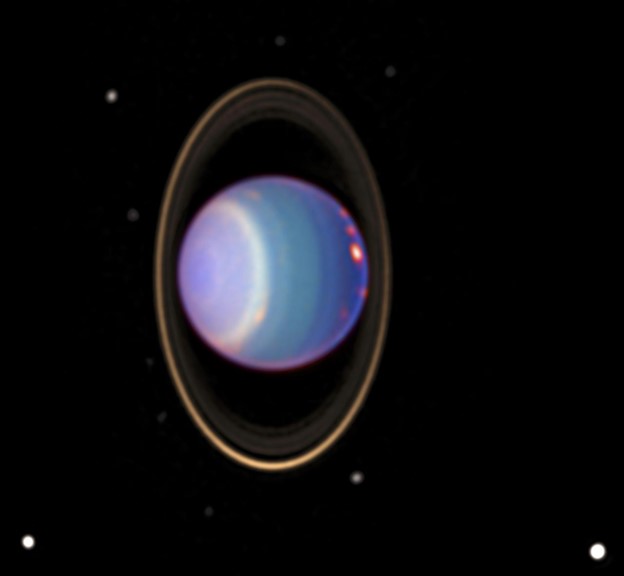
Among the planets of our solar system, Uranus stands apart in many ways. It is distant, cold, and somewhat mysterious compared to the brighter planets that have been known since ancient times. When astronomers first realized that Uranus was a planet, it expanded humanity’s understanding of the solar system. It was the first planet discovered with a telescope rather than by ancient sky watchers.
Uranus is a fascinating world. It is enormous, yet it appears faint in our sky. Its pale blue color hints at an atmosphere filled with icy gases and distant sunlight. One of the most remarkable features of Uranus is its unusual tilt. The planet appears to rotate almost on its side as it travels around the Sun. This strange orientation creates seasons unlike anything seen on other planets.
Although Uranus was not known as a planet in ancient times, its name comes from very old mythology. The name refers to Uranus, the ancient Greek god of the sky. In myth, Uranus was the father of the Titans and the personification of the heavens themselves. The connection between the distant planet and the ancient sky deity creates a poetic link between science and myth.
Today Uranus remains one of the most intriguing planets in the solar system. Scientists continue to study its atmosphere, rings, and moons. Sky watchers can also find it with careful observation. Even though it is far away, Uranus still reminds us that the universe is full of surprising discoveries.
Uranus in the Solar System
Uranus is the seventh planet from the Sun. It orbits at an average distance of about 1.8 billion miles from our star. Because of this great distance, sunlight reaching Uranus is much weaker than the sunlight we experience on Earth.
A year on Uranus lasts about 84 Earth years. This means the planet moves very slowly through the constellations from our perspective. Ancient observers occasionally saw Uranus, but it appeared so faint that they believed it was simply another star.
Uranus is one of the four giant outer planets. It belongs to a category known as ice giants. Unlike Jupiter and Saturn, which are mostly made of hydrogen and helium, Uranus contains larger amounts of icy materials such as water, methane, and ammonia.
The diameter of Uranus measures about 31,500 miles. This makes it the third largest planet in the solar system after Jupiter and Saturn. Despite its large size, Uranus has a lower density than Earth because it is made mostly of gases and icy compounds.
The planet’s interior likely contains a small rocky core surrounded by a deep mantle of icy materials. Above this layer lies the thick atmosphere that we see when observing the planet.
The Unique Tilt of Uranus
One of the most remarkable features of Uranus is its extreme tilt. Most planets rotate with their poles pointing roughly upward relative to their orbital path. Uranus is different.
The planet is tilted at an angle of about 98 degrees. This means it rotates almost completely on its side. Imagine a spinning top lying nearly flat on a table. That is somewhat similar to the way Uranus spins as it travels around the Sun.
Scientists believe this unusual tilt may have been caused by a massive collision long ago. Early in the solar system’s history, a large planetary object may have struck Uranus and knocked it sideways.
Because of this tilt, the seasons on Uranus are extreme. Each pole experiences about 42 years of continuous sunlight followed by 42 years of darkness. When one pole faces the Sun, the opposite pole remains in shadow for decades.
These unusual seasons make Uranus one of the most unique planets in the solar system.
The Pale Blue Atmosphere
Uranus appears as a soft blue green world when viewed through a telescope. This color comes from methane gas in the planet’s atmosphere. Methane absorbs red wavelengths of sunlight and reflects blue light back into space.
The atmosphere of Uranus is composed mainly of hydrogen and helium with smaller amounts of methane. The methane creates the distinctive color that makes Uranus recognizable among the planets.
Temperatures on Uranus are extremely cold. The upper atmosphere can reach temperatures around minus 350 degrees Fahrenheit. Because of this intense cold, Uranus is sometimes considered the coldest planet in the solar system.
Despite its calm appearance, Uranus experiences strong winds. Some winds in the upper atmosphere can reach speeds of more than 500 miles per hour. These winds shape faint cloud patterns that occasionally become visible through powerful telescopes.
For many years Uranus appeared relatively featureless compared to the dramatic storms seen on Jupiter and Saturn. However more recent observations have revealed that the planet does experience seasonal storms and atmospheric changes.
The Rings of Uranus
Many people know that Saturn has rings, but fewer realize that Uranus also possesses a ring system. Uranus has a set of narrow, dark rings that circle the planet’s equator.
These rings were discovered in 1977 when astronomers observed a star passing behind Uranus. As the star’s light flickered, scientists realized that rings of material were blocking the light.
The rings of Uranus are very different from the bright icy rings of Saturn. They are darker and composed of rock and dust particles. These particles may be the remains of shattered moons or debris left over from earlier collisions.
The rings form thin bands that orbit close to the planet. Several small moons help maintain the structure of these rings through gravitational interactions.
Although the rings are difficult to see from Earth, spacecraft observations have revealed their delicate structure.
The Moons of Uranus
Uranus has a fascinating system of moons. More than 25 moons are known to orbit the planet. Many of them were discovered by astronomers using powerful telescopes.
The largest moons include Titania, Oberon, Umbriel, Ariel, and Miranda. These moons have icy surfaces and display a variety of geological features.
Miranda is especially interesting because of its unusual terrain. The moon shows deep canyons, steep cliffs, and patchwork regions of different landscapes. Scientists believe Miranda may have experienced dramatic internal activity in the past.
Titania and Oberon are the largest moons of Uranus. They contain large impact craters and signs of ancient geological changes.
One charming detail about the moons of Uranus is their names. Instead of being named after mythological figures from Greek or Roman mythology, most Uranian moons are named after characters from the works of William Shakespeare and Alexander Pope.
For example Titania and Oberon are characters from Shakespeare’s play A Midsummer Night’s Dream.
The Discovery of Uranus
Unlike the planets known since ancient times, Uranus was discovered during the age of telescopes. The discovery occurred in 1781 when the British astronomer William Herschel observed an unusual object moving slowly among the stars.
At first Herschel believed the object might be a comet. However further observations revealed that it followed a nearly circular orbit around the Sun. This meant it was actually a new planet.
The discovery of Uranus expanded the known boundaries of the solar system. Until that time Saturn had been considered the outermost planet.
The naming of the new planet sparked some debate. Herschel originally suggested naming it after King George the Third of England. Eventually astronomers adopted the name Uranus, following the tradition of naming planets after mythological figures.
The Mythological Sky Father
The name Uranus comes from ancient Greek mythology. Uranus was the primordial god who represented the sky itself. According to myth, he was one of the earliest beings in the universe.
Uranus was said to be the father of the Titans, including Kronos, who later became known as Saturn in Roman mythology. In this way the mythological family tree mirrors the order of the planets in the solar system.
In myth, Uranus ruled the heavens until he was overthrown by his son Kronos. This dramatic story reflected ancient ideas about cosmic cycles and the passage of power between generations of gods.
The name Uranus therefore connects the distant planet with the ancient concept of the sky as a divine force. It also maintains the tradition of linking planetary names with mythological figures.
Uranus in Astrology
In astrology Uranus represents change, innovation, and sudden breakthroughs. Astrologers associate the planet with originality and unconventional thinking.
Uranus was incorporated into astrological systems after its discovery in the eighteenth century. Because it represented a newly discovered world, astrologers linked it with new ideas and revolutionary change.
The planet is associated with the zodiac sign Aquarius in modern astrology. Aquarius is often connected with creativity, independence, and social progress.
Astrologers believe Uranus encourages people to break away from tradition and explore new possibilities. Its influence is often described as surprising or unpredictable.
Although astrology is symbolic rather than scientific, Uranus has become an important part of astrological interpretation.
Observing Uranus from Earth
Uranus is much farther away than the planets that ancient observers easily recognized. Because of this distance, the planet appears quite faint in the night sky.
Under very dark skies and excellent conditions, Uranus can sometimes be seen with the naked eye. However it usually appears as a dim point of light that is difficult to distinguish from nearby stars.
Most observers use binoculars or a small telescope to locate Uranus. Through a telescope the planet appears as a tiny blue green disk.
Unlike the brighter planets, Uranus does not show dramatic surface details when viewed from Earth. However its distinctive color and slow movement among the stars make it an interesting target for observers.
Uranus reaches its best visibility during opposition. At this time the planet lies opposite the Sun in Earth’s sky and is visible throughout the night.
Because Uranus moves slowly across the sky, it remains in the same region of the zodiac for several years.
A Planet of Discovery and Curiosity
Uranus represents an important chapter in the story of astronomy. Its discovery proved that the solar system was larger than previously imagined. Later discoveries of Neptune and Pluto continued this expansion of knowledge.
Although spacecraft have visited Jupiter and Saturn many times, only one spacecraft has ever visited Uranus. NASA’s Voyager 2 spacecraft flew past the planet in 1986. During this flyby it captured the first close images of Uranus and its moons.
Voyager 2 revealed new details about the planet’s rings, atmosphere, and magnetic field. It also discovered several new moons.
Since that historic flyby, scientists have continued studying Uranus using powerful telescopes and space based instruments. Many researchers hope future missions will return to explore the planet in greater detail.
The Quiet Blue World
Uranus may not be as bright as Venus or as dramatic as Jupiter, but it holds a quiet beauty of its own. Its pale blue color reflects the distant sunlight that reaches its cold atmosphere. Its sideways rotation and unique seasons make it unlike any other planet.
The planet also reminds us that discovery often happens when we look closely at the familiar. Uranus had been visible in the sky for centuries before astronomers realized it was a planet.
By connecting the distant ice giant with the ancient sky god Uranus, astronomers created a poetic link between mythology and science. The name reflects humanity’s long tradition of looking up and wondering about the heavens.
When you search the night sky and locate the faint blue point of Uranus, you are seeing a world that expanded the boundaries of our solar system. It is a reminder that the universe still holds many mysteries waiting to be discovered.
Please be advised that, despite our best efforts, International Star Registry – Name a star provides astronomical content for entertainment purposes. We cannot guarantee the accuracy of all information given.