
Pluto, Distant World of Imagination and Discovery
At the far edge of our solar system lies a small and distant world that has fascinated scientists and sky watchers for nearly a century. Pluto is tiny compared to the giant planets, yet its story has captured the imagination of generations. It was once celebrated as the ninth planet of our solar system. Later it was reclassified as a dwarf planet after astronomers learned more about the distant region of space where it resides. Despite this change, Pluto remains one of the most beloved objects in the solar system.
Pluto is a world of extremes. It travels on a long and tilted path around the Sun and takes nearly two and a half centuries to complete one orbit. Its surface is covered with frozen nitrogen, methane, and frozen water. Beneath those frozen plains may lie a hidden ocean. Even though it is far from the Sun, Pluto shows signs of surprising geological activity.
The story of Pluto is also a story about how science and cultural forces evolve. When the planet was discovered in 1930, it expanded the known boundaries of the solar system. This excitement was expanded further when Walt Disney adopted the name Pluto for Mickey Mouse’s dog in 1931. Disney’s Pluto character soon became well known and beloved in his own right. For decades schoolchildren learned about nine planets and developed a special affection for little Pluto. Later discoveries in the outer solar system, including the discovery of a 10th planet, 2003 UB313 which became the dwarf planet Eris, forced scientists to rethink what defines a planet and the redesignation remains controversial. The Pluto controversary became the center of a debate that reshaped astronomy.
Pluto’s name also connects it to ancient mythology. The dwarf planet carries the name of the Roman god of the underworld. In myth, Pluto ruled a dark and distant realm beneath the Earth. In a poetic way, the icy world that bears his name also exists in a remote and shadowy region of the solar system.
Today Pluto stands as a symbol of discovery, affection, controversy, and curiosity. Its story reminds us that the universe is always revealing new surprises.
Pluto’s Place in the Solar System
Pluto orbits the Sun far beyond the giant planets. It lies within a vast region of icy objects known as the Kuiper Belt. This distant belt begins just beyond the orbit of Neptune and stretches billions of miles into space.
The Kuiper Belt contains countless icy bodies left over from the formation of the solar system. Many of these objects are similar to Pluto in size and composition. Some are even larger than Pluto. The discovery of these objects eventually led astronomers to reconsider Pluto’s status as a planet.
Pluto travels around the Sun at an average distance of about 3.7 billion miles. Because of this immense distance, sunlight reaching Pluto is very faint. At noon on Pluto, the Sun would appear no brighter than a bright star seen from Earth.
One orbit around the Sun takes about 248 Earth years. Pluto was discovered in 1930, and it will not complete its first full orbit since that discovery until the year 2178.
Pluto’s orbit is also unusual. Unlike the nearly circular paths of many planets, Pluto follows an elliptical orbit that brings it closer to the Sun at some times and much farther away at others. The orbit is also tilted at a steep angle compared to the paths of the other planets.
At certain points in its orbit Pluto actually travels closer to the Sun than Neptune. This happened from 1979 until 1999. However the two worlds never collide because their orbits are carefully aligned by gravitational interactions.
A Small but Complex World
Pluto is much smaller than the eight major planets. Its diameter measures about 1,477 miles. This makes it smaller than Earth’s Moon.
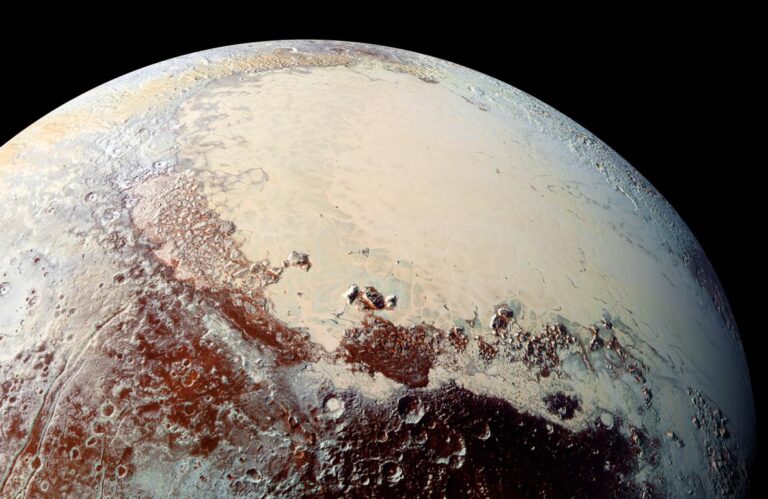
Despite its small size, Pluto is a surprisingly complex world. Photographs from NASA’s New Horizons spacecraft show its surface contains mountains, glaciers, and plains of frozen ice. Scientists once expected Pluto to be a quiet and frozen relic of the early solar system. Instead spacecraft observations revealed a landscape shaped by active geological processes.
The surface temperature on Pluto averages around -375 degrees Fahrenheit. At these extremely cold temperatures water ice behaves like rock, while nitrogen and methane form soft glacial flows.
One of the most famous features on Pluto is a vast heart shaped region known as Tombaugh Regio. This bright region includes a large plain called Sputnik Planitia. The plain is made mostly of frozen nitrogen ice.
Sputnik Planitia appears smooth and relatively young compared to the surrounding terrain. Scientists believe convection within the ice may slowly reshape this region over time. This means Pluto’s surface may still be changing even today.
Pluto also contains mountains made of water ice that rise several miles high. Some of these mountains may have formed through internal geological activity similar to volcanism.
Pluto’s Thin Atmosphere
Although Pluto is extremely cold, it does possess a thin atmosphere. This atmosphere forms when sunlight warms the surface ice and causes some of it to evaporate into gas.
The atmosphere is composed mainly of nitrogen with traces of methane and carbon monoxide. Because Pluto’s gravity is weak, the atmosphere is very thin compared to Earth’s.
As Pluto moves farther from the Sun during its long orbit, the atmosphere may freeze and fall back onto the surface as frost. When the planet moves closer to the Sun again, the atmosphere can reappear.
This cycle of freezing and evaporation creates a dynamic environment even on such a distant world.
The Moons of Pluto
Pluto is not alone in its distant orbit. It has a fascinating system of moons that travel alongside it.
The largest moon is Charon. Charon is about half the size of Pluto itself, making it unusually large compared with its parent body. Because of this size relationship, Pluto and Charon are sometimes described as a double dwarf planet system.
The two worlds orbit a common center of gravity located in the space between them. As a result they always show the same face toward each other.
Charon’s surface is covered with water ice and deep canyons. One large canyon system stretches more than a thousand miles across the moon.
Pluto also has four smaller moons named Nix, Hydra, Kerberos, and Styx. These moons are irregularly shaped and much smaller than Charon.
Together these five moons form a miniature planetary system at the edge of the solar system.
The Discovery of Pluto
The discovery of Pluto began with a search for an unknown world sometimes called Planet X. Astronomers believed that irregularities in the orbit of Uranus suggested the presence of another distant planet.
The American astronomer Percival Lowell began searching for this mysterious object in the early twentieth century. Although Lowell died before the planet was found, his observatory continued the search.
In 1930 a young astronomer named Clyde Tombaugh made a remarkable discovery at Lowell Observatory in Arizona. Tombaugh carefully compared photographic plates of the night sky taken on different nights.
By examining these images with a device called a blink comparator, he noticed a faint object that had shifted position relative to the background stars. This movement revealed that the object was not a star but a previously unknown world.
The discovery was announced in March 1930 and quickly captured public attention around the world.
The Naming of Pluto
The new planet needed a name that fit the tradition of mythological figures. The name Pluto was suggested by an eleven year old girl from England named Venetia Burney.
She proposed the name after the Roman god of the underworld. The suggestion quickly gained support among astronomers.
The name Pluto seemed appropriate for several reasons. The distant world existed in a dark and remote region of the solar system. In mythology Pluto ruled a shadowy realm beneath the Earth.
The name also honored Percival Lowell who did not live to see his dream of finding Planet X become a reality. The first two letters of Pluto form the initials P and L, which match Lowell’s initials.
The name was officially adopted in 1930, and Pluto became known as the ninth planet.
Public Excitement About the Ninth Planet
The discovery of Pluto sparked enormous excitement. Newspapers around the world reported the news, and the new planet quickly became part of popular culture.
For decades students learned about nine planets in the solar system. Pluto’s distant orbit and mysterious nature made it a fascinating subject for both scientists and the public. Pluto’s further association among children with the Disney character also created an emotional attachment to the small, newly discovered planet.
Although telescopes revealed only a faint point of light, astronomers continued studying Pluto in hopes of learning more about its nature.
The Planet Versus Dwarf Planet Debate
During the late twentieth century astronomers began discovering many new objects beyond Neptune. These discoveries showed that Pluto was not alone in the outer solar system.
Several of these objects were similar in size to Pluto. One of them, a tenth planet called Eris (2003 UB313), was even slightly larger.
These discoveries raised an important question. If Pluto was considered a planet, should these other objects also be called planets?
To resolve this issue, a group of astronomers called the International Astronomical Union decided upon a formal definition of a planet in 2006. According to this definition, a planet must meet three criteria.
It must orbit the Sun. It must have enough gravity to form a nearly round shape. It must also clear its orbital region of other objects.
Pluto meets the first two conditions but not the third. Because it shares its orbital region with many other Kuiper Belt objects, it was reclassified as a dwarf planet.
The decision sparked intense debate among many other scientists and the public. Many people still feel a strong emotional connection to Pluto as the ninth planet. The change in semantics, removing the planetary status of Pluto, still feels unfortunate and unnecessary to many.
Regardless of its classification, Pluto remains one of the most fascinating objects in the solar system.
Pluto in Mythology
The name Pluto comes from Roman mythology. Pluto was the god who ruled the underworld. His realm was hidden beneath the surface of the Earth and was associated with darkness and mystery.
Pluto was the Roman counterpart of the Greek god Hades. Both figures governed the land of the dead and guarded the hidden riches beneath the Earth.
Despite his association with death, in myth Pluto was not considered evil. Instead he was a powerful and serious ruler who maintained balance in the world of the dead.
The name Pluto therefore reflects the distant and shadowy nature of the dwarf planet that bears his name.
Pluto in Astrology
In astrology Pluto represents transformation, rebirth, and deep change. Astrologers often associate the planet with powerful emotional forces and hidden truths.
Because Pluto moves very slowly through the zodiac, it is believed to influence entire generations. Its symbolic meaning is often connected with cycles of destruction and renewal.
Pluto is associated with the zodiac sign Scorpio in modern astrology. Scorpio is often linked with intensity, mystery, and emotional depth.
Although astrology is symbolic rather than scientific, Pluto’s mythological connection with the underworld fits well with themes of transformation and renewal.
Observing Pluto from Earth
Pluto is extremely difficult to observe from Earth. Even at its brightest it appears as a faint speck of light.
Large telescopes and detailed star charts are required to locate it. Through most amateur telescopes Pluto appears as a tiny point that cannot be distinguished from nearby stars without careful observation.
The challenge of observing Pluto adds to its mystique. It remains one of the most elusive objects in the solar system.
The New Horizons Mission
For many decades Pluto remained a distant mystery. That changed in 2015 when NASA’s New Horizons spacecraft flew past the dwarf planet.
The spacecraft traveled more than three billion miles to reach Pluto. During its brief flyby it captured the first detailed images of the world.
These images revealed mountains, glaciers, and complex terrain that scientists had never expected to see.
The mission transformed Pluto from a faint point of light into a richly detailed world.
The Distant Icy Dwarf Planet Retains its Fame
Pluto may no longer hold the official title of planet, but its story continues to inspire curiosity. Its distant orbit, icy landscapes, and fascinating moons make it one of the most intriguing objects in the solar system.
The dwarf planet reminds us that scientific understanding evolves as new discoveries are made. Pluto also reminds us that even small worlds at the edge of the solar system can hold extraordinary surprises.
When astronomers study Pluto, they are exploring a frontier that was unknown only a century ago. Its discovery, its reclassification, and its exploration all show how our view of the universe continues to grow.
Pluto stands as a symbol of exploration and wonder. Even in the cold darkness of the outer solar system, this small world continues to capture our imagination and expand our understanding of the cosmos.
Please be advised that, despite our best efforts, International Star Registry – Name a star provides astronomical content for entertainment purposes. We cannot guarantee the accuracy of all information given.