
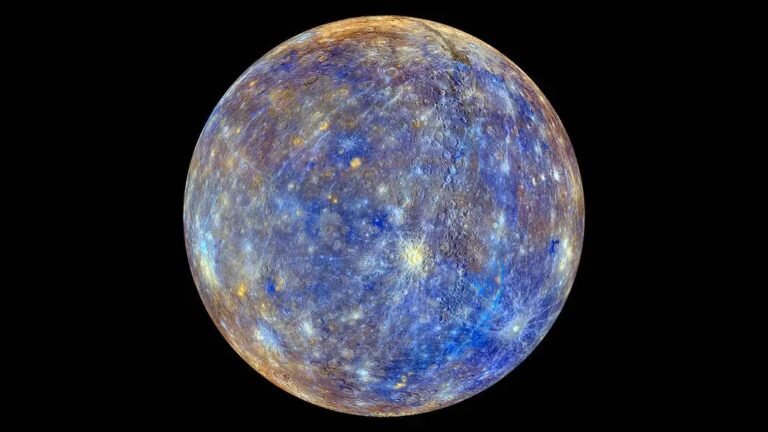
When you step outside just after sunset or before sunrise, the sky often reveals bright and familiar planets like Venus or Jupiter. Yet one world remains far more elusive. Mercury, the smallest planet in our solar system, lives close to the Sun and rarely strays far from its brilliant glare. Because of this, many people have never knowingly seen it. But those who take the time to find Mercury often feel a special sense of discovery.
Mercury has fascinated humans for thousands of years. Ancient observers noticed how quickly it moved through the sky. They saw it appear briefly, disappear again, and return on the opposite side of the Sun. Cultures across the world connected this restless motion with messengers, travelers, and trickster figures. Over time the planet became associated with the Roman god Mercury, a swift messenger who carried news between the heavens and Earth.
Today Mercury continues to captivate astronomers, historians, astrologers, and sky watchers alike. It tells a story that blends science with mythology and careful observation. By exploring Mercury from these perspectives, we gain a deeper appreciation for both the planet itself and the long human tradition of watching the skies.
Mercury in the Solar System
Mercury is the closest planet to the Sun. It orbits our star at an average distance of about 36 million miles. This distance may sound large, but compared to the rest of the solar system it is quite small. A year on Mercury lasts only 88 Earth days because the planet completes its orbit so quickly.
Mercury is also the smallest of the eight major planets. Its diameter is just under 3,100 miles, which is only slightly larger than Earth’s Moon. Despite its small size, Mercury is surprisingly dense. Scientists believe it contains a large iron core that makes up most of its interior. This heavy core gives Mercury the second highest density of any planet after Earth.
The surface of Mercury looks somewhat like the Moon. It is covered with craters that formed when asteroids and comets struck the planet billions of years ago. Vast plains of hardened lava stretch across parts of the landscape. These plains formed when molten rock flowed across the surface in ancient volcanic eruptions.
One of the most striking features on Mercury is a massive impact basin called Caloris Basin. This enormous crater spans about 960 miles across. When the asteroid that created it struck Mercury long ago, the impact sent shock waves around the entire planet. On the opposite side of Mercury, these shock waves produced a chaotic region of broken terrain that scientists sometimes call “weird terrain.”
Mercury experiences some of the most extreme temperature swings in the solar system. During the day, temperatures near the equator can reach about 800 degrees Fahrenheit. At night the temperature can fall to minus 290 degrees Fahrenheit. These dramatic changes occur because Mercury has almost no atmosphere to trap heat.
Although Mercury appears small and quiet today, its early history was likely violent. The planet endured intense bombardment during the early formation of the solar system. Over time the surface cooled and hardened. The result is a world that preserves ancient scars from billions of years ago.
A Unique Planetary Rotation
Mercury has an unusual pattern of rotation that sets it apart from other planets. It rotates slowly on its axis while moving quickly around the Sun. In fact, Mercury spins three times for every two trips it makes around the Sun.
This arrangement creates a strange rhythm between Mercury’s day and year. One full rotation relative to the distant stars takes about 59 Earth days. But a solar day on Mercury, which is the time between one sunrise and the next, lasts about 176 Earth days.
This means that a single day on Mercury is twice as long as a Mercury year. If a person could stand on the surface of Mercury, the Sun would appear to move slowly across the sky. In some places it might even appear to pause briefly and move backward before continuing its path. This unusual motion happens because of the planet’s complex orbital relationship with the Sun.
Mercury’s slow rotation also affects its environment. Because one side of the planet faces the Sun for a long time, the surface heats intensely. The long nights allow temperatures to plunge to incredible lows.
Mercury’s Thin Atmosphere
Unlike Earth or Venus, Mercury does not possess a thick atmosphere. Instead it has a very thin layer of atoms called an exosphere. This exosphere contains small amounts of elements such as sodium, oxygen, hydrogen, helium, and potassium.
These atoms are constantly being knocked off the surface by solar radiation and micrometeorite impacts. The Sun’s strong energy strips away many particles before they can accumulate into a stable atmosphere.
Despite its thinness, Mercury’s exosphere can produce faint glowing clouds of sodium that extend far into space. Spacecraft observations have revealed that this cloud can stretch for tens of thousands of miles behind the planet.
Mercury also has a magnetic field, although it is much weaker than Earth’s. This magnetic field suggests that the planet still has a partially molten core deep inside. Scientists continue to study Mercury’s magnetic environment because it offers clues about the planet’s interior structure.
Exploring Mercury with Spacecraft
For many years Mercury remained one of the least explored planets. Its proximity to the Sun makes it difficult for spacecraft to reach. The strong gravitational pull of the Sun requires careful planning and multiple flybys to slow a spacecraft enough to enter orbit.
The first spacecraft to visit Mercury was NASA’s Mariner 10 mission in the 1970s. Mariner 10 flew past Mercury three times and captured the first close images of the planet. These pictures revealed the cratered surface and massive impact basins that define Mercury’s appearance.
Decades later NASA launched the MESSENGER spacecraft. This mission entered orbit around Mercury in 2011 and studied the planet for four years. MESSENGER mapped nearly the entire surface and discovered evidence of water ice hidden in permanently shadowed craters near the poles.
These icy deposits exist in deep craters that never receive direct sunlight. Even though Mercury is extremely hot during the day, the bottoms of these polar craters remain cold enough to preserve ice.
Another mission called BepiColombo, led by the European Space Agency and the Japan Aerospace Exploration Agency, is currently on its journey to Mercury. It will arrive later in the decade and provide even more detailed information about the planet’s surface, magnetic field, and interior.
Mercury in Ancient Sky Watching
Long before telescopes existed, ancient astronomers watched Mercury carefully. Because the planet appears only briefly near sunrise or sunset, it was often considered mysterious or difficult to observe.
Early civilizations noticed that Mercury sometimes appeared in the morning sky and at other times in the evening sky. Some cultures believed these two appearances represented different celestial objects. Over time they realized both sightings belonged to the same wandering star.
In ancient Mesopotamia, Mercury was associated with the god Nabu. Nabu served as a divine messenger and patron of writing and wisdom. The planet’s quick movements across the sky reflected the swift duties of this messenger deity.
Ancient Greek observers also recognized Mercury’s changing appearances. They originally used two names. One name referred to the planet when it appeared in the morning sky, and another name described its evening appearance. Eventually Greek astronomers understood that both sightings belonged to the same planet.
The Romans later linked the planet with their god Mercury. This deity served as a messenger of the gods and a protector of travelers and merchants. The planet’s rapid motion through the sky seemed to match the speed and agility of this divine messenger.
In ancient China, Mercury was associated with water and the northern direction. Chinese astronomers carefully recorded the movements of the planet as part of their long tradition of celestial observation.
These early observations helped shape the mythological and symbolic meaning of Mercury across many cultures.
The Roman God Mercury
The Roman god Mercury holds a special place in classical mythology. He was known as the swift messenger of the gods. Stories describe him traveling quickly between the heavens, Earth, and even the underworld.
Mercury often carried a staff called the caduceus. This staff featured two intertwined serpents and sometimes wings at the top. The symbol later became associated with communication and commerce.
Roman mythology portrays Mercury as clever and resourceful. He guided souls to the underworld, protected travelers, and served as a patron of merchants and traders. Because of these roles, Mercury represented movement, communication, and exchange.
Artists often depicted Mercury wearing winged sandals and a winged helmet. These wings symbolized his incredible speed. It is easy to see how ancient sky watchers connected this swift messenger with the fast moving planet they observed near the Sun.
The mythological Mercury also shared similarities with the Greek god Hermes. Hermes played a nearly identical role in Greek mythology. Both gods represented communication, intelligence, and cleverness.
Over centuries the name Mercury became firmly attached to the planet. The connection between the myth and the planet’s behavior remains one of the most enduring examples of mythology influencing astronomy.
Mercury in Astrology
In astrology, Mercury represents communication, thought, and the exchange of information. Astrologers associate the planet with intellect, language, learning, and reasoning. Because Mercury moves quickly through the zodiac, it is believed to influence everyday interactions and mental processes.
Mercury rules the zodiac signs Gemini and Virgo. These signs are often associated with curiosity, adaptability, and analytical thinking. Astrologers believe Mercury encourages conversation, writing, teaching, and problem solving.
One of the most well known astrological events involving Mercury is Mercury retrograde. During these periods the planet appears to move backward across the sky from Earth’s perspective. This effect occurs because Earth is passing Mercury in its orbit.
Astrologers traditionally associate Mercury retrograde with communication challenges, travel delays, and misunderstandings. While these beliefs are symbolic rather than scientific, the phrase “Mercury retrograde” has become widely known in popular culture.
In astrology Mercury also represents messages and connections. The planet’s position in a birth chart is thought to influence how a person communicates and processes information.
Whether one views astrology as symbolic storytelling or personal reflection, Mercury’s connection with communication remains central to its astrological identity.
Viewing Mercury from Earth
For sky watchers, Mercury can be both rewarding and challenging to observe. Because the planet never moves far from the Sun, it is visible only for short periods during twilight.
Mercury usually appears low above the horizon shortly after sunset or just before sunrise. The best times to see Mercury occur during events called greatest elongations. These moments happen when Mercury reaches its maximum angular distance from the Sun in the sky.
Even during these favorable times, Mercury can be difficult to spot. The sky may still be bright, and the planet remains close to the horizon. Trees, buildings, or hills can block the view if the horizon is not clear.
Observers often find Mercury easier to see with the help of binoculars. Once located, the planet appears as a small bright point of light. Through a telescope Mercury reveals phases similar to those of the Moon. These phases occur because we see different portions of Mercury’s sunlit side as it orbits the Sun.
Many experienced sky watchers describe the first successful sighting of Mercury as a special moment. Because the planet is so elusive, finding it feels like uncovering a hidden treasure in the sky.
Mercury’s Place in the Night Sky
Mercury moves quickly through the constellations along the path known as the ecliptic. This path is the same route followed by the Sun, Moon, and other planets.
During certain times of the year Mercury becomes easier to observe depending on the observer’s latitude and the angle of the ecliptic. In spring evenings or autumn mornings, the planet can climb higher above the horizon for observers in the northern hemisphere.
Because Mercury completes its orbit so quickly, it cycles through its appearances several times each year. Each cycle brings a new opportunity for observers to try spotting the planet.
Patience and careful timing are the keys to success. Watching the sky during twilight with a clear view of the horizon greatly improves the chances of seeing Mercury.
A Planet That Connects Science and Story
Mercury stands at the crossroads of science, mythology, and human curiosity. Astronomers study its iron core, cratered surface, and strange orbital rhythms. Historians explore the myths that ancient cultures created to explain its restless motion. Astrologers connect its symbolism with communication and thought.
For sky watchers, Mercury offers a unique challenge and reward. Its brief appearances remind us that the sky still holds discoveries waiting for those who look carefully.
When you next watch the fading glow of sunset or the first light of dawn, you might catch a glimpse of this swift planet near the horizon. That small bright point represents not only a distant world but also thousands of years of stories and observations.
Mercury continues to move quickly through the heavens, just as it did for the ancient observers who first named it after the fleet footed messenger of the gods. Its journey reminds us that the sky is both a scientific frontier and a timeless source of wonder.
Please be advised that, despite our best efforts, International Star Registry – Name a star provides astronomical content for entertainment purposes. We cannot guarantee the accuracy of all information given.