
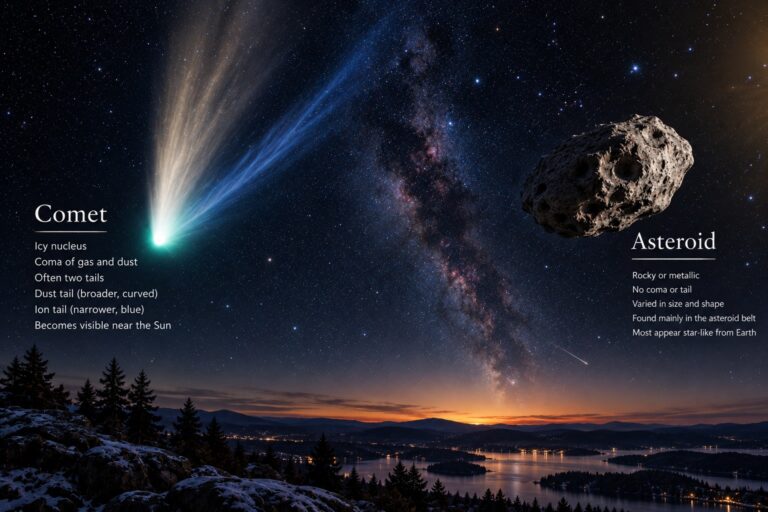
A bright comet can become one of the most beautiful sights in the night sky. Its glowing head and sweeping tail may remain visible for days or weeks. An asteroid is usually far less dramatic. Most appear as tiny points of light, even through a telescope.
Despite their different appearances, comets and asteroids have something important in common. Both are ancient remnants left over from the formation of our solar system about 4.6 billion years ago. They preserve materials from a time before Earth and the other planets had fully formed.
Comets and asteroids are not simply two names for the same thing. They usually have different compositions, come from different regions, and behave differently when they approach the Sun. However, modern discoveries have also shown that the boundary between them is not always as clear as it once seemed.
What Is an Asteroid?
An asteroid is a relatively small object that orbits the Sun. Most asteroids are made primarily of rock, metal, or a mixture of the two. Unlike planets, they are usually too small for their gravity to pull them into a round shape. Many are irregular, battered worlds covered with craters, boulders, and loose debris.
Most known asteroids orbit between Mars and Jupiter in a region called the main asteroid belt. This belt formed from material left over during the creation of the planets. Jupiter’s powerful gravity helped prevent that material from gathering into another full-sized planet. Repeated collisions then broke many of the remaining bodies into smaller pieces.
The asteroid belt is not the crowded obstacle course sometimes shown in science fiction. Its objects are separated by enormous distances. Spacecraft routinely travel through the region without weaving between closely packed rocks.
Asteroids also exist outside the main belt. Trojan asteroids share the orbital paths of planets while gathering around gravitationally stable regions. Jupiter has especially large populations of Trojans moving ahead of and behind it.
Near-Earth asteroids have orbits that bring them into Earth’s general neighborhood. The name can sound alarming, but it does not mean an asteroid is heading for a collision. Astronomers carefully calculate these objects’ paths and continue to refine their predictions as new observations become available.
What Is a Comet?
A comet is also a small object orbiting the Sun, but it generally contains more frozen material than an asteroid. A comet’s nucleus can contain dust, rock, water ice, frozen carbon dioxide, and other frozen gases.
Comets spend much of their lives in the cold outer regions of the solar system. Short-period comets often originate in or beyond the Kuiper Belt, a broad region of icy bodies past Neptune. Long-period comets are believed to come from the much more distant Oort Cloud, a vast shell of icy objects surrounding the solar system.
Far from the Sun, a comet can look like a dark and inactive lump. As it enters the warmer inner solar system, sunlight heats its surface. Frozen materials begin changing directly into gas. This process is called sublimation.
The escaping gas carries dust away from the nucleus and creates a large, hazy atmosphere called a coma. Sunlight and the solar wind push some of this material outward to form tails.
A comet normally develops two main tails. The dust tail can appear pale, broad, and slightly curved. The ion tail is formed from electrically charged gas and often looks straighter and bluer. Both point generally away from the Sun. A comet’s tail does not necessarily trail behind it like the wake of a boat. When a comet is traveling away from the Sun, its tails can point in the direction it is moving.
Why Do Comets Glow While Asteroids Usually Do Not?
A comet becomes active because the Sun heats its frozen materials. The resulting coma can grow much larger than the solid nucleus hidden inside it. Dust in the coma and tail reflects sunlight, while electrically charged gases can produce their own characteristic glow.
A typical asteroid does not contain enough exposed ice to create this kind of display. It normally reflects sunlight from its solid surface and continues to resemble a point of light.
This is why an asteroid usually needs a telescope or binoculars to be seen. A particularly bright comet can sometimes become visible to the unaided eye and may stretch across a large section of the sky.
The traditional description of a comet as a “dirty snowball” remains useful, but it is incomplete. Spacecraft have revealed extremely dark comet nuclei covered in dust, rough terrain, pits, cliffs, and jets. Much of the ice may be hidden beneath a dark surface rather than shining like a clean ball of snow.
Where Did Their Names Come From?
The word comet comes from a Greek expression meaning “long-haired.” To ancient observers, the tail of a bright comet resembled streaming hair or a beard.
The word asteroid means “star-like.” Early telescopes could show the planets as small disks, but newly discovered asteroids continued to look like points of light resembling stars.
The first object found in the main asteroid belt was Ceres. Italian astronomer Giuseppe Piazzi discovered it on January 1, 1801. At first, it was treated as a new planet. After more small bodies were found in the same region, astronomer William Herschel proposed the term “asteroid” for this new class of objects.
Ceres has continued to challenge simple categories. It was first called a planet, later classified as an asteroid, and is now officially a dwarf planet. NASA’s Dawn spacecraft entered orbit around Ceres in 2015 and revealed a surprisingly complex world with evidence of water-rich materials and past geological activity.
Are Comets and Asteroids Always Easy to Tell Apart?
Not always.
Astronomers once expected a simple division. Asteroids were rocky objects from the warmer inner solar system. Comets were icy objects from the colder outer solar system.
That general distinction is still useful, but nature is more complicated. Some objects classified as asteroids suddenly release dust and develop tails. These are often called active asteroids. Other objects may be dormant or nearly extinct comets whose easily vaporized material has been depleted or sealed beneath the surface.
Composition also creates overlap. Some asteroids contain water-bearing minerals and carbon-rich material. Some comets have rocky, dusty surfaces that appear surprisingly asteroid-like.
Scientists therefore consider more than appearance when classifying an object. They study its orbit, composition, surface, activity, and history. Even then, a few objects resist a simple label.
The Strange Case of 3200 Phaethon
One of the best examples is 3200 Phaethon. Astronomers classify Phaethon as an asteroid, yet it behaves in several ways like a comet.
Its orbit takes it extremely close to the Sun. Intense heating causes it to brighten and produce a faint tail. Research suggests that sodium vaporizing from its hot rock may help create this comet-like activity. For this reason, Phaethon is sometimes described as a “rock comet,” although active asteroid may be the more accurate term.
Phaethon is also the parent of the Geminid meteor shower, which occurs every December. Most major meteor showers come from comet debris, but the Geminids are produced by material associated with this unusual asteroid.
Phaethon shows why the distinction between comets and asteroids is not always absolute. Our solar system contains transitional objects that share characteristics of both.
How Do Comets and Asteroids Produce Meteors?
Small particles break away from comets and asteroids. While those particles remain in space, they are called meteoroids.
When a meteoroid enters Earth’s atmosphere at high speed, friction and compressed air heat it until it glows. That streak of light is a meteor, commonly called a shooting star.
If part of the object survives its journey through the atmosphere and reaches the ground, it becomes a meteorite.
Many annual meteor showers begin with a comet. Each time the comet passes near the Sun, it releases dust along its orbit. Earth encounters that debris stream at approximately the same time each year.
Halley’s Comet supplies material for both the Orionid and Eta Aquariid meteor showers. Swift-Tuttle is the parent of the Perseids. Tempel-Tuttle produces the Leonids, and Giacobini-Zinner is responsible for the Draconids.
The comet does not need to be near Earth when the meteor shower occurs. The particles may have been released during earlier passages hundreds or even thousands of years ago.
Asteroids can also supply meteoroids through collisions, surface cracking, or other forms of disruption. Most meteorites recovered on Earth are thought to have originated in asteroids.
Do Comets or Asteroids Pose a Greater Danger?
Both can strike planets, but impact risk depends on an object’s size, speed, orbit, and composition rather than its label alone.
Asteroids receive much of the attention because many near-Earth objects are rocky bodies that can be detected, tracked, and studied repeatedly. Astronomers use telescopes and radar observations to calculate their future positions.
A long-period comet can be harder to predict far in advance because it may arrive from the distant Oort Cloud on a very long orbit. These comets can also travel at tremendous speeds as they enter the inner solar system. Fortunately, dangerous comet impacts are rare.
The term “potentially hazardous asteroid” is often misunderstood. It is a technical category based on an asteroid’s size and how closely its orbit can approach Earth’s orbit. It does not mean that an impact is expected.
NASA and other organizations continually monitor near-Earth objects. Their goal is to discover them early, calculate their paths, and determine whether any future encounter deserves closer attention. NASA reports that no known asteroid large enough to cause widespread destruction is expected to strike Earth within the next century.
Ancient Remnants With Different Stories
The clearest difference between comets and asteroids is what happens when they approach the Sun. A comet’s frozen materials can create a coma and magnificent tails. An asteroid normally remains a solid, inactive body reflecting sunlight.
Their origins are also generally different. Most asteroids formed in the warmer regions closer to the Sun, especially around the main belt. Many comets come from the colder Kuiper Belt and Oort Cloud.
Yet these categories meet at the edges. Active asteroids, dormant comets, carbon-rich bodies, and objects like Phaethon remind us that the solar system is not divided into perfectly tidy groups.
Comets and asteroids are more than wandering rocks and ice. They are surviving pieces of the material from which the planets were built. By studying them, scientists are looking backward through billions of years of history and learning how our solar system, including Earth, came to be.
Please be advised that, despite our best efforts, International Star Registry – Name a star provides astronomical content for entertainment purposes. We cannot guarantee the accuracy of all information given.