
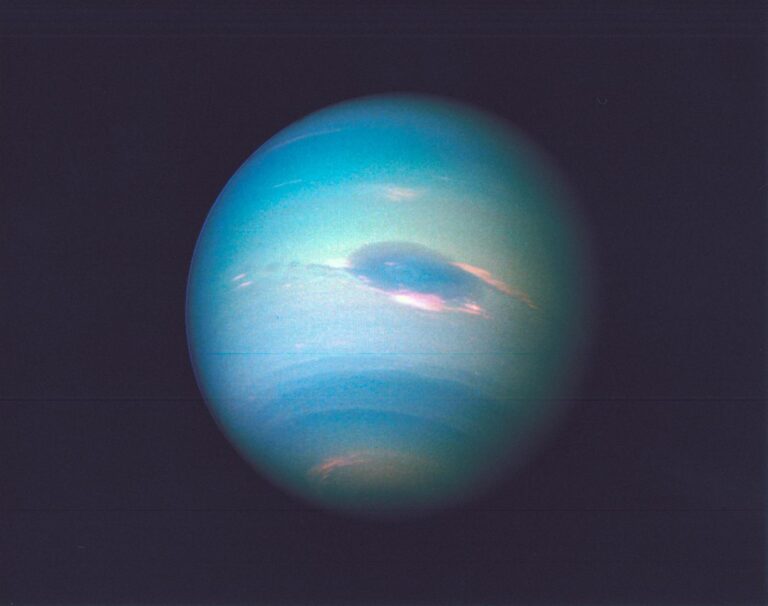
The Planet Neptune and the Myths of the Sea
Far beyond the familiar planets that shine brightly in the night sky lies a world of deep blue color and powerful winds. Neptune is the eighth planet from the Sun and the most distant of the major planets in our solar system. Although it cannot be seen with the naked eye under normal conditions, this distant giant has captured the imagination of astronomers and storytellers alike.
Neptune is a world of mystery. Its atmosphere moves with some of the fastest winds known in the solar system. Its deep blue color gives it an appearance that reminds many people of the oceans of Earth. It is fitting that the planet carries the name of the Roman god of the sea. Just as the oceans of Earth can be calm or stormy, Neptune’s atmosphere hides powerful weather systems and enormous storms.
Unlike the planets known since ancient times, Neptune was discovered through careful mathematical prediction. Its existence was first suggested when astronomers noticed strange changes in the orbit of Uranus. By studying those changes, scientists realized that another unseen planet must be pulling on Uranus with its gravity. When telescopes finally found Neptune on September 23-24, 1846, it marked one of the greatest triumphs of scientific reasoning.
Neptune connects many different threads of human curiosity. It represents the outer frontier of our planetary neighborhood. Its name links it to ancient myth. Its discovery shows the power of mathematics and observation. Even though it lies billions of miles away, Neptune continues to inspire fascination and exploration.
Neptune in the Solar System
Neptune is the eighth planet from the Sun and the most distant of the major planets. It orbits the Sun at an average distance of about 2.8 billion miles. At this great distance, sunlight is very faint compared with the light we receive on Earth.
Because Neptune is so far from the Sun, it takes a very long time to complete one orbit. A year on Neptune lasts about 165 Earth years. This means that since the planet’s discovery in 1846, Neptune has only recently completed its first full orbit around the Sun.
Despite the weak sunlight at that distance, Neptune remains an active and dynamic planet. It belongs to the group known as ice giants. This group also includes Uranus. Ice giants differ from the gas giants Jupiter and Saturn because they contain larger amounts of icy materials such as water, methane, and ammonia.
Neptune’s diameter measures about 30,600 miles. This makes it slightly smaller than Uranus but still nearly four times wider than Earth. Like other giant planets, Neptune does not have a solid surface that spacecraft could land on. Instead it consists of thick layers of gas and icy fluids surrounding a small rocky core.
Deep within the planet the pressure becomes enormous. Scientists believe the interior may contain a dense mantle of superheated water and other materials under extreme pressure. These unusual conditions make Neptune one of the most fascinating planets to study.
The Blue Color of Neptune
Neptune is famous for its striking blue color. When viewed through powerful telescopes or spacecraft images, the planet appears as a deep sapphire colored world.
This color comes from methane gas in the atmosphere. Methane absorbs red wavelengths of sunlight while reflecting blue light back into space. This effect gives Neptune its beautiful blue appearance.
Although Uranus also contains methane and appears blue green, Neptune is darker and richer in color. Scientists believe this difference may be caused by additional atmospheric processes that are still being studied.
The blue color of Neptune often reminds people of Earth’s oceans. This similarity makes the planet’s name especially appropriate, since Neptune was the Roman god of the sea.
Neptune’s Powerful Atmosphere
Neptune has one of the most active atmospheres in the solar system. Despite receiving only a small fraction of the sunlight that Earth receives, the planet produces intense storms and powerful winds.
Wind speeds on Neptune can exceed 1,200 miles per hour. These winds are the fastest recorded anywhere in the solar system. Scientists are still investigating why such extreme winds occur on such a distant and cold planet.
The atmosphere of Neptune forms bands of clouds that circle the planet. These cloud systems resemble the bands seen on Jupiter and Saturn but are less clearly defined.
Occasionally large storms appear in Neptune’s atmosphere. One of the most famous was the Great Dark Spot observed by the Voyager 2 spacecraft in 1989. This enormous storm resembled Jupiter’s Great Red Spot, although it later disappeared.
Other storms have formed and faded over time. These changing weather systems show that Neptune’s atmosphere remains highly dynamic.
High altitude clouds made of methane ice sometimes appear as bright white streaks against the darker blue background. These clouds can form and dissipate rapidly as powerful winds sweep across the planet.
The Rings of Neptune
Neptune also possesses a system of rings. These rings are faint and difficult to see from Earth. They were discovered during the twentieth century through careful observations.
The rings consist mostly of dark particles made of dust and small rocks. Unlike Saturn’s bright icy rings, Neptune’s rings are much darker and thinner.
One unusual feature of Neptune’s rings is the presence of clumps or arcs within the ring system. These arcs appear as brighter sections where particles gather in certain regions.
Scientists believe the gravity of nearby moons helps maintain these arcs. Without this gravitational influence, the particles would likely spread out evenly around the planet.
Although Neptune’s rings are not as spectacular as Saturn’s, they add another layer of complexity to this distant planetary system.
Neptune’s Moons
Neptune has a family of moons that orbit the planet. More than a dozen moons have been discovered so far. Each moon has its own unique characteristics.
The largest moon is Triton. Triton is one of the most unusual moons in the solar system. It orbits Neptune in the opposite direction of the planet’s rotation. This retrograde orbit suggests that Triton may have been captured long ago rather than forming alongside Neptune.
Triton has a surface covered with nitrogen ice and frozen materials. The moon also displays geysers that erupt and send plumes of gas into space. These eruptions were observed during the Voyager 2 flyby.
Scientists believe Triton may contain a subsurface ocean beneath its icy crust. If this ocean exists, it raises intriguing possibilities about the conditions that might support life.
Other moons of Neptune are much smaller and irregular in shape. Many of them were discovered using powerful telescopes in recent decades.
The Mathematical Discovery of Neptune
Neptune holds a special place in the history of astronomy because it was discovered through mathematics before it was seen through a telescope.
In the early nineteenth century astronomers noticed that the orbit of Uranus did not behave exactly as expected. Small irregularities suggested that another planet might be affecting Uranus through gravity.
Two mathematicians, Urbain Le Verrier in France and John Couch Adams in England, independently calculated where this unseen planet might be located.
Their calculations guided astronomers to point telescopes toward the predicted position. In September 1846 the German astronomer Johann Galle observed the planet near the predicted location.
This discovery confirmed the power of mathematical prediction. Neptune became the first planet found through scientific calculation rather than direct observation.
Neptune in Mythology
The planet Neptune takes its name from the Roman god of the sea. In Roman mythology Neptune ruled over oceans, rivers, and water in all its forms. The Roman god Neptune originated as a lesser god in Italy but as of around 399 B.C.E. he corresponds closely with the powerful Greek god Poseidon. Both figures were powerful deities who controlled the waters of the world.
Like the sea itself, Neptune was said to be tempetuous. The god of the sea was said to have fathered many children including 12 daughters both through his wife Salacia and others. His children included Proteus, Rhode, and Benthesikyme. One child was Triton who, like Neptune, was often depicted carrying a trident, a three pronged spear used by fishermen. This symbol represented Neptune’s control over the seas and storms. Other children included two with constellations named in their honor, Orion and Pegasus.
Ancient sailors often prayed to Neptune for safe voyages. The sea could be calm and generous one moment and violent the next. This unpredictable nature gave Neptune a reputation as both protector and destroyer.
Naming the distant blue planet after the god of the sea was a natural choice. The deep blue color of Neptune reminded astronomers of Earth’s oceans, and the name continued the tradition of using mythological figures for planetary names.
Neptune in Astrology
In astrology Neptune represents imagination, dreams, and spirituality. Astrologers associate the planet with creativity, intuition, and emotional depth.
Neptune was incorporated into astrology after its discovery in the nineteenth century. Because it was discovered during a time of scientific and artistic change, astrologers connected it with inspiration and visionary thinking.
The planet is associated with the zodiac sign Pisces in modern astrology. Pisces is often linked with compassion, creativity, and emotional sensitivity.
Astrologers believe Neptune encourages imagination and artistic expression. It is sometimes described as the planet of dreams and illusion.
Because Neptune moves slowly through the zodiac, it is believed to influence entire generations rather than individuals alone.
While astrology is symbolic rather than scientific, Neptune’s role within astrological systems reflects humanity’s desire to find meaning in the movements of the planets.
Observing Neptune from Earth
Neptune is the most distant planet in the solar system and cannot usually be seen with the naked eye. Even under very dark skies it appears extremely faint.
Most observers require binoculars or a telescope to locate Neptune. Through a telescope the planet appears as a tiny bluish disk.
Unlike Jupiter or Saturn, Neptune does not show dramatic visible features through small telescopes. However its distinct color helps observers identify it once they locate the planet.
Neptune moves very slowly across the sky. It spends many years within a single constellation of the zodiac. Careful star charts or astronomy apps are often used to locate it.
The best time to observe Neptune occurs during opposition. At this time the planet lies opposite the Sun in Earth’s sky and is visible throughout the night.
Although Neptune is challenging to observe, many astronomers enjoy the challenge of locating this distant world.
The Voyager 2 Flyby
Only one spacecraft has ever visited Neptune. NASA’s Voyager 2 spacecraft flew past the planet in August 1989.
During this historic encounter Voyager 2 captured the first detailed images of Neptune and its moons. The spacecraft revealed the planet’s storms, rings, and complex atmosphere.
Voyager 2 also discovered several new moons and provided the first close view of Triton’s unusual surface.
This brief flyby transformed our understanding of Neptune. Before Voyager 2, the planet appeared as a distant blue point of light. After the mission, scientists gained a deeper appreciation of its dynamic environment.
Even today most of what we know about Neptune comes from this single encounter.
A Planet at the Edge of the Solar System
Neptune stands at the outer frontier of the solar system’s major planets. Beyond its orbit lies a region filled with icy objects and dwarf planets known as the Kuiper Belt.
Studying Neptune helps scientists understand the structure and evolution of the outer solar system. The planet’s gravity also influences the motion of many smaller objects in this distant region.
Although Neptune lies billions of miles away, it remains connected to the rest of the solar system through these gravitational relationships.
Future missions may someday return to Neptune to study it more closely. Such missions could reveal new information about the planet’s atmosphere, moons, and interior.
The Deep Blue Frontier
Neptune represents both mystery and discovery. It is a world of powerful winds, deep blue clouds, and distant sunlight. Its discovery showed the strength of scientific reasoning, and its name preserves an ancient connection to myth and storytelling.
The planet reminds us that the solar system extends far beyond the familiar worlds visible in the night sky. Even at the edge of our planetary neighborhood, Neptune remains active and full of surprises.
When astronomers look toward Neptune, they see a planet that reflects both science and imagination. It carries the name of a sea god from ancient mythology, yet it also stands as a symbol of modern exploration and discovery.
Neptune invites us to continue exploring the distant reaches of our solar system. It reminds us that even the most remote worlds can teach us new things about the universe and our place within it.
Please be advised that, despite our best efforts, International Star Registry – Name a star provides astronomical content for entertainment purposes. We cannot guarantee the accuracy of all information given.