
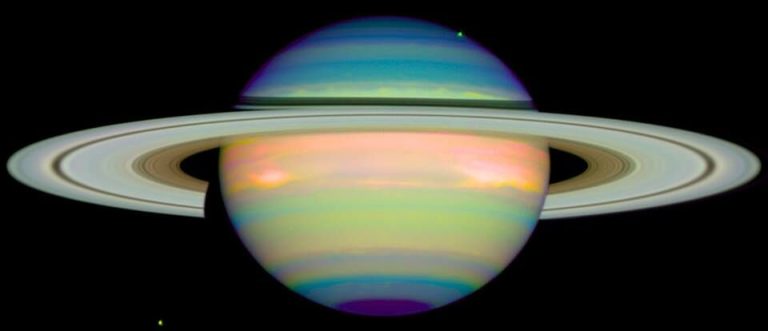
Among the planets visible to the human eye, Saturn has always held a special place. It moves slowly across the sky and shines with a soft golden light that stands apart from the surrounding stars. Ancient observers watched it carefully and noticed its steady pace among the constellations. Its slow journey across the heavens inspired stories about time, wisdom, and powerful gods who ruled long ago.
Today Saturn is known as the second largest planet in our solar system. It is famous for its spectacular ring system that can be seen through a small telescope. These rings give Saturn an appearance unlike any other world. The planet’s beauty has captivated astronomers, sky watchers, and storytellers for centuries.
Saturn connects science and mythology in fascinating ways. Ancient cultures saw the planet as a symbol of age, discipline, and the passage of time. Modern scientists study Saturn to learn more about planetary formation and the complex systems that exist within our solar system. When we look at Saturn today, we see both a distant world of swirling clouds and a symbol that has inspired human imagination for thousands of years.
Saturn in the Solar System
Saturn is the sixth planet from the Sun. It orbits our star at an average distance of about 886 million miles. Because it lies so far from the Sun, Saturn takes a long time to complete one full orbit.
A year on Saturn lasts about 29 and a half Earth years. That means the planet moves slowly through the constellations from our perspective on Earth. Ancient astronomers tracked this slow movement carefully and recognized that Saturn returned to the same regions of the sky after nearly three decades.
Saturn is enormous. Its diameter measures about 74,900 miles. This makes it the second largest planet in the solar system after Jupiter. More than 760 Earth sized planets could fit inside Saturn if it were hollow.
Like Jupiter, Saturn is a gas giant composed mostly of hydrogen and helium. It does not have a solid surface that spacecraft could land on. Instead the atmosphere gradually becomes denser as one moves deeper toward the planet’s interior.
Despite its great size, Saturn is surprisingly light in terms of density. In fact Saturn is the least dense planet in the solar system. If there were a body of water large enough, Saturn would theoretically float.
Deep within the planet, pressure and temperature increase dramatically. Scientists believe the interior may contain a core of rock and ice surrounded by layers of compressed hydrogen.
The Magnificent Rings of Saturn
Saturn is best known for its spectacular rings. These rings form a wide disk of icy particles that circle the planet’s equator. When viewed through a telescope, the rings appear as bright arcs that extend far beyond the planet itself.
The rings are made mostly of water ice mixed with smaller amounts of rock and dust. Some pieces are as small as grains of sand while others are as large as houses. Despite their impressive appearance, the rings are very thin. In many places they are only a few dozen feet thick.
The ring system is divided into several main sections. Astronomers identify these as the A, B, and C rings, along with several fainter outer rings. Gaps between these rings are created by gravitational interactions with Saturn’s moons.
One of the most famous gaps is called the Cassini Division. This dark region separates two of the brightest rings. It was first observed in the seventeenth century by the Italian astronomer Giovanni Cassini.
Scientists believe the rings may have formed from the remains of a shattered moon or comet that wandered too close to Saturn. The planet’s strong gravity tore the object apart and spread the debris into orbit.
Although the rings appear permanent, they may actually be temporary features in cosmic terms. Some researchers think the rings could slowly disappear over millions of years as particles fall into Saturn’s atmosphere.
Saturn’s Moons
Saturn has an impressive collection of moons. More than 140 moons have been discovered orbiting the planet. These moons vary widely in size and composition.
The largest moon of Saturn is Titan. Titan is an extraordinary world with a thick atmosphere made mostly of nitrogen. Its surface contains lakes and rivers, but instead of water they are filled with liquid methane and ethane.
Titan is larger than the planet Mercury. It is the only moon in the solar system with a dense atmosphere. Scientists are especially interested in Titan because its chemistry may resemble conditions that existed on early Earth.
Another remarkable moon is Enceladus. This small icy world contains geysers that shoot plumes of water vapor and ice particles into space. These plumes originate from a hidden ocean beneath the moon’s icy crust.
Because Enceladus has liquid water, heat, and organic molecules, scientists believe it could potentially support microbial life.
Other moons such as Rhea, Dione, and Tethys display icy surfaces covered with impact craters and deep fractures. Together these moons create a diverse and fascinating system around Saturn.
Saturn’s Atmosphere and Weather
Saturn’s atmosphere contains beautiful cloud patterns that circle the planet in bands similar to those seen on Jupiter. However the colors on Saturn are more subtle. The clouds often appear pale yellow or gold when viewed through a telescope.
Powerful winds sweep across the planet’s upper atmosphere. Some of these winds reach speeds of more than 1,000 miles per hour near the equator. These winds help shape the planet’s banded appearance.
Saturn also experiences enormous storms. One of the most remarkable features on the planet is a strange hexagon shaped storm located at the north pole. This hexagonal cloud pattern measures about 20,000 miles across and has persisted for decades.
The origin of the hexagon is still being studied. Scientists believe it may be related to powerful atmospheric waves circulating around the pole.
Lightning storms also occur within Saturn’s atmosphere. These storms can generate enormous flashes that are far stronger than lightning on Earth.
Saturn in Ancient Sky Watching
Saturn has been known since ancient times because it can be seen without a telescope. Its steady golden light and slow movement across the sky made it easy for early astronomers to track.
Ancient Babylonian astronomers recorded the motion of Saturn more than 2,500 years ago. Their careful observations helped form the basis of early planetary models.
Because Saturn moves slowly across the sky, ancient observers often associated it with age and wisdom. The planet’s long cycle also influenced early ideas about time and calendars.
In ancient Greece Saturn was linked with the god Kronos. Kronos was a powerful Titan who ruled during a mythical golden age before the rise of the Olympian gods.
Chinese astronomers referred to Saturn as the Earth Star. It was associated with the element earth in traditional Chinese cosmology. The planet’s appearance was considered important for understanding celestial balance.
Across many cultures Saturn symbolized stability, patience, and the passage of long periods of time.
The Roman God Saturn
The planet Saturn takes its name from the Roman god Saturn. In Roman mythology Saturn was an ancient god associated with agriculture, harvest, and the passage of time.
Saturn was believed to have ruled during a legendary golden age when humanity lived in peace and abundance. According to myth, this era ended when Jupiter rose to power and Saturn’s rule came to an end.
Despite losing his throne, Saturn remained an important figure in Roman culture. He was honored during the festival of Saturnalia, which celebrated abundance and the harvest season.
Saturnalia was one of the most popular festivals in ancient Rome. During the celebration people exchanged gifts, shared meals, and temporarily reversed social roles. Servants were sometimes served by their masters, and the usual rules of society were relaxed.
The connection between Saturn and agriculture reflected the rhythms of planting and harvest that governed ancient life. Over time the planet Saturn came to symbolize cycles, discipline, and the passage of years.
Because Saturn moves slowly across the sky, the association with time and aging seemed natural to ancient observers.
Saturn in Astrology
In astrology Saturn represents structure, responsibility, and discipline. Astrologers often describe it as the planet that teaches important life lessons.
Saturn moves slowly through the zodiac and spends about two and a half years in each zodiac sign. It takes roughly 29 and a half years to complete one full cycle through the zodiac.
This cycle has influenced the concept known as the Saturn return. Around the age of twenty nine or thirty, Saturn returns to the same position it held at a person’s birth. Astrologers believe this period marks a time of maturity and significant life decisions.
Saturn rules the zodiac sign Capricorn and traditionally also Aquarius. Capricorn is associated with ambition, structure, and long term goals. Aquarius is connected with innovation and social change.
In astrological symbolism Saturn represents boundaries, responsibility, and the need for patience. Although it can be associated with challenges, it is also believed to help individuals develop strength and wisdom.
These interpretations reflect the ancient view of Saturn as a planet connected with time and discipline.
Observing Saturn from Earth
Saturn is one of the most beautiful sights in the night sky. Even without a telescope it appears as a bright golden star moving slowly among the constellations.
Through binoculars Saturn still appears as a tiny point of light. However a small telescope reveals something truly extraordinary. The planet’s rings become visible as delicate arcs extending from the planet.
Seeing Saturn’s rings for the first time is often a memorable experience for amateur astronomers. The sight is so unusual that it almost looks unreal.
With larger telescopes observers can see several of Saturn’s moons as small points of light nearby. Titan is often the easiest moon to spot because it is relatively bright.
Saturn reaches its best visibility during events called oppositions. At opposition the planet lies opposite the Sun in Earth’s sky. This means it rises at sunset and remains visible throughout the night.
Oppositions occur about once every year. During these times Saturn appears brighter and larger through telescopes.
The angle of Saturn’s rings changes over time as the planet orbits the Sun. Sometimes the rings appear wide open, while at other times they appear thinner. This changing view adds another layer of fascination for observers.
Saturn’s Role in the Solar System
Saturn plays an important role in the architecture of the solar system. Its strong gravity influences the motion of nearby objects, including some asteroids and comets.
The planet’s gravitational pull also shapes the structure of its ring system and helps control the orbits of its many moons.
Studying Saturn allows scientists to better understand how giant planets form and evolve. These studies also help astronomers learn about distant planetary systems around other stars.
Saturn serves as a natural laboratory where researchers can observe complex interactions between gravity, atmospheres, and orbital motion.
A Planet of Beauty and Meaning
Saturn stands as one of the most remarkable planets in our solar system. Its graceful rings and golden glow have inspired wonder in observers for centuries.
Ancient civilizations saw Saturn as a symbol of time, age, and the cycles of life. Roman mythology connected the planet with harvest and the memory of a golden age. Astrology linked it with discipline and personal growth.
Modern science has revealed Saturn as a vast world of swirling clouds, icy rings, and fascinating moons. Space missions such as the Cassini spacecraft have transformed our understanding of this distant planet.
Yet Saturn still inspires the same sense of awe that ancient sky watchers felt long ago. When you look at Saturn through a telescope and see its rings suspended in the darkness of space, you are witnessing one of the most beautiful sights in the universe.
Saturn reminds us that the night sky is filled with wonders waiting to be explored. It connects ancient myths with modern discovery and continues to inspire curiosity about the vast universe beyond our world.
Please be advised that, despite our best efforts, International Star Registry – Name a star provides astronomical content for entertainment purposes. We cannot guarantee the accuracy of all information given.