
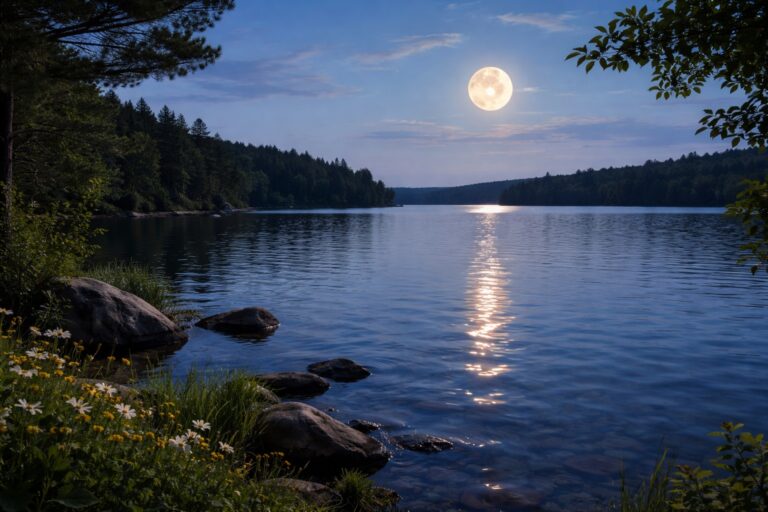
The Beloved Flower Moon
On May 1, 2026, the Moon reaches full phase at 17:24 UTC. At that precise moment, the Moon will be located on the opposite side of Earth as the Sun. Its entire near side will be fully illuminated by sunlight. Astronomers define this alignment as opposition. To observers on Earth, the Moon will appear round and bright for a night before and after this exact time.
The May 1 full Moon is traditionally known as the Flower Moon. This name reflects the abundance of blossoms that appear across much of the Northern Hemisphere in late spring. In 2026, this Flower Moon carries an additional distinction. It is the first of two full moons in the month of May. A second full Moon will occur later in the month, making May 2026 a two full Moon month.
The Flower Moon has long been associated with growth, planting, fertility, and agricultural preparation. Across cultures, the May full Moon signals that spring has fully arrived and summer is approaching.
The Science of the May 1, 2026 Full Moon
A full Moon occurs when Earth sits between the Sun and the Moon. The Moon’s orbit carries it around Earth approximately every 29.5 days. When the Sun, Earth, and Moon align in a straight or nearly straight line, the side of the Moon facing Earth is completely illuminated.
For the May 1, 2026 full Moon, this alignment happens at 17:24 UTC. In North America, this corresponds to late morning or early afternoon depending on time zone. Even though the exact phase occurs during daylight hours in many regions, the Moon will appear full when it rises after sunset.
During a full Moon, the Moon rises near sunset and sets near sunrise. It reaches its highest point in the sky around local midnight. This predictable rhythm makes the full Moon one of the easiest astronomical events to observe.
This year, the May 1 full Moon does not qualify as a supermoon. Its distance from Earth falls within normal monthly variation. It will appear similar in size to most other full Moons of the year. However, its brightness will dominate the night sky and outshine all surrounding stars except the brightest.
Why It Is Called the Flower Moon
The name Flower Moon comes from early Native American traditions. Many tribes in North America observed that May brought an explosion of blossoms. Wildflowers, flowering trees, and meadow blooms appeared in abundance. The landscape shifted from the fresh green of early spring to a colorful display of petals and fragrance.
Because this full Moon occurred during peak bloom season, it became known as the Flower Moon. The name reflects careful environmental observation. Indigenous communities relied on seasonal markers for planting, hunting, and gathering. The full Moon provided a reliable calendar reference.
The Flower Moon does not mean the Moon itself changes color. Like all full Moons, it may appear golden or orange near the horizon due to atmospheric scattering. Once higher in the sky, it appears bright white or slightly ivory in tone.
Other Traditional Names for the May Full Moon
The May full Moon has carried several other names in different cultures. These names often reflect agriculture, livestock, and the growth cycle of crops.
The Corn Planting Moon
Among some Native American communities, May’s full Moon was also called the Corn Planting Moon. By this time, soil temperatures had warmed sufficiently for planting corn. Corn was a staple crop in many Indigenous societies. Planting it at the proper time was essential for survival.
The Moon’s cycle helped guide agricultural timing. A full Moon near planting season marked a key moment for preparing fields and sowing seeds.
The Milk Moon
In European traditions, May’s full Moon was sometimes called the Milk Moon. This name reflected the time of year when cows were brought back to pasture after winter confinement. As grasses grew richer and new calves were born, dairy production increased. Milk became more abundant, and livestock thrived.
The Milk Moon symbolized nourishment and productivity. It highlighted the relationship between seasonal grass growth and agricultural prosperity.
Other Cultural Names
Some cultures referred to the May full Moon as the Hare Moon. In parts of Europe, hares were associated with fertility and spring. The Moon itself has long been symbolically connected to fertility cycles.
Other traditions called it the Bright Moon or the Grass Moon. These names reflected the lengthening days and rapidly growing vegetation.
Across regions, the theme is consistent. May’s full Moon represents growth, abundance, and preparation for summer.
The First of Two Full Moons in May 2026
May 2026 is unusual because it contains two full Moons. The first occurs on May 1 at 17:24 UTC. The second will occur at the end of the month. When two full Moons fall within a single calendar month, the second is often referred to as a Blue Moon in modern terminology.
However, the May 1 Flower Moon remains rooted in traditional seasonal naming. Its identity is tied to blossoms and planting rather than calendar anomalies.
Having two full Moons in one month is special because it does not happen every year. It occurs because the lunar cycle, at 29.5 days, is slightly shorter than the average calendar month and the full moon cycle must coincide with the beginning and end of the month.
Seasonal Meaning of the May Full Moon
By early May, spring is no longer tentative. It is fully established across much of North America and Europe. Trees are budding and blooming. Gardens are planned or planted. Fields may show early crop growth.
Gardeners are filled with excitement and expectation while the Flower Moon shines over landscapes filled with new life. Birds are nesting. Insects are becoming active. Evenings are milder and more comfortable for outdoor observation.
Historically, this Moon marked a period of agricultural confidence. Winter is over and the risk of frost has decreased in many regions. Communities shifted from winter survival to active production.
The symbolism of the Flower Moon centers on abundance and optimism. It celebrates the visible rewards of longer daylight and warmer temperatures.
Viewing the May 1 Full Moon in North America
The May 1 full Moon will rise in the east shortly after sunset on May 1 for observers across North America. The exact time of moonrise depends on location. The Moon will appear large and golden as it clears the horizon.
This apparent size is due to the Moon illusion. It is a psychological effect that makes the Moon seem larger when it is near the horizon. As it climbs higher, it will appear smaller but brighter.
Because the exact full phase occurs at 17:24 UTC, the Moon will appear completely full on the evening of May 1 and remain nearly full on May 2.
What to Expect in the Western United States
In the western United States, the full Moon will rise in the east around sunset on May 1. Clear desert and mountain air often provide excellent viewing conditions. The Moon may glow warmly at moonrise against colorful twilight skies.
Higher elevations may produce sharper detail. Observers may notice distinct dark regions known as lunar maria without optical aid. Binoculars can enhance the view and reveal subtle shading.
Evening temperatures are generally comfortable in May. This makes extended viewing sessions pleasant compared to winter months.
What to Expect in the Midwest
In the Midwest, the Flower Moon rises over green fields and expanding farmland. Spring storms are common during May, so cloud cover may vary. Clear nights after a passing cold front often provide crisp visibility.
The Moon’s brightness may illuminate rural landscapes dramatically. Fresh vegetation reflects moonlight in subtle ways. Observers in darker areas will notice how strongly the full Moon lights up surroundings.
The Moon reaches its highest point around midnight local time. It remains visible until sunrise.
What to Expect on the East Coast
On the East Coast, the Flower Moon rises near sunset on May 1. Urban skylines and Atlantic views can create striking silhouettes against the bright lunar disk.
Humidity levels may be higher than in western regions. Slight haze can soften the Moon’s edges, giving it a gentle glow. As the night progresses, the Moon climbs higher into the southern sky.
Even in cities, the full Moon remains visible despite light pollution. Its brightness overpowers most artificial lighting.
Constellations Visible During the Flower Moon
Although the full Moon brightens the sky, several prominent spring constellations remain visible.
Leo the Lion stands high in the sky during May evenings. Its brightest star, Regulus, can still be seen near the Moon’s glow. Virgo follows, with its bright star Spica often appearing nearby depending on the Moon’s position.
The Big Dipper rides high overhead in northern latitudes. Its familiar shape makes it easy to locate. From the curve of the Dipper’s handle, observers can trace a path to Arcturus in Boötes and then onward to Spica.
Fainter galaxies and nebulae are difficult to see during a full Moon. However, the bright seasonal stars provide a beautiful backdrop.
The Moon’s Surface During Full Illumination
During full phase, the Moon’s face is fully illuminated. Large dark plains called maria are clearly visible to the naked eye. These regions were formed by ancient volcanic eruptions billions of years ago.
Mare Imbrium, Mare Serenitatis, and Mare Tranquillitatis stand out prominently. Because sunlight strikes the surface directly, crater shadows are minimal. This reduces surface contrast compared to quarter phases.
Binoculars can reveal subtle color differences between highlands and maria. Observers may also notice bright ray systems extending from some impact craters.
Cultural and Agricultural Significance
The Flower Moon has long served as an agricultural marker. In farming communities, it signaled that planting was well underway. Crops such as corn, beans, and squash were often planted in late spring.
European dairy traditions tied the Milk Moon to increased milk production. Livestock feeding on fresh grass produced richer milk.
In fertility symbolism, May was linked to growth and reproduction. Festivals celebrating spring were common in many cultures. Lunar cycles provided timing for ceremonies and seasonal gatherings.
The Moon’s regular rhythm offered reassurance. No matter how unpredictable weather might be, the Moon’s cycle continued reliably.
Religious and Calendar Connections
Lunar cycles continue to shape religious calendars. The timing of certain observances depends on full Moons that follow the spring equinox. While the May 1, 2026 Flower Moon does not determine Easter in that year, it still sits within the broader framework of spring lunar observances.
Many cultures use lunar or lunisolar calendars. These systems blend solar seasons with lunar months. The full Moon remains an important reference point.
Photography and Observation Tips
The full Moon is bright enough to photograph with simple equipment. Reducing exposure prevents overexposure. A tripod improves clarity.
Including flowering trees, gardens, or spring landscapes in the foreground can reflect the spirit of the Flower Moon. Moonrise often provides the most dramatic lighting.
Observers should allow time for their eyes to adjust to outdoor conditions. While the Moon itself is bright, surrounding stars become more noticeable after several minutes outside.
Why the Flower Moon Feels Special
The Flower Moon feels different from winter full Moons. The warm wether is more dependable and the air feeles softer on your skin. Evening temperatures are comfortable for stepping out to observe the full moon overhead with family or friends. The sounds of birds and insects once again fill the air at dusk.
Landscapes are becoming alive with color and we see the Moon rises over blooming trees and expanding greenery, rather than peeking through snow or bare branches.
This Moon brings a sense of fulfillment as spring has matured into active growth. Summer stands just ahead.
Don’t miss the Flower Moon and First Breaths of Summer
The Full Moon of May 1, 2026, known as the Flower Moon, occurs at 17:24 UTC when the Moon stands opposite the Sun and its beautiful face is fully illuminated. This year, the flower moon is the first of two full Moons in May. It is known by several traditional names, including the Flower Moon, Corn Planting Moon, and Milk Moon. These names reflect blooming landscapes, agricultural preparation, and livestock abundance.
Across cultures, the May full Moon has symbolized growth, fertility, and prosperity. For observers in North America, it offers a bright and welcoming glow in the evening sky as it shines over fields, forests, waterfronts, mountains, and cities alike.
Stepping outside under the Flower Moon reminds us of the joyous anticipation of summer’s return, like generations before us who also watched this season unfold beneath its light. The Moon continues its steady rhythm above, marking time as spring reaches its height and summer approaches.
Please be advised that, despite our best efforts, International Star Registry – Name a star provides astronomical content for entertainment purposes. We cannot guarantee the accuracy of all information given.