
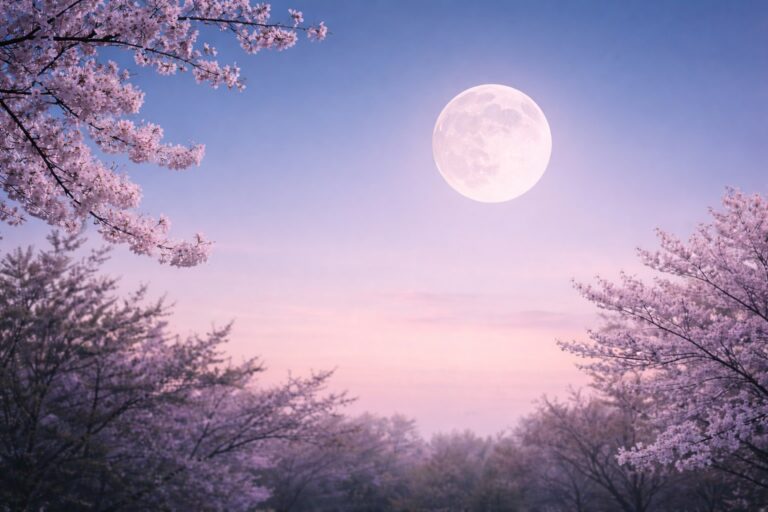
On April 2, 2026, the Moon reaches full phase at 02:11 UTC. At that precise moment, the Moon sits opposite the Sun in Earth’s sky. Its near side is fully illuminated by sunlight. The full Moon appears round and bright for about a night before and after the exact time. We are treated to a full moon every month, but a perfect full phase with the exact alignment of the Sun, Earth, and Moon creating an eclipse only occurs about three times per year. The Moon’s orbit is tilted by 5 degrees relative to Earth’s orbit, meaning it will not pass through Earth’s shadow in April.
The April full Moon arrives during a powerful seasonal transition. In much of the Northern Hemisphere, winter has loosened its grip. Snow melts in northern regions. Rivers flow freely again. Buds begin forming on trees. Spring is no longer a promise but a visible reality. Across many cultures, the April full Moon reflects this change.
The Astronomy Behind the April Full Moon
A full Moon occurs when Earth lies between the Sun and the Moon. The Moon is positioned approximately 180 degrees from the Sun in celestial longitude. This alignment is called opposition. At opposition, the hemisphere of the Moon facing Earth receives direct sunlight.
On April 2, 2026, the full Moon occurs at 02:11 UTC. For North American observers, this moment falls during the late evening of April 1 in many time zones. The Moon will rise near sunset and remain visible throughout the night. It will set close to sunrise the following morning.
The Moon’s orbit is slightly elliptical. Its distance from Earth varies throughout the month. The April 2026 full Moon will be average in size, but will still be a striking sight on the eastern horizon around sunset. The brightness, of the April full moon will dominate the night sky.
Why It Is Called the Pink Moon
The April full Moon is widely known as the Pink Moon and is a romantic welcome to the warm months ahead. The name does not refer to the Moon’s color and the Moon will not appear pink. The name comes from seasonal observations in North America.
It is linked to the blooming of wild ground phlox, sometimes called moss pink. These small pink flowers bloom in early spring, particularly in eastern parts of North America. The appearance of these flowers coincided with the April full Moon. Over time, the name Pink Moon became common in almanac traditions.
Many people assume the Moon itself changes color during this time. That is not the case. The Moon may appear orange or golden near the horizon due to atmospheric scattering. This effect happens throughout the year and is not unique to April.
Traditional Names from Many Cultures
The April full Moon has been given many names across cultures. Most names reflect signs of spring and renewal.
Indigenous North American Traditions
As with other cultures throughout history, different Indigenous communities across North America observed the natural world closely. They used lunar cycles as seasonal markers in anticipation of the changes in weather, animal behavior, and vegitation.
Some tribes called April’s full Moon the Breaking Ice Moon. This name referred to the thawing of rivers and lakes. Others used names such as Moon When the Streams Are Navigable Again. This reflected the reopening of waterways for travel.
In some regions, the Moon was known as the Moon When the Ducks Come Back. Migratory birds returned north during early spring. Other communities used names connected to plant growth, such as the Budding Moon of Plants and Shrubs.
Some traditions called it the Frog Moon. Frogs became active again as temperatures rose. In maple producing regions, it was sometimes called the Sugar Maker Moon. This name recognized the time when sap was collected to produce maple syrup.
Each name captured a local seasonal event. The Moon served as a reliable timekeeper for environmental change.
European Traditions
In parts of Europe, April’s full Moon was known as the Egg Moon. This name reflected fertility and the laying of eggs by birds. Spring was associated with reproduction and new life.
Other European traditions used names such as the Seed Moon or the Growing Moon. These names were connected to planting and agricultural preparation. Fields were plowed and seeds were sown during this period.
Celtic traditions often emphasized growth and renewal. The Moon symbolized the strengthening sunlight and lengthening days.
Blended Naming Traditions
Modern full Moon names often combine Indigenous and European influences. Printed almanacs in North America adopted many Native names while also including colonial European traditions. As a result, multiple names are commonly listed for the April full Moon.
This blending reflects centuries of shared observation. Despite cultural differences, the common theme remains the same. April marks the return of life.
Seasonal Meaning of the April Full Moon
April represents a turning point in the annual cycle. The spring equinox has already passed. Daylight increases noticeably each week. Nights grow shorter but remain cool enough for comfortable observation.
The April full Moon historically signaled the beginning of serious planting. Farmers prepared soil and sowed crops. Wildlife became more active. Insects emerged. Amphibians began calling in wetlands and ponds.
The Moon’s brightness at this time of year illuminated newly green landscapes. In rural areas without artificial light, the full Moon provided natural light for evening work or travel.
Many communities associated this Moon with hope. Winter survival was no longer uncertain. The future growing season could now begin.
Viewing the April 2026 Full Moon in North America
The April full Moon is easy to observe from anywhere with a clear sky. No telescope is required. In fact, telescopes sometimes reduce the overall visual impact because the entire Moon fills the field of view.
The Moon rises close to sunset. On April 1 local time in North America, observers will see the Moon appear near the eastern horizon shortly after the Sun sets in the west. As it rises, it may look larger than usual. This effect is called the Moon illusion. It is a psychological effect caused by comparing the Moon to objects on the horizon.
As the Moon climbs higher, it will appear smaller but brighter and whiter.
What to Expect in the Western United States
Observers in the western United States will see the full Moon during the evening hours of April 1. The exact full phase occurs late in the evening by local clocks. The Moon will already be high in the sky for much of the night.
Western regions often benefit from lower humidity. Dry air can produce sharp lunar detail. Mountainous areas may provide dramatic foreground scenery.
The Moon may appear golden or orange at moonrise. This color fades as the Moon gains altitude. Higher elevation observers may notice especially crisp views due to reduced atmospheric distortion.
What to Expect in the Midwest
In the Midwest, the Moon will rise soon after sunset on April 1. The sky may contain lingering moisture from early spring weather systems. Thin clouds can create halos around the Moon. Ice crystals high in the atmosphere may produce faint rings of light.
The April Moon shines over farmland and newly thawed fields. In rural areas with minimal light pollution, the Moon’s brightness can illuminate landscapes vividly. The ground may still be damp from melting snow or spring rain, which enhances reflected light.
Midwestern observers will see the Moon reach its highest point near local midnight. It will remain visible until dawn.
What to Expect on the East Coast
On the East Coast, the Moon will rise close to sunset on April 1. Urban skylines often provide dramatic silhouettes against the rising Moon. The Moon illusion can make it appear impressively large near the horizon.
As the evening progresses, the Moon climbs into the southern sky. Spring constellations surround it. Temperatures are usually mild compared to winter months, which makes extended viewing more comfortable.
By early morning on April 2, the Moon will set in the western sky near sunrise.
Constellations Visible During the April Full Moon
Even with strong moonlight, many bright stars remain visible in April.
Virgo becomes the dominant constellation of the season. The bright star Spica often appears near the full Moon during this time of year. Leo the Lion stands high in the sky. Its distinctive curved pattern is easy to recognize.
The Big Dipper rides high overhead in northern latitudes. Its handle curves toward Arcturus, a bright orange star in the constellation Boötes. Continuing that arc leads to Spica in Virgo.
While faint galaxies and nebulae are washed out by moonlight, these bright stars remain visible.
The Moon’s Surface at Full Phase
During a full Moon, large dark regions known as lunar maria are clearly visible to the naked eye. These plains were formed by ancient volcanic activity billions of years ago.
Mare Imbrium and Mare Serenitatis are easy to identify. Mare Tranquillitatis appears on the eastern side of the lunar face. Because sunlight falls directly onto the surface, crater shadows are minimal. The Moon looks flatter than it does during quarter phases.
Binoculars can reveal more detail. They show subtle variations in color between highlands and maria.
Religious and Calendar Significance
The April full Moon plays an important role in calendar systems. In Christianity, Easter is celebrated on the first Sunday after the first full Moon following the spring equinox. This means April full Moons often influence the date of Easter.
In Jewish tradition, Passover occurs during the full Moon of the Hebrew month of Nisan. Lunar cycles are central to many religious calendars.
These connections highlight the Moon’s influence beyond astronomy. It has shaped human timekeeping for thousands of years.
Photography and Observing Tips
The full Moon is bright. Photographers should reduce exposure settings compared to other night scenes. A tripod improves clarity. Including trees, buildings, or natural landscapes in the foreground can create dramatic images.
Early evening moonrise offers the warmest colors. As the Moon climbs higher, its light becomes cooler and more neutral.
Observers should allow their eyes time to adjust to darkness. Even though the Moon is bright, surrounding stars become more visible after several minutes outdoors.
Why April’s Full Moon Feels Unique
April’s full Moon feels different from winter Moons. The air carries the scent of thawing earth. Nighttime temperatures are more comfortable. The sounds of spring, such as frogs and insects, return.
Winter constellations fade in the west. Spring constellations take their place. The sky reflects transition and renewal.
This Moon shines not over frozen ground, but over budding trees and green fields. It signals that the cycle of seasons continues.
Conclusion: The Pink Moon and the Return of Growth
The Full Moon of April 2, 2026, known as the Pink Moon, marks a period of renewal and growth. Its name comes from blooming spring flowers rather than lunar color. Across cultures, this Moon has symbolized thawing ice, planting season, fertility, and returning wildlife.
Astronomically, it represents a precise alignment of Sun, Earth, and Moon. Culturally, it represents hope and continuity. For observers across North America, it offers a bright and beautiful reminder that spring has truly arrived.
Stepping outside under the April full Moon connects us with centuries of skywatchers who also looked up during this season of change. The Moon remains steady, even as the world beneath it awakens once again.
Please be advised that, despite our best efforts, International Star Registry – Name a star provides astronomical content for entertainment purposes. We cannot guarantee the accuracy of all information given.