
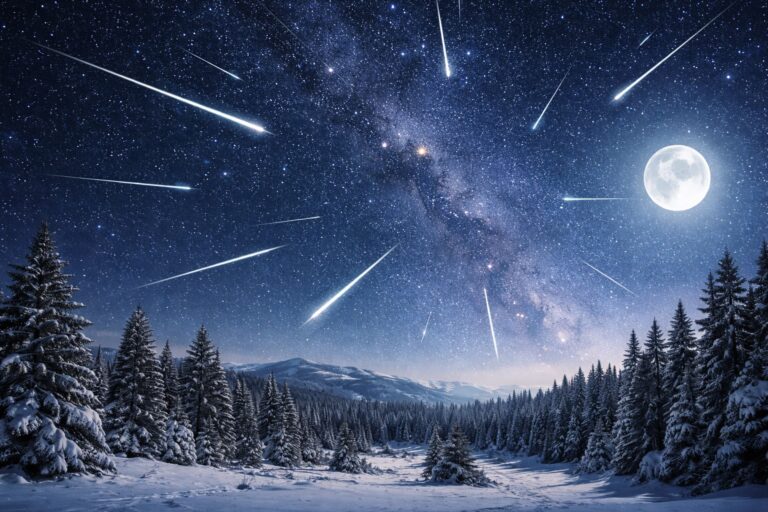
Every January, as the holiday lights fade and winter settles into quiet stillness across much of the Northern Hemisphere, the night sky offers a dramatic celestial encore. The Quadrantids Meteor Shower is one of the most powerful but underrated meteor showers of the year.
In 2026, the Quadrantids will peak during the night of January 3 and the early morning hours of January 4, delivering a burst of cosmic activity capable of producing up to 40 meteors per hour under ideal conditions. Unfortunately, this year comes with a challenge: a Full Super Moon will wash the sky in silvery light, obscuring many of the fainter streaks.
Still, for patient observers willing to bundle up and venture into the darkness after midnight, the Quadrantids can reward you with bright, fast-moving meteors because even when conditions are less than perfect, the universe still puts on a show.
Let’s explore what you need to know about the 2026 Quadrantids Meteor Shower: its history, science, viewing tips, Moon conditions, and why it remains one of the most fascinating meteor showers of the year.
What Are the Quadrantids?
The Quadrantids are an above-average meteor shower that occurs annually from January 1 through January 5, with a short but intense peak usually lasting only a few hours. Unlike more famous showers like the Perseids or Geminids, the Quadrantids are easy to miss because they peak in early January, when cold temperatures and post-holiday fatigue keep many people indoors.
Yet astronomers and seasoned skywatchers know the truth: the Quadrantids are one of the strongest meteor showers of the year.
Under dark, moonless skies, observers can see 30–40 meteors per hour, and in rare years, even more. These meteors are known for being bright, swift, and sharp, often leaving brief but striking trails across the sky.
The 2026 Peak: Dates and Times to Watch
In 2026, the Quadrantids will reach their maximum activity late on January 3 and into the morning of January 4.
Active period: January 1–5, 2026
Peak: Night of January 3 / Morning of January 4
Best viewing window: After midnight through dawn
Best location: Northern Hemisphere
The Quadrantids favor early-morning viewing, when Earth’s rotation turns your location directly into the oncoming stream of debris. This increases the number of meteors you can see per hour.
The Moon’s Role in 2026: A Mixed Blessing
One of the most important factors in meteor watching is moonlight, and unfortunately, 2026 brings a full Supermoon during the Quadrantids peak.
Bright moonlight dramatically reduces visibility by:
Washing out faint meteors
Lowering overall contrast in the sky
Making it harder for eyes to fully dark-adapt
As a result, only the brightest Quadrantid meteors will be visible this year.
That said, the Quadrantids are known for producing some exceptionally bright fireballs, and those can still cut through moonlight with stunning clarity. If you’re patient and give your eyes time to adjust, you may still catch several memorable streaks.
Where Do Quadrantid Meteors Come From?
Every meteor shower occurs when Earth passes through a stream of debris left behind by a celestial body—usually a comet.
In the case of the Quadrantids, the parent body is 2003 EH1, an unusual object discovered in 2003.
Scientists believe:
2003 EH1 is likely the remnant of an extinct comet
Over time, it shed dust grains into a dense, narrow stream
Earth passes through this stream of debris every January as it completes its circular path around the sun
This debris enters Earth’s atmosphere at incredible speeds, burning up and vaporizing instantly and producing the bright streaks we call meteors.
Why the Quadrantids Have Such a Short Peak
Unlike meteor showers with broad debris streams, the Quadrantids originate from a relatively compact cloud of dust. This results in:
A very sharp peak lasting only a few hours
Rapid changes in meteor rates
A “now or never” viewing window
Miss the peak, and meteor counts can drop dramatically. This makes planning especially important—particularly in a year like 2026, when moonlight already limits visibility.
The Radiant: Where to Look in the Sky
Quadrantid meteors appear to radiate from the constellation Boötes, which rises higher in the sky after midnight. They may also appear from the constellations Draco, the Dragon or Ursa Major, the Big Bear.
A few important things to remember:
You do not need to stare directly at Boötes
Meteors can appear anywhere in the sky
Look toward the darkest area, away from the Moon
If possible, position yourself so a building, tree, or hill blocks direct moonlight while keeping most of the sky visible.
Why the Quadrantids Favor the Northern Hemisphere
The Quadrantids are best seen from mid- to high-northern latitudes. Observers in North America, Europe, and much of Asia have the best chance of seeing this shower.
Southern Hemisphere viewers:
May see only a few meteors
Will have limited radiant altitude
Are generally better served by other showers later in the year
For Northern Hemisphere observers, however, the Quadrantids are a true winter highlight.
How Bright Are Quadrantid Meteors?
Even in moonlit years, the Quadrantids stand out because of their brightness and speed.
Typical characteristics include:
Fast entry speeds
Sharp, clean streaks
Occasional fireballs brighter than Venus
These brighter meteors are your best targets in 2026, as they can overcome the Moon’s glare and remain visible even when the sky isn’t fully dark.
How to Watch the Quadrantids in 2026: Practical Tips
1. Choose the Right Time
Observe after midnight, taking advantage of the late winter sunrise, ideally between 2:00–6:00 a.m.
This is when the radiant is highest, the moon moves to the west, and meteor rates improve
2. Find a Dark Location
Escape city lights if possible
Rural or far suburban areas with minimal light pollution work best
3. Dress for Winter
January nights are cold
Bring layers, gloves, a hat, and blankets
4. Use Your Eyes—Not Equipment
No telescope or binoculars needed
Wide-field viewing is key
5. Be Patient
Give yourself 20–30 minutes for eyes to adjust
Meteor watching rewards persistence
The Lost Constellation Behind the Name
The Quadrantids get their name from Quadrans Muralis, a constellation that no longer officially exists.
Once used by astronomers in the 18th century, Quadrans Muralis was eventually removed from modern star charts. However, the meteor shower’s name remains. It is a rare astronomical relic of the past.
This historical quirk makes the Quadrantids unique among meteor showers and adds a layer of astronomical nostalgia to each January display.
Comparing the Quadrantids to Other Meteor Showers
While the Quadrantids may not receive the same attention as summer showers, they consistently outperform many of them.
| Shower | Peak Rate | Season | Peak Duration |
|---|---|---|---|
| Quadrantids | Up to 40/hr | January | Very short |
| Perseids | 50–60/hr | August | Several nights |
| Geminids | 120/hr | December | Broad peak |
| Leonids | Variable | November | Rare storms |
The Quadrantids’ intensity makes them a favorite among dedicated observers—even when conditions aren’t perfect.
Photographing the Quadrantids (Moonlight Edition)
Astrophotography is challenging in 2026, but not impossible.
Tips:
Use a wide-angle lens (14–24mm)
Set ISO between 1600–3200
Shoot continuous long exposures
Aim away from the Moon
Bright fireballs can still be captured, especially during the peak hours.
A Moment of Reflection Under a Winter Sky
Meteor showers have captivated humanity for centuries. There’s something truly memorable about standing under the night sky in winter. We are excited by the cold air, quiet surroundings, and the sudden flash of a meteor reminding us of our place in the cosmos.
Even in a moonlit year like 2026, the Quadrantids offer that sense of wonder.
Each meteor is:
A tiny grain of cosmic dust relative to the vast universe
Older than Earth itself
Ending its journey in a brief flash of light
Final Thoughts: Is the Quadrantids Meteor Shower 2026 Worth Watching?
Absolutely.
While the Super Moon will reduce meteor counts, the Quadrantids’ brightness, speed, and intensity mean that dedicated observers can still enjoy a rewarding experience. This is especially true during the peak after midnight.
If you’re willing to brave the cold, find a dark spot, and give the sky your attention, you may just catch a few brilliant streaks that make the start of 2026 feel truly cosmic.
So step outside, look up, and welcome the new year with a reminder that the universe is alive with motion, mystery, and light. 🌠
Please be advised that, despite our best efforts, International Star Registry – Name a star provides astronomical content for entertainment purposes. We cannot guarantee the accuracy of all information given.