
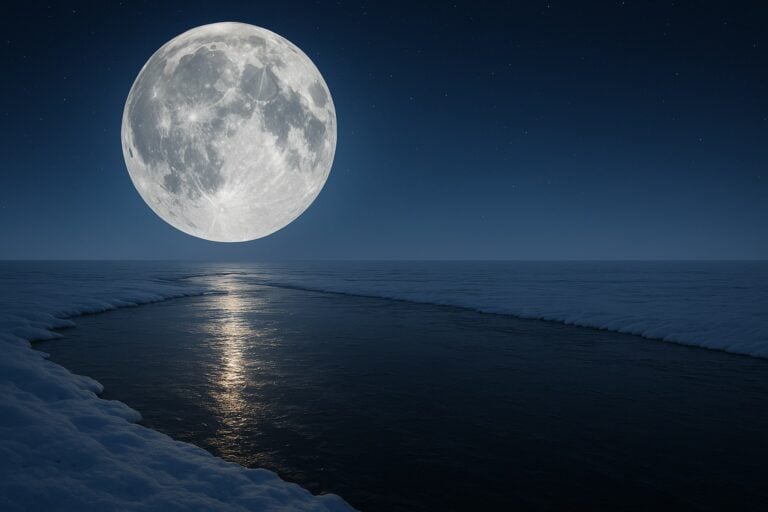
On Thursday, December 4, 2025, the night sky will be illuminated by a beautiful December full moon know as the Cold Moon, which also happens to be the last Supermoon of 2025. Reaching full phase at 23:15 UTC, this full moon will shine brighter and appear slightly larger than usual because it is located closer to the Earth than during other times of the year.
Known to early Native American people as the Cold Moon, this lunar phase marked the deepening chill of the upcoming winter season. This marks a time when cold winds sweep into the Northern Hemisphere, and nights stretch long and dark. It was also known by other evocative names, including the Long Nights Moon, for its association with the longest nights of the year, and the Moon Before Yule, a nod to the upcoming winter solstice and festive traditions in many cultures.
This final Supermoon of the year offers more than just a spectacle, it’s a moment for reflection on the year behind us, preparation for the winter ahead, and celebration as we move from the fading days of autumn into the stillness of winter and the joy of the holiday season.
🌕 What Makes This a Supermoon?
Let’s start with what sets this moon apart: its status as a Supermoon.
Supermoon Defined
This is the third in a cycle of four supermoons which began in October, 2025. A Supermoon occurs when a full moon coincides with the Moon’s perigee, meaning the closest point to Earth in its elliptical orbit. This proximity means that the Moon appears:
Up to 14% larger
Up to 30% brighter
While not dramatically different to the casual observer, Supermoons are noticeably more luminous and can appear massive when rising low on the horizon.
The Last of Three Supermoons in 2025
The December 4 event is the third and final Supermoon of 2025, following:
October’s Harvest or Hunter’s Moon Supermoon
November’s Beaver Moon Supermoon
This trilogy of Supermoons brings an atmospheric close to the astronomical year, culminating in a Cold Moon that gleams with clarity and strength, illuminating the early winter darkness.
❄️ The Cold Moon: A Season Turns
The Cold Moon is a name that reflects both astronomical timing and seasonal significance.
Why “Cold Moon”?
In early Native American and colonial traditions, this full moon marked the time when:
Winter cold began to bite
Frost blanketed the ground
Animals retreated to dens or migrated
Communities huddled by the fire, prepared for winter’s endurance
It is the full moon that follows the beaver traps, harvest feasts, and first frosts. By December, nature has quieted. The final leaves have fallen, and winter’s silence settles in.
The Cold Moon symbolizes:
Stillness
Endurance
Inner warmth and reflection
Its light was a comfort in the dark, and a reminder that even in the coldest season, the sky still watches over us.
🌒 Other Names: Long Nights Moon & Moon Before Yule
This moon has also been known by two other traditional names:
1. Long Nights Moon
December brings the longest nights of the year in the Northern Hemisphere. With the winter solstice just weeks away (on December 21, 2025), darkness dominates the landscape.
The Long Nights Moon rises high in the sky and stays there longer than any other full moon of the year, due to the Moon’s position relative to Earth’s tilt. It’s a natural beacon, lighting up long nights and symbolizing rest, peace, and introspection.
2. Moon Before Yule
In European and Pagan traditions, this moon was called the Moon Before Yule, signaling that Yule (or winter solstice celebrations) were approaching. Yule, one of the oldest known midwinter festivals, centers on light in darkness, making the light of the Full moon a welcome event as the hours of daylight fade.
🗓️ Timing: When to See the December 4 Supermoon
The Moon reaches full illumination at:
23:15 UTC on Thursday, December 4, 2025
In North America, this corresponds to:
6:15 PM EST The sky will already be dark, so you will be treated to a beautiful moonrise to the East as the sun sets in the west.
3:15 PM PST
Best Viewing Windows
The nights of December 3–5 will all showcase the full moon in near-perfect brightness.
Moonrise on December 4 will occur shortly after sunset—ideal for dramatic photos and skywatching.
Moonset the following morning will provide lingering views in the dawn sky.
Wherever you are, check your local moonrise times, and try to catch the Moon low on the horizon, where its larger appearance is especially breathtaking.
🌌 The December Night Sky: What to Look For
Beyond the Supermoon, the December sky offers a wealth of celestial activity.
🌠 Stars and Constellations
Orion: Dominating the southeastern sky, rising earlier each night.
The Pleiades – A sparkling star cluster in Taurus, visible all month.
Aldebaran – The bright red eye of the bull, near the Moon on many nights.
🌠 Meteor Activity
While the Cold Moon may outshine most meteors, keep watch for:
Geminid Meteor Shower – Begins around December 4 and peaks later in the month, one of the most active showers of the year.
📷 Photographing the Cold Supermoon
For night sky photographers, the December Supermoon offers an extraordinary canvas.
Pro Tips:
Shoot at moonrise/moonset for larger-than-life shots.
Include seasonal elements—bare trees, snow, warm lights, icy water.
DSLR Settings: ISO 100–400, aperture f/8–f/11, shutter speed around 1/125 for lunar detail.
Smartphone Tips: Use night mode, lower exposure manually, and stabilize with a tripod or stand.
Creative Ideas:
Moon behind holiday lights
Reflection on ice or snow
Silhouettes of bare branches against the glowing orb
🧘 Full Moon Reflections: Embracing Stillness
The Cold Moon invites inner reflection, mirroring nature’s quieting.
Themes to Reflect On:
Rest and restoration
Letting go of the year’s weight
Finding light in darkness. What are you thankful for?
Creating warmth in cold spaces, emotionally and physically. Spread warmth by sharing the season’s joy.
This is a good time for:
Journaling by moonlight
Practicing breathwork or meditation
Writing letters of forgiveness or closure
Crafting a vision for the coming year
🔥 Cozy Ways to Celebrate the Cold Moon
Make the most of this frosty Supermoon with indoor and outdoor activities that celebrate the season.
1. Full Moon Bonfire
If safe to do so, gather outside with friends for a moonlit fire. Roast marshmallows, sip hot chocolate, and share stories of the year’s journey. If it’s too cold, a warm fireplace works too.
2. Full Moon Walk
Bundle up and go for a winter walk under the light of the moon. Notice how the moon reflects on snow, water, or rooftops. As more holiday lights appear in neighborhoods, this can be a fun family excursion.
3. Moon Meditation
Sit by a window or outside, facing the moon. Focus on its still presence and match your breath to its quiet power.
4. Seasonal Moon Dinner
Create a menu inspired by the Cold Moon: This may include root vegetables, hearty stews, baked apples, and herbal teas. Holiday cookies are often a welcome seasonal treat
5. Lunar Lantern Making
Craft candle lanterns or mason jar luminaries to honor the Moon and light up your space.
🧒 Family-Friendly Fun Under the Cold Moon
Get kids involved with full moon festivities that are fun and meaningful.
Moon-themed bedtime stories
Full Moon scavenger hunt (find: pinecones, frost, acorns, stars in the sky, and the moon overhead!)
DIY constellations using glow-in-the-dark stickers
Cold Moon crafts like painting the moon’s surface or creating paper lanterns
📖 Legends, Lore, and Global Traditions
Indigenous Beliefs
Native American people across North America viewed the Cold Moon as a time to prepare spiritually and physically for the hardships of winter. The moon was a guide, a guardian, and a reminder that darkness would pass.
European Pagan Traditions
In Norse and Celtic belief, the full moon before Yule was deeply spiritual, tied to winter solstice rituals. It was a time to reflect, protect, and light candles to guide the return of the sun.
Chinese and East Asian Celebrations
Although the Mid-Autumn Festival falls earlier, many cultures celebrate winter’s approach with moon-viewing traditions and family gatherings, lighting lanterns or sharing seasonal treats.
🔮 Supermoon Symbolism: Light in the Darkness
The December Cold Supermoon is rich in symbolic power.
It Encourages:
Acceptance: Winter cannot be rushed. We prepare for the long months ahead and find our happiness there.
Illumination: The Moon reflects light even in the longest night.
Stillness: Growth is happening beneath the surface. Winter is a wonderful time to recharge after a busy year
Resilience: Life is what we make of it. Embrace the season, even in frost and silence.
It is the Moon of quiet strength, of finding beauty in the dark, and of holding hope when the sun is far away.
🌕 The Magic of the December 4 Supermoon
The Cold Moon on December 4, 2025 is not just the last full moon of autumn or the final Supermoon of the year—it is a moment of transition, a pause between seasons, a whisper of winter magic.
Let it be:
A time to rest
A time to reflect
A time to reconnect with what matters most
As the Cold Moon climbs high in the December sky, wrapping the world in silver light, let it remind you that peace can be found in stillness, and beauty endures even in the coldest hours.
Please be advised that, despite our best efforts, International Star Registry – Name a star provides astronomical content for entertainment purposes. We cannot guarantee the accuracy of all information given.