
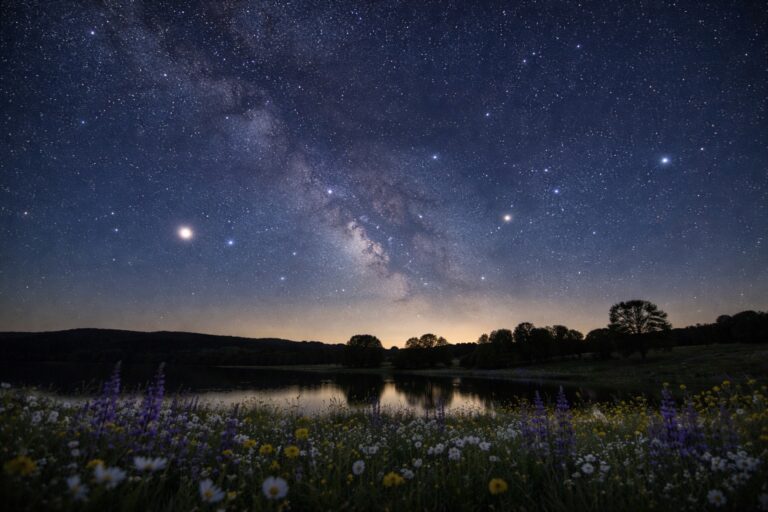
Welcoming Spring Under a Dark, Moonless Sky
March always feels like a turning point. Winter begins to loosen its grip, daylight stretches a little longer each day, and the night sky quietly shifts into a new season. In 2026, two meaningful celestial events arrive almost back to back. The New Moon occurs during the evening of March 18 in North America, leading into March 19, and the Spring Equinox follows on March 20. Together they create a rare moment of balance, renewal, and beautiful observing conditions for anyone who enjoys looking upward.
This period is especially exciting for skywatchers. The sky is dark and free from moonlight, which allows stars and planets to shine more clearly. Jupiter is bright and easy to spot, Uranus can be seen with binoculars or a small telescope, and the spring constellations begin to rise into prominence. It is a moment that feels both peaceful and full of promise. In astronomical terms, the equinox is the first day of spring, and spring is in the air! While the days are getting longer, the nights are getting shorter. That makes this window a perfect time to step outside and enjoy the wonders of the universe.
Let’s explore what makes this week in March 2026 so special, both astronomically and culturally, and how you can enjoy it for yourself.
The New Moon on March 19, 2026
The New Moon marks the beginning of a lunar cycle. Astronomically, it occurs when the Moon sits between Earth and the Sun. Because the sunlit side of the Moon faces away from us, the Moon becomes nearly invisible in the sky. On the evening of March 18 into March 19, 2026, this alignment creates one of the darkest skies of the month.
For observers, this darkness is a gift. Without moonlight washing out the sky, fainter stars become easier to see. Subtle details in the constellations appear sharper. Even the Milky Way, depending on your location and light pollution, may look more defined.
A New Moon often feels quiet and reflective. The night seems deeper and calmer. Many people find this phase inspiring because it symbolizes beginnings. Each new lunar cycle offers a natural chance to pause, set intentions, and look ahead.
From an observing standpoint, this is also the best time to search the sky for planets and deep sky objects. On March 19, 2026, the Moon will not interfere with your view, making it ideal for beginners and experienced observers alike.
Why Dark Skies Matter for Stargazing
When the Moon is bright, it acts like a giant sky lamp. That light scatters in the atmosphere and reduces contrast. Faint stars disappear. Subtle colors fade. Even bright constellations lose some of their definition.
During a New Moon, the opposite happens. The sky regains depth. More stars become visible. Your eyes adapt more fully to darkness, allowing you to see details that are normally hidden.
This matters especially in early spring because the sky is transitioning. Winter constellations are setting in the west, while new seasonal patterns rise in the east and south. With a dark sky, you can clearly see this shift happening.
If possible, choose a location away from city lights. Even a short drive to a rural area can dramatically improve your view. Give your eyes at least twenty minutes to adjust to darkness, and avoid looking at bright phone screens.
The Spring Equinox on March 20, 2026
Only a day after the New Moon comes one of the most important astronomical moments of the year. The Spring Equinox occurs on March 20, 2026. On this day, Earth reaches a point in its orbit where neither hemisphere is tilted toward or away from the Sun. Sunlight falls almost equally on both hemispheres.
The word equinox comes from Latin, meaning “equal night.” Day and night are nearly equal in length across the globe. After this moment, the Northern Hemisphere begins receiving more sunlight than darkness, and spring officially begins in astronomical terms.
The equinox is not just a date on the calendar. It represents a real geometric alignment in space. Earth continues its steady journey around the Sun, and this balance point marks the seasonal transition from winter to spring.
For observers, the equinox has another interesting effect. The path of the Sun changes direction in the sky, rising more directly east and setting more directly west. The arc of daylight grows longer each day, which means evenings warm up and become more inviting for outdoor activities.
A Time of Balance and Renewal
There is something symbolic about the timing of the New Moon and the equinox occurring so close together. The New Moon represents a fresh cycle, and the equinox represents balance and the start of a new season. Together they create an atmosphere of renewal that many cultures have recognized for thousands of years.
Astronomically, this pairing reminds us that celestial cycles overlap. The Moon follows its monthly rhythm while Earth continues its yearly path around the Sun. When these rhythms align near the beginning of spring, it naturally feels significant.
It is easy to understand why people throughout history connected this time with growth and new beginnings. The Earth awakens. Plants begin to sprout. Animals become more active. Human energy shifts too, moving from the quiet of winter into the activity of spring.
Cultural Significance of the Spring Equinox
The spring equinox has been celebrated across many civilizations. Ancient cultures observed the returning light and built monuments aligned to the rising or setting Sun during this time of year.
In parts of Europe, spring festivals marked the end of winter hardships and the return of fertile ground. In Persian culture, Nowruz celebrates the new year at the equinox and emphasizes renewal, family, and hope. In East Asia, seasonal festivals have long honored the balance between light and darkness.
Even in modern times, echoes of these traditions remain. Spring holidays, seasonal foods, and outdoor celebrations often trace their roots back to equinox observations. The underlying theme is consistent. The world is beginning again.
When you step outside during the equinox week, you are participating in a tradition that stretches back thousands of years. People have always looked to the sky during this moment, noticing the same stars and the same seasonal shift.
Spring Constellations Begin to Shine
As winter fades, new constellations take center stage. During the dark skies around March 19, these patterns become easier to spot.
One of the most recognizable signs of spring is the rise of Leo the Lion. Look toward the eastern sky during the evening. Leo appears as a backward question mark shape known as the Sickle. Its bright star Regulus marks the lion’s heart.
Another constellation climbing higher is Virgo. Although it becomes more prominent later in spring, its bright star Spica begins to rise in the late evening. The area around Virgo is rich with galaxies, making it a favorite target for telescope users.
High overhead, you may still catch the last of the winter constellations drifting westward. Orion, Taurus, and Gemini remind us that seasonal transitions are gradual. The sky is always changing, but never suddenly.
Spotting Jupiter in the March 2026 Sky
Jupiter will be the easiest planet to observe during this period. It shines brightly and stands out even to casual observers. On the nights around March 19, look toward the western sky after sunset. Jupiter appears as a steady, bright light that does not twinkle like stars.
The best viewing time is during the early evening hours. Start watching about one hour after sunset. Jupiter will be comfortably above the horizon, giving you plenty of time to admire it before it gradually sinks lower.
Even a simple pair of binoculars can reveal Jupiter’s largest moons lined up beside the planet. Through a small telescope, you may notice cloud bands across its surface. This turns the viewing experience into something deeply personal. You are seeing a world millions of miles away with your own eyes.
Finding Uranus During the Dark Moon
Uranus is much fainter than Jupiter, but the moonless sky gives you a better chance to find it. It requires binoculars or a small telescope and a bit of patience.
Look generally in the western sky during the evening, not far from where Jupiter can be seen. Uranus appears as a tiny pale dot rather than a sparkling star. Because it does not shine brightly, dark skies are essential.
While spotting Uranus can feel challenging, that challenge is part of the reward. You are locating a distant ice giant that orbits far beyond Saturn. Seeing it reminds us how vast the solar system truly is.
Direction and Time to Look
Timing matters when observing spring skies. Around March 19, 2026, a good plan is to head outside about an hour after sunset.
Face west to find Jupiter first. It will be the brightest object in that part of the sky. Nearby, Uranus waits for observers using binoculars or a small telescope. As the evening progresses, turn your attention toward the east and southeast, where spring constellations rise higher.
If you stay out longer, you will notice how quickly the sky changes. Stars climb higher while others set. The movement is subtle but continuous, reminding us that Earth itself is rotating beneath us.
Shorter Nights, Longer Days
One of the quiet themes of the equinox season is a change in daylight hours. Each day after the equinox, days grows slightly longer, sunsets happen later, and evenings feel warmer and more inviting.
For skywatchers, this means nights are becoming shorter. The window for observing the night sky slowly decreases as spring advances. That is why late March is such a sweet spot. The weather is improving, but the nights are still long enough for meaningful stargazing.
This balance creates a gentle urgency. It encourages us to make time for the sky while we can.
A Perfect Moment for Reflection
Both the New Moon and the Spring Equinox carry symbolic meaning related to growth and new beginnings. The Moon resets its cycle and the Earth resets its seasonal balance. Together they suggest a natural time to reflect on personal goals, hopes, and change.
Many people find comfort in stepping outside during these nights. Looking at the stars can bring a sense of peace and perspective. When daily worries feel smaller, the universe may feel both vast and intimately welcoming.
Spring invites movement. The sky reminds us that cycles continue. Even after long winters, the light and warmth always returns.
Enjoying the Experience
You do not need expensive equipment to enjoy this celestial pairing. A comfortable chair, warm clothing, and patience are enough.
Try turning off nearby lights if possible. Bring a blanket. Allow yourself time to adjust to the darkness, simply look and notice the sky. Watch Jupiter glow steadily. You can trace the shapes of spring constellations, and even feel the quiet energy of a moonless night.
If you have children or friends nearby, share the experience. Pointing out planets and stars can spark curiosity and connection. These moments often become lasting memories.
The Beauty of Cosmic Timing
What makes March 2026 special is not just that a New Moon and equinox occur close together. It is the feeling of renewal created by their timing. Seasonal darkness gives way to light as winter gives way to spring. The sky changes and so do we.
Astronomy helps us see that these shifts are predictable and reliable. Year after year, Earth moves through the same rhythms. Yet each season still feels new.
When you stand under a dark sky during this week, you can become a part of that rhythm. Consider that you are witnessing a moment that has inspired humanity for countless generations.
Looking Ahead Into Spring
As spring continues, more planets and constellations will become visible. The sky will transform again. But this early spring window remains special because it combines deep darkness with the emotional lift of a new season.
Take advantage of it this week. Step outside, breathe cool night air, and look upward. Let Jupiter be a point of light to guide your eyes. Grab a telescope and search for Uranus if you feel adventurous. Watch the spring constellations rise and consider your place in the universe today now that a new chapter in the sky has begun.
Spring is in the air. The days are growing longer. The nights are slowly shrinking. That makes right now the perfect time to pause, look up, and enjoy the wonders of the universe as we welcome the season of growth and new beginnings.
Please be advised that, despite our best efforts, International Star Registry – Name a star provides astronomical content for entertainment purposes. We cannot guarantee the accuracy of all information given.