
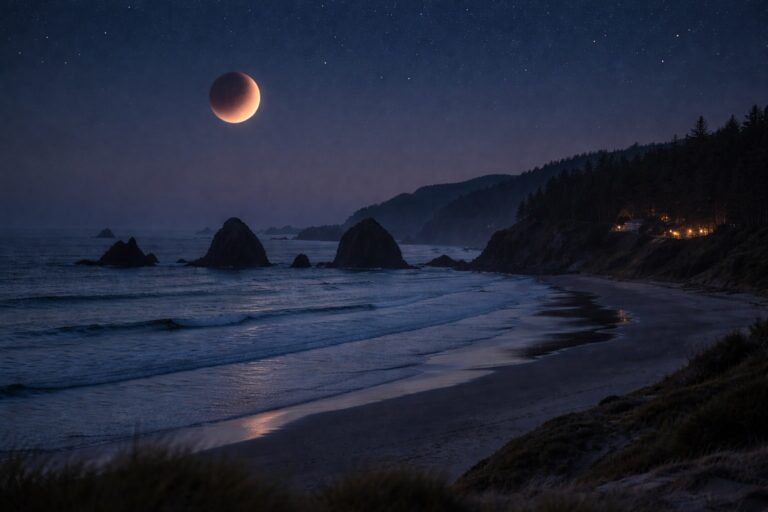
The Worm Moon and a Total Lunar Eclipse Viewing Guide for North America
On March 3, 2026, the Moon reaches full phase at 11:37 UTC, shining as the traditional March “Worm Moon.” This year, March’s full moon is more than a bright lunar landmark on the calendar. It coincides with a total lunar eclipse visible from much of North America, an event that can turn the Moon a deep coppery red, commonly called a Blood Moon.
For skywatchers across the western United States, the Midwest, and the East Coast, this is one of the most anticipated lunar spectacles of 2026. A lunar eclipse full moon unfolds against the shifting seasonal sky of late winter moving toward early spring. Below is a complete, region by region guide to what to expect, when to look, and what else you can see in the March night sky.
Understanding the March 2026 Full Moon
The Moon becomes full at the exact instant it reaches opposition, when it lies on the opposite side of Earth from the Sun and its near side is fully illuminated. For the March full moon in 2026, that moment occurs at 11:37 UTC on March 3.
To observers, the Moon appears full for a couple of nights around that instant. In March 2026, however, the alignment is perfect. The Earth’s shadow will sweep across the Moon during the same morning, producing a total lunar eclipse with a peak around 11:33 UTC, just minutes before the official full moon moment. That close timing is why the eclipse is so visually satisfying. The Moon is fully illuminated and passes deeply through Earth’s shadow at nearly the same time.
Traditional Names for the March Full Moon
The Worm Moon
The most widely used traditional name for March’s full moon is the Worm Moon. This name is linked to seasonal thawing, when frozen ground begins to soften and earthworms and other small signs of life reappear. It also corresponds with the increasing return of migrating birds in many parts of North America.
Other Traditional March Full Moon Names
Full moon naming traditions vary by region and culture. March’s full moon has accumulated several well known alternatives. These include the Crow Moon, associated with the cawing of returning crows, and the Sap Moon, which connects to maple sap runs in parts of the northeastern United States and Canada. In European traditions, the full moon nearest the beginning of Lent was sometimes called the Lenten Moon.
Across traditions, the message is consistent. March marks a turning point. Winter still has influence, but the sky and landscape begin to signal change.
The Total Lunar Eclipse of March 2 to March 3, 2026
A lunar eclipse occurs when the full Moon passes through Earth’s shadow. In March 2026, the eclipse is total, meaning the Moon enters Earth’s central shadow, called the umbra, completely. During totality, the Moon can appear red because sunlight is filtered through Earth’s atmosphere and bent into the shadow.
Will This Be a Blood Moon
Yes. Because this event is a total lunar eclipse, it can produce what is popularly known as a Blood Moon. The red coloration depends on atmospheric conditions on Earth, including dust and cloud cover. Some eclipses produce a bright copper color, while others appear darker and more subdued.
Key Eclipse Phases in UTC
The major eclipse phases occur at the following times in Coordinated Universal Time.
Penumbral eclipse begins at 08:44 UTC
Partial eclipse begins at 09:50 UTC
Totality begins at 11:04 UTC
Greatest eclipse occurs at 11:33 UTC
Totality ends at 12:02 UTC
Partial eclipse ends at 13:17 UTC
Penumbral eclipse ends at 14:23 UTC
These times form the backbone of viewing plans across North America.
Western United States Viewing Guide
Observers in the western United States are especially well positioned for this eclipse. The Moon will be high enough in the sky during the key phases, and most of totality occurs in full darkness before dawn.
Pacific Standard Time Conversion
Penumbral phase begins at 12:44 a.m. PST
Partial phase begins at 1:50 a.m. PST
Totality begins at 3:04 a.m. PST
Greatest eclipse occurs at 3:33 a.m. PST
Totality ends at 4:02 a.m. PST
Partial phase ends at 5:17 a.m. PST
Penumbral phase ends at 6:23 a.m. PST
In the West, the eclipse unfolds in the deep quiet following midnight and into early morning. As totality approaches, the Moon dims dramatically before turning red. Around greatest eclipse, the sky is dark enough that additional stars may become visible near the eclipsed Moon.
Mountain Standard Time locations follow one hour later by the clock. The sequence is the same, but totality centers around 4:33 a.m. MST.
Choose a viewing location with a clear southern and western sky. As morning approaches, the Moon will gradually lower toward the western horizon.
The Midwest Viewing Guide
For the Midwest, the eclipse occurs in the early morning hours moments before sunrise. Observers will see the partial phase clearly but may not experience totality fully as the dawn light begins to brighten the horizon.
Central Standard Time Conversion
Penumbral phase begins at 2:44 a.m. CST
Partial phase begins at 3:50 a.m. CST
Totality begins at 5:04 a.m. CST
Greatest eclipse occurs at 5:33 a.m. CST
Totality ends at 6:02 a.m. CST (sunrise 6:22 a.m. CST)
Partial phase ends at 7:17 a.m. CST
Penumbral phase ends at 8:23 a.m. CST
The most dramatic moment in the Midwest will be between approximately 5:04 a.m. and 6:02 a.m. CST, when totality is underway. Even as dawn approaches, the red Moon can remain striking.
If planning to wake for only one portion of the eclipse, the window around greatest eclipse at 5:33 a.m. CST is ideal.
East Coast Viewing Guide
On the East Coast, the full eclipse occurs around sunrise. This creates both challenge and beauty. Dawn begins during totality, but the sight of a red Moon hanging in a brightening sky can be memorable.
Eastern Standard Time Conversion
Penumbral phase begins at 3:44 a.m. EST
Partial phase begins at 4:50 a.m. EST
Totality begins at 6:04 a.m. EST (sunrise 6:27 a.m. EST)
Greatest eclipse occurs at 6:33 a.m. EST
Totality ends at 7:02 a.m. EST
Partial phase ends at 8:17 a.m. EST
Penumbral phase ends at 9:23 a.m. EST
Depending on local sunrise time, the sky may already be brightening during totality. Observers should choose a viewing location with an open western horizon if the Moon is descending toward the skyline.
If catching only a brief portion, focus on the start of totality around 6:04 a.m. EST and the peak at 6:33 a.m. EST.
March Constellations During the Full Moon
Even with full moonlight, several constellations remain visible in early March.
Orion continues to occupy the western evening sky. Taurus and Gemini follow nearby, while Canis Major with bright Sirius remains easy to locate.
Spring constellations begin rising higher. Leo becomes increasingly prominent and Virgo starts to dominate later night hours. The Big Dipper stands high and can guide observers toward Arcturus in Boötes and then onward to Spica in Virgo.
During totality, when the Moon darkens significantly, additional stars become visible. This temporary dimming of lunar glare offers a rare chance to see the surrounding sky in greater detail.
What Each Eclipse Stage Looks Like
During the penumbral phase, the Moon appears slightly dimmer on one side. The change can be subtle.
As the partial phase begins, Earth’s curved shadow takes a visible bite from the Moon’s edge. The shadow gradually advances across the lunar disk.
Once totality begins, the Moon often turns shades of red, orange, or copper. The color results from sunlight passing through Earth’s atmosphere and scattering shorter wavelengths while allowing red light to bend into the shadow.
Full Moon Timing and Eclipse Alignment
The full moon occurs at 11:37 UTC, while greatest eclipse occurs at approximately 11:33 UTC. The near alignment of these two moments produces a centrally placed total lunar eclipse. Lunar eclipses can only occur at full moon, but not every full moon produces an eclipse because the Moon’s orbit is slightly tilted relative to Earth’s orbit.
Observing Comfort and Preparation
March nights can still be very cold across North America. Dress in layers and prepare for standing outdoors for extended periods.
Binoculars are especially useful during a lunar eclipse. They enhance the visibility of subtle shadow boundaries and reveal surface features as lighting changes.
If photographing the event, use a tripod and adjust exposure during totality, since the Moon becomes significantly dimmer than during its normal full phase.
Conclusion
The March 2026 full moon, traditionally called the Worm Moon, marks the seasonal shift toward spring. In 2026 it also delivers a total lunar eclipse visible across much of North America. For many observers, it will indeed be a Blood Moon.
Those in the western United States will experience the most complete dark sky viewing of totality. The Midwest offers a prime early morning eclipse window. The East Coast may contend with dawn light but can still witness a dramatic red Moon low in the brightening sky.
It is a reminder that full moons are more than calendar events. Occasionally, as in March 2026, they become rare and unforgettable celestial performances.
Please be advised that, despite our best efforts, International Star Registry – Name a star provides astronomical content for entertainment purposes. We cannot guarantee the accuracy of all information given.