
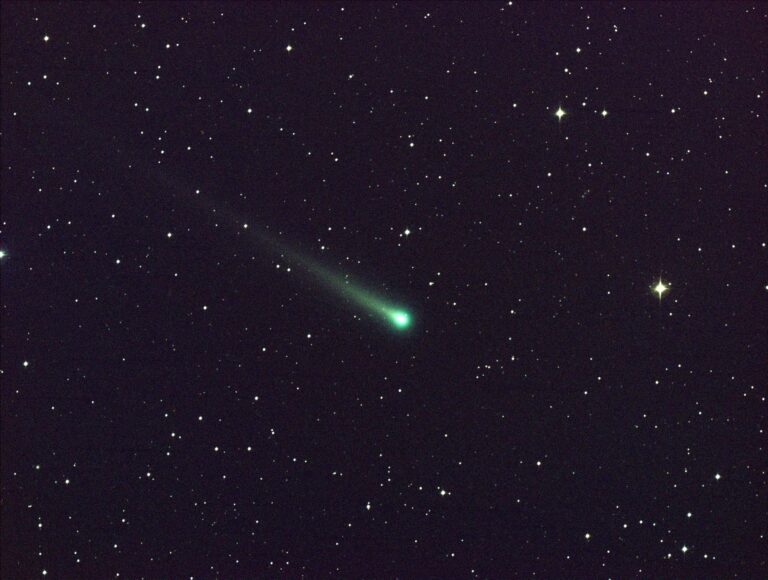
A Midwinter Visitor for Both Hemispheres Appearing Overhead Now
On November 8, 2013, NASA shared this image of Comet ISON Passing Through Virgo. Now we have another lovely comet similarly located. January 2026 offers comet watchers a rewarding and unusually well-timed opportunity with Comet 24P/Schaumasse. While not a naked-eye object, this periodic comet becomes a standout telescopic target in the weeks surrounding January 8, 2026, when it reaches perihelion and peaks near 8th magnitude, briefly dipping to about magnitude 7.94. That makes it the brightest comet available to Northern Hemisphere observers at the time, and a viable target from the Southern Hemisphere as well.
What makes 24P/Schaumasse especially compelling isn’t extreme brightness or dramatic tails? Geometry. At perihelion the comet remains far from the Sun’s position in the sky, lingering in Virgo and staying well placed near the middle of the night. This unusual configuration gives observers extended dark-sky windows, relaxed pacing, and excellent conditions for careful visual study and astrophotography.
This guide explores the comet’s background, explains why its January 2026 apparition is special, and provides detailed observing and photography tips for the nights around perihelion and the weeks that follow.
1. A Brief Introduction to Comet 24P/Schaumasse
Comet 24P/Schaumasse is a short-period comet with an orbital period of roughly 8.25 years. It was discovered in 1911 by French astronomer Alexandre Schaumasse, and has been observed through many returns since.
Unlike long-period or dynamically new comets, 24P is a seasoned traveler of the inner solar system. Over time, repeated passages near the Sun have reduced its volatile content, making it more subtle and predictable—but also stable. These are the kinds of comets amateur astronomers often appreciate most: they don’t flare unexpectedly, but they reward patience, careful technique, and dark skies.
In January 2026, 24P once again makes a favorable pass, not because it becomes intrinsically spectacular, but because Earth’s viewing angle is unusually advantageous.
2. January 8, 2026: Perihelion and Peak Brightness
The comet reaches perihelion now, on or around January 8, 2026, at a distance of 1.184 astronomical units (AU) from the Sun. That’s actually farther than Earth’s average distance, which may sound counterintuitive for a brightness peak.
Yet comets don’t brighten based on solar distance alone. Apparent brightness depends on a combination of:
Distance from the Sun
Distance from Earth
Phase angle (how sunlight reflects toward us)
Geometry relative to Earth’s night sky
In this case, while 24P is not especially close to the Sun, it is well positioned relative to Earth, spending the night far from solar glare and remaining observable for many hours.
Around January 8, predictions place its brightness at approximately magnitude 7.94, making it accessible to:
7×50 or 10×50 binoculars under dark skies
Small telescopes (80–100 mm) from suburban sites
Larger instruments for coma detail and subtle tail structure
For Northern Hemisphere observers, it is expected to be the brightest comet in the sky at that time, even though it will not be visible without optical aid.
3. Why This Apparition Is Unusual
Far from the Sun, Yet at Its Best
Most comets peak near perihelion when they are also visually close to the Sun, often limiting observing opportunities to dawn or dusk. Comet 24P/Schaumasse breaks this pattern.
In early January 2026, the comet remains deep in the night sky, still located in or near Virgo, far removed from the Sun’s position. This geometry provides:
Dark observing windows around local midnight
Minimal twilight interference
Reduced atmospheric extinction
More stable seeing conditions
In practical terms, this means observers can take their time to find this comet. There will be no racing sunset or sunrise, no low-altitude haze, and no awkward telescope angles.
4. Where to Look: Virgo and the Winter–Spring Transition
Virgo is a sprawling constellation straddling the boundary between winter and spring skies. In January:
It rises in the late evening
Reaches a favorable altitude around midnight to early morning
Continues climbing higher as weeks pass
The comet’s slow motion through Virgo also helps observers return night after night, tracking its gradual shift against familiar background stars.
Star-Hopping Basics
To locate the comet visually:
Identify Spica, Virgo’s brightest star.
Use a detailed star chart or astronomy app with comet elements loaded.
Star-hop using medium-power eyepieces or binoculars.
At magnitude ~8, the comet will appear as a small, diffuse glow, slightly brighter toward the center, without sharp stellar edges.
5. Visibility from Both Hemispheres
One of the most appealing aspects of this apparition is global accessibility.
Northern Hemisphere
Best visibility from mid-northern latitudes
High enough altitude for clean telescopic views
Long observing sessions around midnight
Southern Hemisphere
Still visible, especially from mid-southern latitudes
Slightly lower altitude but well clear of horizon haze
Excellent opportunity for astrophotographers with dark skies
Because the comet avoids solar proximity, observers worldwide share a similar viewing window, which is a rarity for comet apparitions.
6. What to Expect at the Eyepiece
Comet 24P/Schaumasse is not a showy tail-streamer, but it offers subtle beauty.
Visual Appearance
Diffuse coma, several arcminutes across
Gradual central brightening
Possible faint tail extension with larger apertures
Soft, ghostly glow rather than sharp structure
Observers using 150–250 mm telescopes under dark skies may detect:
Asymmetry in the coma
Slight elongation pointing away from the Sun
Changes in brightness from night to night
This makes 24P an excellent target for sketching, a practice that reveals details often missed in casual viewing.
7. How the Comet Evolves After January 8
Although January 8 marks perihelion and peak predicted brightness, the comet remains rewarding for several weeks afterward.
Mid-January
Brightness declines slowly
Still near magnitude 8–8.3
Geometry remains favorable
Late January into February
Gradual fading
Increasing distance from Earth
Still trackable in moderate telescopes
Because the fade is gentle, observers can follow the comet over time, watching subtle structural changes and refining observing techniques.
8. Binocular Observing Tips
Binoculars are often overlooked for comets of this brightness, but under the right conditions they excel.
Recommended Binoculars
7×50 for maximum surface brightness
10×50 for better contrast and framing
15×70 for darker skies and structural hints
Technique
Observe from the darkest site available
Use a reclining chair or tripod mount
Sweep slowly; let the coma “pop” into view
Under pristine skies, the comet may appear as a soft, oval smudge, distinct from stars by its lack of sharp edges.
9. Telescope Observing Strategies
Aperture Considerations
80–100 mm: clear detection, diffuse coma
150–200 mm: coma structure, possible tail hint
250 mm+: detailed inner coma, brightness gradient
Magnification
Start low (30–50×) to locate
Increase to 80–120× for detail
Avoid excessive magnification that dims surface brightness
Filters generally do not help significantly for comets of this type, though some observers experiment with broadband light-pollution filters in suburban skies.
10. Astrophotography Opportunities
Comet 24P/Schaumasse is well suited to astrophotography, particularly for intermediate imagers looking to refine comet-specific techniques.
Camera and Optics
DSLR or mirrorless camera with good high-ISO performance
Short telephoto (85–135 mm) for wide-field context
Small refractor (60–80 mm) for coma detail
Mount and Tracking
Equatorial mount strongly recommended
Track at sidereal rate, then process for comet motion
Alternatively, track the comet and accept star trails
Exposure Guidelines
Individual frames: 30–120 seconds
ISO 800–3200 depending on sky brightness
Total integration: 30–90 minutes
Stacking software that supports comet alignment can separate star and comet detail, producing professional-looking results.
11. Processing Tips for Comet Images
Create two stacks: one aligned on stars, one on comet
Blend carefully to avoid artificial edges
Preserve the soft nature of the coma
Avoid over-sharpening or aggressive contrast
Comet images shine when they retain their ethereal quality—subtle gradients often tell a more compelling story than dramatic processing.
12. Planning Your Observing Sessions
Best Nights
January 6–10: peak brightness window
Clear, moonless nights are ideal
Observe when Virgo is highest
Moon Considerations
Darker skies significantly improve contrast
Even modest moonlight can wash out faint coma detail
Weather and Transparency
Transparency matters more than seeing
Cold, dry winter air often helps
Keeping an observing log enhances the experience, allowing you to note changes in brightness, shape, and position.
13. Why Comet 24P/Schaumasse Matters
Not every memorable comet blazes across headlines. Many of the most satisfying comet experiences come from quiet, well-placed apparitions like this one.
Comet 24P/Schaumasse in January 2026 offers:
Predictable brightness
Excellent night-time placement
Accessibility from both hemispheres
Opportunities for visual observing and imaging
It reminds us that astronomy isn’t only about spectacle—it’s about connection, patience, and watching celestial visitors move against the stars.
14. A Moment Worth Marking
For many observers, January nights are long, cold, and still. Under those conditions, following a faint comet through Virgo feels deeply personal. You’re not just seeing an object—you’re tracing a traveler that has returned again and again, long before modern astronomy and long after our own moment passes.
Whether you observe with binoculars from a dark field, sketch at the eyepiece, or capture photons with a camera, Comet 24P/Schaumasse offers a rewarding winter project.
Mark January 8, 2026 on your calendar, prepare your charts and equipment, and take advantage of this quietly elegant visitor while it lingers in the heart of the night sky.
Clear skies, steady hands, and patient eyes! This is a comet worth your time.
Please be advised that, despite our best efforts, International Star Registry – Name a star provides astronomical content for entertainment purposes. We cannot guarantee the accuracy of all information given.