
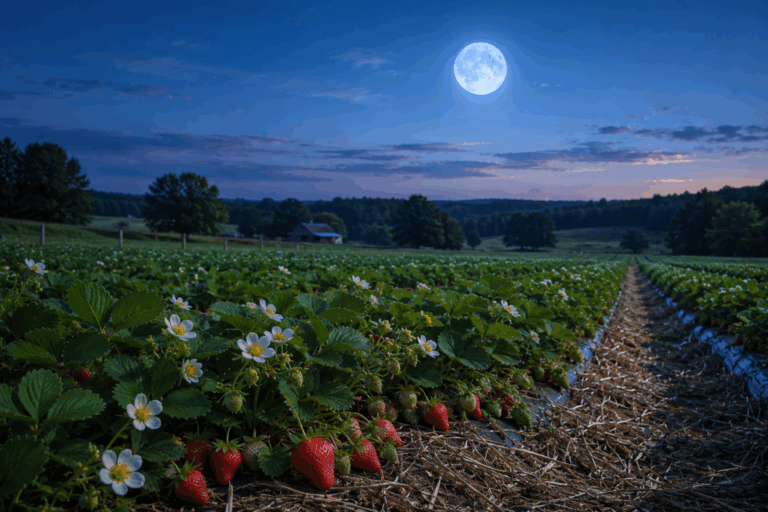
The Full Moon of June 29, 2026: The Strawberry Moon and the Beauty of Early Summer
On June 29, 2026, the Moon reaches its full phase at 23:58 UTC. At that precise moment, the Moon will be positioned on the opposite side of Earth from the Sun, allowing its entire near side to be fully illuminated by sunlight. This alignment creates the familiar bright, round disk that has fascinated skywatchers for thousands of years. Although the exact full phase occurs at a specific instant, the Moon will appear full to most observers throughout the night before and after this time.
June’s full Moon is traditionally known as the Strawberry Moon, a name that has nothing to do with the Moon’s color. Instead, it marks the short but important strawberry harvesting season in North America. For many early Native American tribes, the ripening of wild strawberries signaled that summer had truly arrived. The June full Moon became a reliable seasonal marker that helped communities recognize the beginning of one of the year’s sweetest harvests.
The June full Moon has also been known by several other names throughout history. In Europe, it was often called the Rose Moon because roses reach their peak bloom during June. It has also been known as the Honey Moon, reflecting the time when honey was traditionally harvested and when many weddings were held. These names reveal how closely people once observed nature and used the Moon to measure the changing seasons.
Whether you are interested in astronomy, history, or simply enjoy spending time beneath a bright summer sky, the June 29, 2026 Strawberry Moon offers an excellent opportunity to appreciate one of nature’s most beautiful monthly events.
The Astronomy Behind the June 2026 Full Moon
A full Moon occurs when the Sun, Earth, and Moon reach nearly perfect alignment. Earth sits between the Sun and the Moon, allowing sunlight to fully illuminate the side of the Moon facing our planet. Astronomers refer to this position as opposition.
For the June 29, 2026 full Moon, this alignment occurs at 23:58 UTC. Depending on where you live, the exact moment may occur during the afternoon or evening. Fortunately, the Moon appears essentially full for many hours before and after the precise phase, making it easy to enjoy regardless of your location.
Like every full Moon, the June Moon rises around sunset and sets near sunrise. It reaches its highest point in the sky around local midnight. Because it is fully illuminated, it becomes the brightest object in the night sky after the Sun.
The June full Moon also has another interesting characteristic. It follows closely after the June solstice, when the Sun reaches its highest point in the Northern Hemisphere sky. Since the full Moon always appears opposite the Sun, the June full Moon follows one of the lowest paths across the sky for observers in North America. As a result, it often appears larger and more colorful while rising and setting because it spends more time near the horizon.
Why It Is Called the Strawberry Moon
The name Strawberry Moon originated with several Native American tribes living in the northeastern United States and parts of Canada. Unlike many fruits that ripen over long periods, wild strawberries were available for only a short time each year. Their appearance marked an important seasonal event.
The Moon became associated with this harvest because it occurred during the brief window when strawberries were ready to gather. Families recognized this full Moon as a reminder that the harvest season had begun. The name has survived for centuries and remains the most widely recognized traditional name for June’s full Moon.
Despite popular belief, the Strawberry Moon is not usually pink or red. Its color is no different from other full Moons. However, because it follows a low path across the horizon, it may appear golden, orange, or reddish when rising or setting. These colors result from Earth’s atmosphere scattering shorter wavelengths of light while allowing more red and orange light to reach our eyes.
Other Traditional Names for June’s Full Moon
Many cultures developed their own names for the June full Moon based on seasonal events occurring in their regions.
One of the best known is the Rose Moon. Roses reach peak bloom during June throughout much of Europe and North America. Gardens become filled with colorful blossoms, making the name a fitting description of the season rather than the Moon itself.
Another well known name is the Honey Moon. June has traditionally been one of the most popular months for weddings. In many parts of Europe, freshly harvested honey was used to produce mead, a fermented honey drink often served during wedding celebrations. Some historians believe this custom contributed to the modern word “honeymoon,” referring to the first month of marriage.
Other traditional names include the Mead Moon and the Green Corn Moon. Agricultural communities often named the Moon according to planting or growing seasons, while others focused on flowering plants or wildlife activity.
Although the names differ, they all celebrate abundance, warmth, and the arrival of summer.
A Moon That Welcomes Summer
The June full Moon arrives just days after the summer solstice in the Northern Hemisphere. Daylight hours are at or near their annual maximum. Even though nights are shorter than at any other time of year, they remain excellent for moon watching.
Warm evening temperatures encourage people to spend more time outdoors. Parks, beaches, and backyards become ideal places to observe the Moon rising into the eastern sky.
Because the June full Moon stays relatively low above the horizon, it often creates dramatic photographic opportunities. Trees, buildings, mountains, and lakes can all provide beautiful foreground scenery.
Viewing the Strawberry Moon Across North America
The June 29 full Moon will be visible throughout North America, weather permitting.
Observers in the western United States can expect the Moon to rise shortly after sunset. Dry summer air in many western states often provides excellent viewing conditions. The Moon may appear especially colorful as it climbs above distant mountains or desert landscapes.
Across the Midwest, the Strawberry Moon will shine over green fields and forests that have fully awakened after spring. Summer humidity may soften the Moon’s appearance slightly, creating a gentle glow around its edges on some evenings.
Along the East Coast, the Moon will rise above the Atlantic horizon or city skylines shortly after sunset. Coastal observers may notice beautiful reflections across lakes, rivers, and the ocean. If thin clouds are present, they may produce delicate halos surrounding the Moon.
No matter where you observe, the best views usually occur during moonrise. At this time the Moon appears largest because of the well known Moon illusion. Although the Moon does not actually change size, our brains interpret it as larger when it is viewed near the horizon.
Constellations Visible During the June Full Moon
Even though the full Moon brightens the night sky, many of summer’s brightest stars remain easy to find.
The constellation Scorpius rises prominently in the southeastern sky. Its bright red star Antares is often called the heart of the Scorpion. Nearby, Sagittarius begins climbing higher each evening. This constellation points toward the center of our Milky Way Galaxy.
The familiar Summer Triangle also becomes increasingly visible. It is formed by the bright stars Vega, Deneb, and Altair. These stars dominate the summer sky and remain visible despite the Moon’s brightness.
To the west, spring constellations such as Leo and Virgo begin drifting toward the horizon. This gradual seasonal change reminds observers that summer has officially arrived.
The Moon’s Surface During Full Phase
The June Strawberry Moon offers excellent opportunities to observe the Moon without a telescope. Large dark regions called maria are clearly visible with the naked eye. These ancient lava plains formed billions of years ago after massive volcanic eruptions filled enormous impact basins.
Binoculars reveal even more detail. Bright ray systems extend outward from young craters such as Tycho and Copernicus. These rays consist of material blasted across the lunar surface during powerful impacts millions of years ago.
Unlike crescent or quarter phases, the full Moon produces very few shadows across the surface. As a result, mountains and craters appear flatter. Although this reduces surface contrast, it highlights differences in brightness between various regions of the Moon.
Photography Tips for the Strawberry Moon
The June full Moon is one of the year’s most popular subjects for photographers. Warm weather and comfortable evenings make outdoor photography enjoyable.
The best time to photograph the Moon is often within thirty minutes of moonrise. During this period the Moon appears large and colorful. Including trees, flowers, historic buildings, or lakes in the foreground creates a sense of scale and place.
A tripod helps produce sharper images. Because the Moon is much brighter than the surrounding landscape, photographers often expose separately for the Moon and the foreground when creating artistic compositions.
Even smartphone cameras can capture attractive images if they are kept steady and focused carefully.
Why June’s Full Moon Continues to Inspire
For thousands of years, people have looked toward the June full Moon as a sign that the growing season was flourishing. Wild berries ripened, flowers reached their peak, and fields promised future harvests. Communities celebrated weddings, festivals, and outdoor gatherings beneath its light.
Today, the Strawberry Moon continues to connect us with those traditions. Although modern calendars tell us the date, the Moon still reminds us that nature follows rhythms far older than clocks and calendars.
Watching the Moon rise on a warm June evening is a simple experience, yet it remains one of astronomy’s greatest pleasures. It requires no telescope and no special equipment. All that is needed is a clear sky and a few quiet moments to appreciate one of the oldest companions humanity has ever known.
The Sweetest Moon of the Year
The Full Moon of June 29, 2026 reaches its peak at 23:58 UTC, when the Moon stands opposite the Sun and its face is fully illuminated. Known primarily as the Strawberry Moon, it celebrates the brief strawberry harvest that once marked an important seasonal milestone for many Native American tribes. Other traditional names, including the Rose Moon and the Honey Moon, remind us that cultures around the world have long connected the Moon with flowers, harvests, weddings, and the abundance of early summer.
As the first full Moon after the summer solstice, it follows a low path across the sky and often produces spectacular moonrises filled with warm golden and orange colors. It rises above blooming landscapes, growing fields, quiet lakes, and bustling cities alike. Whether viewed with binoculars, photographed through a camera lens, or simply admired with the naked eye, the June Strawberry Moon offers an opportunity to pause, look upward, and enjoy one of the most beautiful sights of the summer season.
Please be advised that, despite our best efforts, International Star Registry – Name a star provides astronomical content for entertainment purposes. We cannot guarantee the accuracy of all information given.